
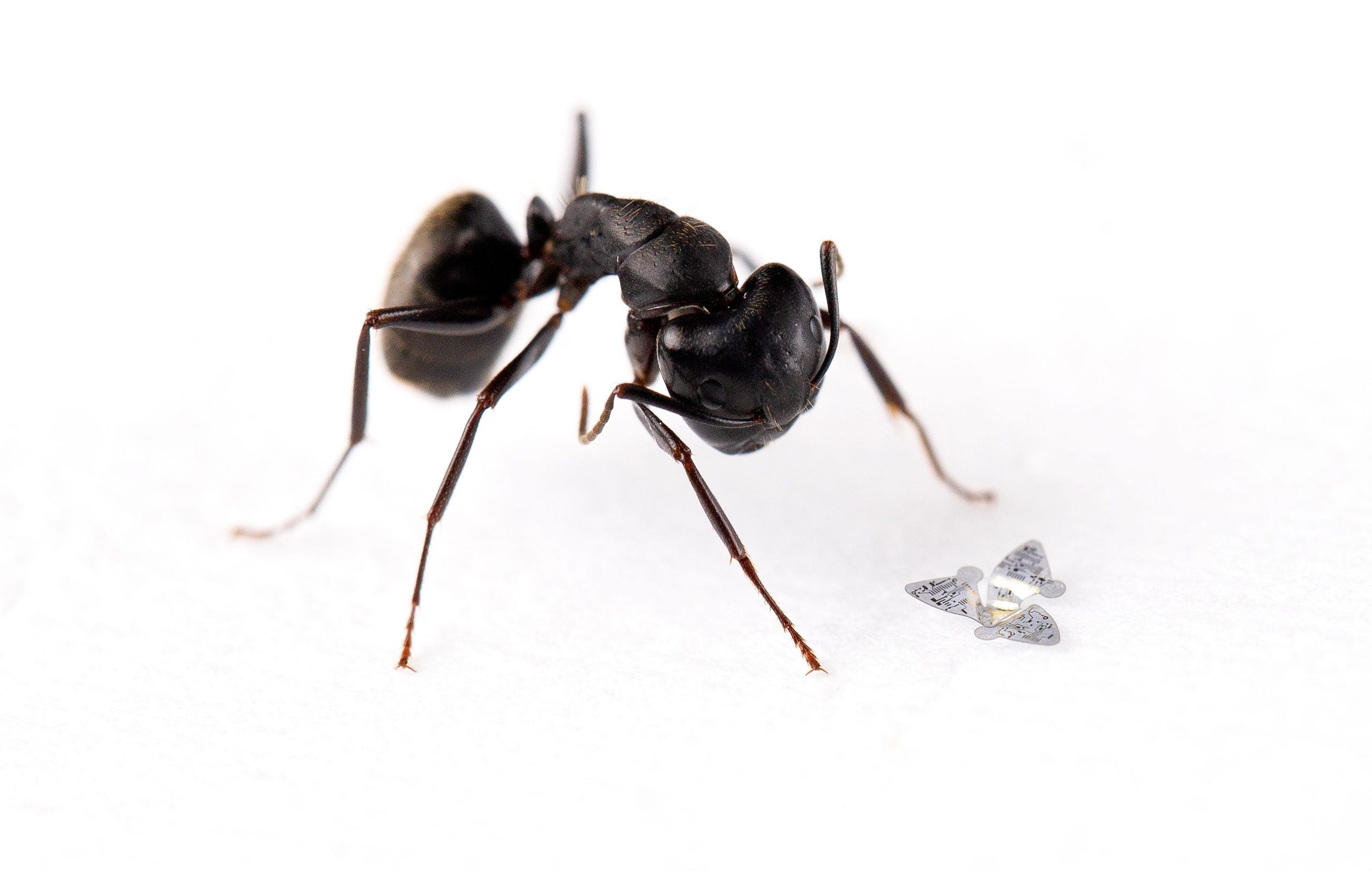
The size of a grain of sand, dispersed microfliers could monitor air pollution, airborne disease, and environmental contamination.
Northwestern University engineers have added a new capability to electronic microchips: flight.
About the size of a grain of sand, the new flying microchip (or “microflier”) does not have a motor or engine. Instead, it catches flight on the wind — much like a maple tree’s propeller seed — and spins like a helicopter through the air toward the ground.
By studying maple trees and other types of wind-dispersed seeds, the engineers optimized the microflier’s aerodynamics to ensure that it — when dropped at a high elevation — falls at a slow velocity in a controlled manner. This behavior stabilizes its flight, ensures dispersal over a broad area, and increases the amount of time it interacts with the air, making it ideal for monitoring air pollution and airborne disease.
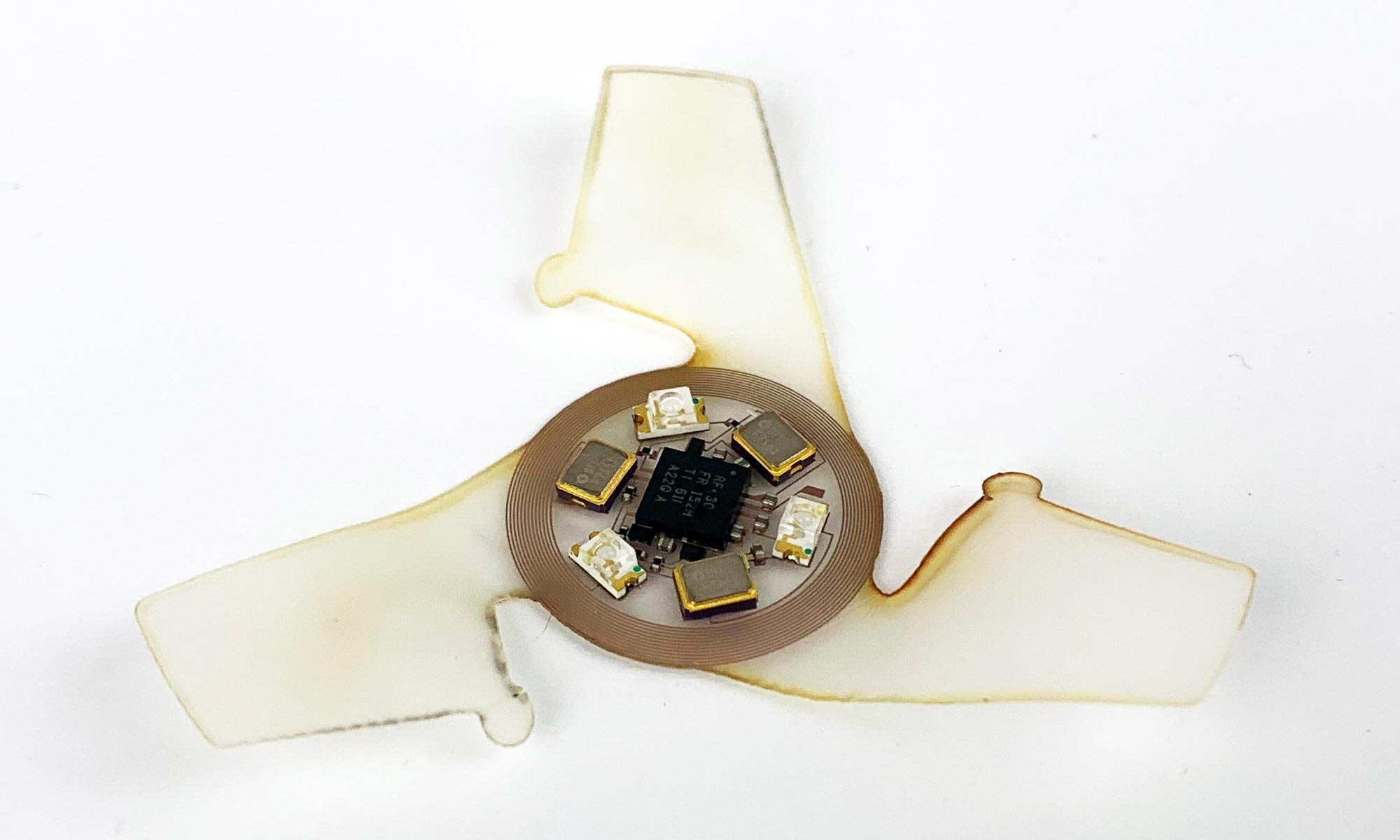
As the smallest-ever human-made flying structures, these microfliers also can be packed with ultra-miniaturized technology, including sensors, power sources, antennas for wireless communication, and embedded memory to store data.
The research is featured on the cover of the September 23, 2021, issue of Nature.
“Our goal was to add winged flight to small-scale electronic systems, with the idea that these capabilities would allow us to distribute highly functional, miniaturized electronic devices to sense the environment for contamination monitoring, population surveillance, or disease tracking,” said Northwestern’s John A. Rogers, who led the device’s development. “We were able to do that using ideas inspired by the biological world. Over the course of billions of years, nature has designed seeds with very sophisticated aerodynamics. We borrowed those design concepts, adapted them, and applied them to electronic circuit platforms.”
A pioneer in bioelectronics, Rogers is the Louis Simpson and Kimberly Querrey Professor of Materials Science and Engineering, Biomedical Engineering, and Neurological Surgery in the McCormick School of Engineering and Feinberg School of Medicine and director of the Querrey Simpson Institute for Bioelectronics. Yonggang Huang, the Jan and Marcia Achenbach Professor of Mechanical Engineering at McCormick, led the study’s theoretical work.
‘We Think We Beat Nature’
Most people have watched a maple leaf’s whirling propeller seed spin through the air and gently land on the sidewalk. This is just one example of how nature has evolved clever, sophisticated methods to increase the survival of various plants. By ensuring that seeds are widely dispersed, otherwise, sedentary plants and trees can propagate their species over vast distances to populate broad areas.
“Evolution was likely the driving force for the sophisticated aerodynamic properties exhibited by many classes of seeds,” Rogers said. “These biological structures are designed to fall slowly and in a controlled manner, so they can interact with wind patterns for the longest possible period of time. This feature maximizes lateral distribution via purely passive, airborne mechanisms.”
To design the microfliers, the Northwestern team studied the aerodynamics of a number of plants’ seeds, drawing its most direct inspiration from the tristellateia plant, a flowering vine with star-shaped seeds. Tristellateia seeds have bladed wings that catch the wind to fall with a slow, rotating spin.
Rogers and his team designed and built many different types of microfliers, including one with three wings, optimized to similar shapes and angles as the wings on a tristellateia seed. To pinpoint the most ideal structure, Huang led full-scale computational modeling of how the air flows around the device to mimic the tristellateia seed’s slow, controlled rotation.
Based on this modeling, Rogers’ group then built and tested structures in the lab, using advanced methods for imaging and quantifying patterns of flow in collaborations with Leonardo Chamorro, an associate professor of mechanical engineering at the University of Illinois at Urbana-Champaign.
The resulting structures can be formed across a wide variety of sizes and shapes, some with properties that can give nature a run for its money.
“We think that we beat nature,” Rogers said. “At least in the narrow sense that we have been able to build structures that fall with more stable trajectories and at slower terminal velocities than equivalent seeds that you would see from plants or trees. We also were able to build these helicopter flying structures at sizes much smaller than those found in nature. That’s important because device miniaturization represents the dominating development trajectory in the electronics industry, where sensors, radios, batteries and other components can be constructed in ever smaller dimensions.”
From Plants To Pop-Up Books
To manufacture the devices, Rogers’ team drew inspiration from another familiar novelty: a child’s pop-up book.
His team first fabricated precursors to flying structures in flat, planar geometries. Then, they bonded these precursors onto a slightly stretched rubber substrate. When the stretched substrate is relaxed, a controlled buckling process occurs that causes the wings to “pop up” into precisely defined three-dimensional forms.
“This strategy of building 3D structures from 2D precursors is powerful because all existing semiconductor devices are built in planar layouts,” Rogers said. “We can thus exploit the most advanced materials and manufacturing methods used by the consumer electronics industry to make completely standard, flat, chip-like designs. Then, we just transform them into 3D flying shapes by principles that are similar to those of a pop-up book.”
Packed With Promise
The microfliers comprise two parts: millimeter-sized electronic functional components and their wings. As the microflier falls through the air, its wings interact with the air to create a slow, stable rotational motion. The weight of the electronics is distributed low in the center of the microflier to prevent it from losing control and chaotically tumbling to the ground.
In demonstrated examples, Rogers’ team included sensors, a power source that can harvest ambient energy, memory storage, and an antenna that can wirelessly transfer data to a smart phone, tablet, or computer.
In the lab, Rogers’ group outfitted one device with all of these elements to detect particulates in the air. In another example, they incorporated pH sensors that could be used to monitor water quality and photodetectors to measure sun exposure at different wavelengths.
Rogers imagines that large numbers of devices could be dropped from a plane or building and broadly dispersed to monitor environmental remediation efforts after a chemical spill or to track levels of air pollution at various altitudes.
“Most monitoring technologies involve bulk instrumentation designed to collect data locally at a small number of locations across a spatial area of interest,” Rogers said. “We envision a large multiplicity of miniaturized sensors that can be distributed at a high spatial density over large areas, to form a wireless network.”
Disappearing Act
But what about all the electronic litter? Rogers has a plan for that. His lab already develops transient electronics that can harmlessly dissolve in water after they are no longer needed — as demonstrated in recent work on bioresorbable pacemakers. Now his team is using the same materials and techniques to build microfliers that naturally degrade and disappear in ground water over time.
“We fabricate such physically transient electronics systems using degradable polymers, compostable conductors and dissolvable integrated circuit chips that naturally vanish into environmentally benign end products when exposed to water,” Roger said. “We recognize that recovery of large collections of microfliers might be difficult. To address this concern, these environmentally resorbable versions dissolve naturally and harmlessly.”
Reference: “Three-dimensional electronic microfliers inspired by wind-dispersed seeds” by Bong Hoon Kim, Kan Li, Jin-Tae Kim, Yoonseok Park, Hokyung Jang, Xueju Wang, Zhaoqian Xie, Sang Min Won, Hong-Joon Yoon, Geumbee Lee, Woo Jin Jang, Kun Hyuck Lee, Ted S. Chung, Yei Hwan Jung, Seung Yun Heo, Yechan Lee, Juyun Kim, Tengfei Cai, Yeonha Kim, Poom Prasopsukh, Yongjoon Yu, Xinge Yu, Raudel Avila, Haiwen Luan, Honglie Song, Feng Zhu, Ying Zhao, Lin Chen, Seung Ho Han, Jiwoong Kim, Soong Ju Oh, Heon Lee, Chi Hwan Lee, Yonggang Huang, Leonardo P. Chamorro, Yihui Zhang and John A. Rogers, 22 September 2021, Nature.
DOI: 10.1038/s41586-021-03847-y
The study was supported by the Querrey Simpson Institute for Bioelectronics at Northwestern University. In addition to Rogers and Huang, co-corresponding authors include Leonardo Chamorro of the University of Illinois and Yihui Zhang of Tsinghua University in China. The paper’s first authors are Bong Hoon Kim of Soongsil University in Korea, Kan Li of Huazhong University of Science and Technology in China and Jin-Tae Kim and Yoonseok Park, both in Rogers’ lab at Northwestern.
Never miss a breakthrough: Join the SciTechDaily newsletter.
Follow us on Google and Google News.
24 Comments
That’s just falling with style
I can just imagine how the conspiracy nuts will go off the deep end over this invention.
Whaddya mean “go off the deep end”? It all makes perfect sense now, inject you with a vaccine that makes you magnetic, then drop these winged microchips by the millions. They’ll stick to people and track them, and they’re so small people won’t notice!
1) Your phone already tracks you wherever you go and records your every word, so there would be no point in wasting millions of dollars on this overly complicated plan.
2) No vaccine can turn your skin into metal, let alone a metal so magnetic that a robotic grain of sand would stick to you through your clothes and somehow stay on as you walk around the city.
You do raise an important point that this technology could be used for surveillance, but they don’t need to stick to you to survey you.
Visible drones that can shoot to kill are bad enough. What idiot invented that sand-sized spy with wings?
Those “conspiracies” that have been proven true, are those who sounded the alarm still “nuts”?
https://www.businessinsider.com/true-government-conspiracies-2013-12
The programming is real!
Word of advice, be sure to tightened tin foil hat just enough so it won’t fall off, one can easily over tightened and cause brain damage…..
9 separate stories about different government cover-ups does not immediately prove every conspiracy theory true. These prove that you have a right to be suspicious, but you need to have a reason to be suspicious beyond being uncomfortable in a mask.
The device reportedly dissolves in water. Question is, what form of residue from its components will remain and how will the accumulation of that substance affect soil and water quality over time? What if it encounters no water but lands in an arid area or on clothing or buildings? As it is no larger than a grain of sand, can it be inhaled or enter the food chain by some other means?
Deus Ex: Invisible War
Have the developers ever read Michael Crighton’s “Prey” or “Micro”? Scary….
Inhale a few dozen and let me know how it goes.
Very clever device! Now, how can we weaponize it?!
There is really NOTHING positive about this development. Population surveillance? Disease tracking? Sure… enjoy hell, glad I am old and ready to go…. the world gets along fine without untraceable self destructing invisible nanobots spying on us.
That’s not flying – that’s falling with style.
So they’re going to spread trillions of this plastic crap all over the place with forever chemicals in the chips?
Led by John Rogers! I saw him in 2014 at a talk at Michigan State. Back then he was showing off sensors on the heart for instance that extracted energy from the stretch caused by the heart beat itself. He took the time in email to answer a couple of dumb questions I had about it.
‘We think we that beat nature’
Can’t wait to get one stuck in my eye.
Anybody else getting a Black Mirror vibe from this?
Needs racing stripes.
Some inventions can only be regarded as utterly irresponsible. Who will be liable if the damn thing gets stuck in my eye and sends me blind? Hay fever from pollen is bad enough.
Photo of the circuit is false and meaningless . At least 6mm across with the chip, 3 led and 3 crystals and some 0201 R&C.
No power source and cannot harvest power with no reasonable sized capacitor. Even the rings are concentric and not spiralled.