
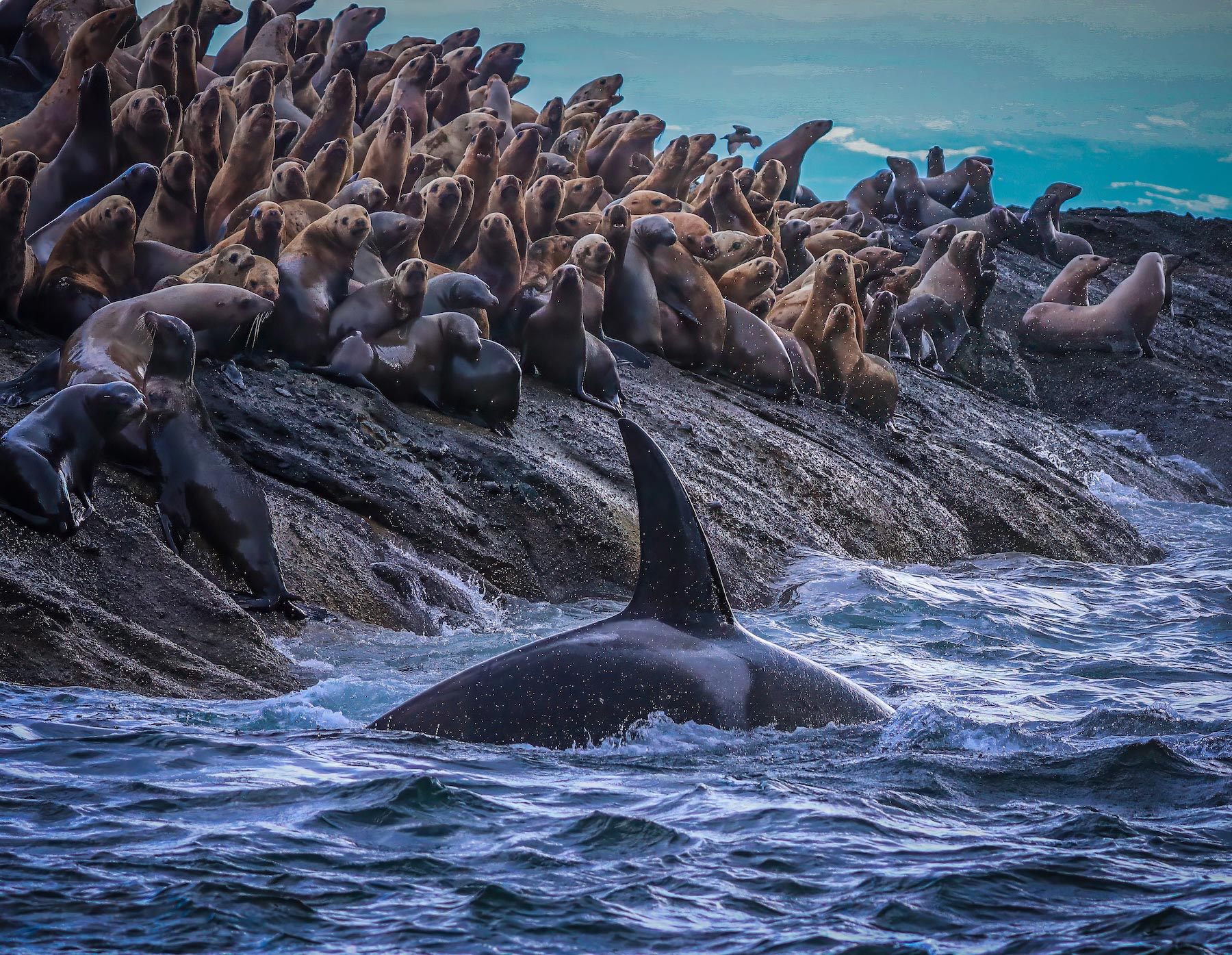
New findings show that transient killer whales living along the West Coast from British Columbia to California actually form two separate subpopulations, known as inner and outer coast transients.
Drawing on 16 years of observations and more than 2,200 documented encounters, the study published in PLOS One challenges long-held views about these mammal-eating whales.
“I’ve been thinking about this possibility for 15 years,” says first author Josh McInnes, who conducted the research as part of his master’s at UBC’s Institute for the Oceans and Fisheries (IOF). “Now our findings show the West Coast transients are two distinct groups, split along an east-west divide. They eat different things, hunt in different areas, and very rarely spend time with each other.”
Ecotypes and background on killer whale diversity
The West Coast is home to three recognized killer whale ecotypes: transients, residents and offshore whales, with a fourth possible ‘oceanic’ group recently suggested. Transients include six populations worldwide, and the West Coast transients are the most extensively studied, with genetic features that set them apart.
These whales, which range from southeast Alaska to southern California, were once thought to be divided north to south. However, the new research indicates that the real differences appear along an east-west boundary instead.
Habitat and lifestyle differences between inner and outer coast groups
“The inner coast killer whales are like city dwellers,” said co-author Dr. Andrew Trites, IOF professor and director of the Marine Mammal Research Unit. “They’re experts at navigating busy, maze-like streets of nearshore inlets, bays, and sheltered waterways—whereas the outer coast killer whales are more like backcountry dwellers thriving in deep canyons and rugged underwater terrain along the edge of the continental shelf.”
The research team conducted a social network analysis of orca sightings by examining photographs collected from scientific surveys and public reports, allowing them to identify individual whales seen between 2005 and 2021. “We essentially drew friendship maps to see which whales spent time together, and then looked at where they were seen to figure out if they hung out in specific neighborhoods,” said Dr. Trites.
Their analysis showed that the inner coast transients, a group of roughly 350 whales, were typically spotted about six kilometers from shore and in much shallower waters than the outer coast whales, including those seen in the Salish Sea. These inner coast whales fed mainly on smaller marine mammals such as harbor seals and harbor porpoises, and usually hunted in relatively small groups of about five individuals.
Outer coast transients, numbering about 210, are mainly found within 20 kilometers of the continental shelf break, frequently near submarine canyons. They were seen up to 120 kilometers from shore and travelled over extensive distances. They ate larger prey such as California sea lions, northern elephant seals, gray whale calves, and Pacific white-sided dolphins, and hunted in groups of about nine on average.
These differences could be due to the different habitats the animals occupy or human effects on the ecosystem, including culling and harvesting of key prey species.
Rare interactions and potential for additional subpopulations
Despite some overlap in their hunting grounds, which run from Southeast Alaska to southern California, the two subpopulations rarely associated with each other, with co-mingling seen in less than one per cent of encounters. “I have seen outer coast transients acting strangely around inner coast animals,” said McInnes, co-founder of the Oceanic Research Alliance. “One of the sightings reported a group of single male outer coast orcas slapping each other with their dorsal fins and charging at inner coast females.”
Given the difficulty of surveying in offshore waters, it’s possible there are even more subpopulations hunting beyond the reach of current observations.
In the meantime, the authors emphasize that their findings highlight the transboundary nature of transient killer whales and the importance of tailoring conservation and management efforts to the distinct ecological traits of each subpopulation. “These two communities of transient killer whale inhabit very different worlds and lead distinctly different lives,” said Dr. Trites. “Protecting them will take more than a one-size-fits-all approach. Each needs a tailored plan that reflects their unique needs and the specific threats they face.”
Reference: “Social associations and habitat selection delineate two subpopulations of west coast transient killer whales (Orcinus orca rectipinnus) in the California Current System” by Josh D. McInnes, Andrew W. Trites, Kevin M. Lester, Chelsea R. Mathieson, Lawrence M. Dill, Jeffrey E. Moore, Marilyn E. Dahlheim, Jonathan J. Scordino, K. S. Jasper Kanes and Paula A. Olson, 6 November 2025, PLOS ONE.
DOI: 10.1371/journal.pone.0325156
Never miss a breakthrough: Join the SciTechDaily newsletter.
Follow us on Google and Google News.
2 Comments
Maybe one of them are The Sharks, and the other are The Jets.
thanks for this