
Close Menu
    Facebook X (Twitter) Instagram
    SciTechDaily
    • Biology
    • Chemistry
    • Earth
    • Health
    • Physics
    • Science
    • Space
    • Technology
    Facebook X (Twitter) Pinterest YouTube RSS
    SciTechDaily
    Home»Biology»Scientists Discover a New Species of Venomous Snake in Australia
    Biology

    Scientists Discover a New Species of Venomous Snake in Australia

    By Mari Hooson, Swansea UniversityJuly 25, 2018No Comments3 Mins Read
    Facebook Twitter Pinterest Telegram LinkedIn WhatsApp Email Reddit
    Share
    Facebook Twitter LinkedIn Pinterest Telegram Email Reddit
    Researchers Discover New Species of Venomous Snake
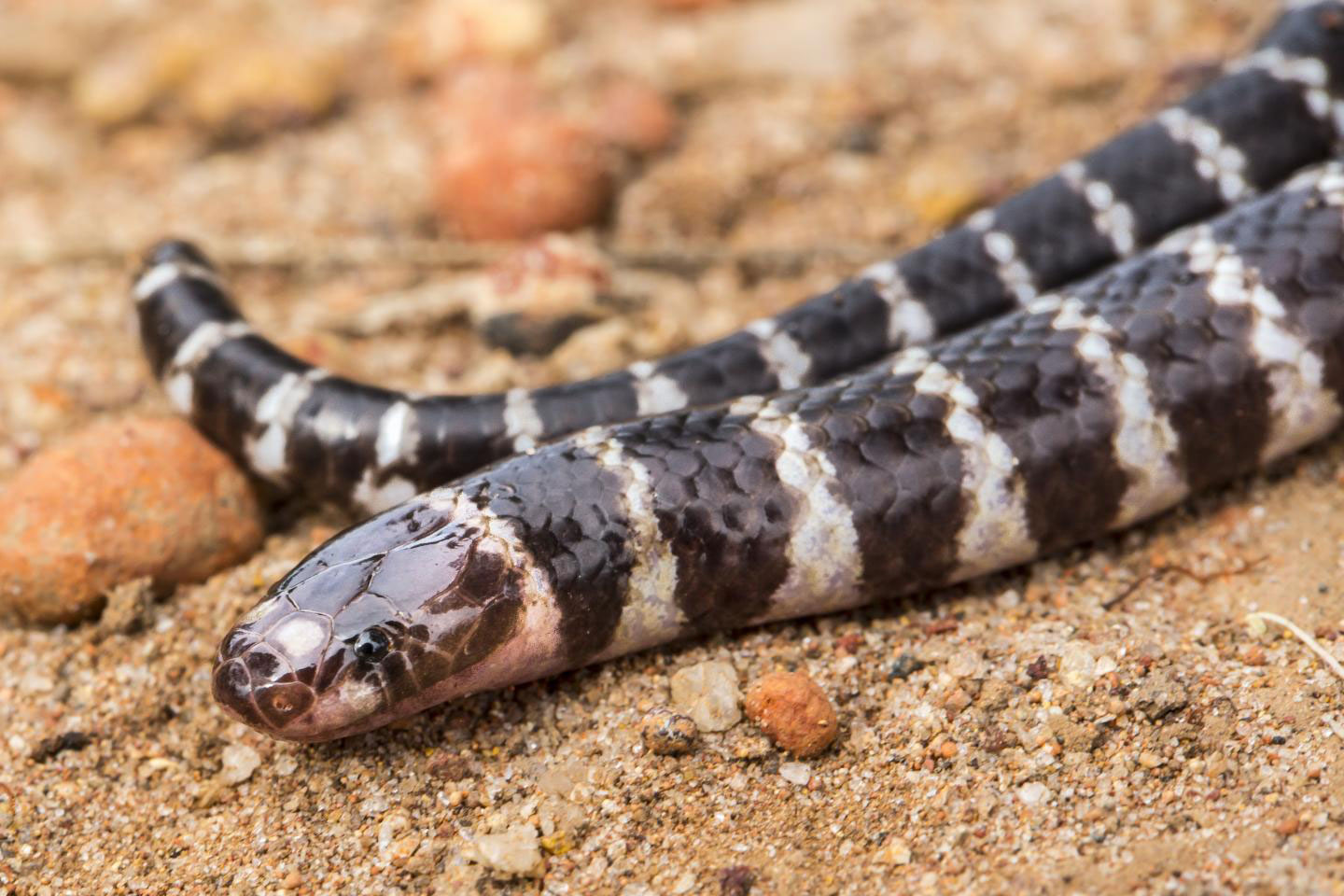
    This is a weipa bandy bandy. Credit: Dr. Freek Vonk

    Researchers at Swansea University’s College of Science are part of an international team that has discovered a new species of venomous snake in Australia.

    The Vermicella parscauda (Weipa bandy-bandy) is a small (50-100 cm or 20-40 in) black and white banded snake found only in Australia. It belongs to a group of venomous snakes known as burrowing elapids. But despite being part of a highly venomous family including cobras and the infamous Australian taipans, bandy-bandys pose no risk to humans and their venom could actually contain medicinal properties.

    Dr. Kevin Arbuckle is leading the molecular data analysis part of the research at Swansea. He said: “We are extremely excited to have identified this new species. After conducting the analyses of molecular data, we found that we had indeed found a distinctly different species than the bandy-bandys known previously.”

    It could be said that the last thing Australia needs is another venomous snake but as Dr. Arbuckle points out, this new species could have distinct benefits. “Due to their secretive habitats, small size, and venom that is not highly toxic to humans, the Weipa bandy-bandy is of no threat to us. In fact, once the venom of this new species is investigated, its complex mixture of biologically active chemicals has the potential to lead to future drug developments that could help humans.”

    The Weipa bandy-bandy was discovered by Dr. Bryan Fry (University of Queensland) and Dr. Freek Vonk (Naturalis Biodiversity Center) in 2014, during a field trip to the Cape York Peninsula. Dr. Vonk and Dr. Fry suspected that the specimen was different from other bandy-bandy species. During a later trip in 2016, another team member from Dr. Fry’s lab came across another of the snakes — a sign that the first wasn’t simply an unusual individual but might represent a new species. New genetic samples and morphological data were collected for these individuals and compared with all other bandy-bandy species. It was then up to Dr. Arbuckle to use the genetic data and test whether the new specimens represented a new, evolutionarily distinct species and to compare this to previously known species.

    The Weipa bandy-bandy might pose no threat to humans, but as Dr. Arbuckle says, the opposite is unfortunately not true: “Despite only just being discovered the new species already faces significant threat through potential habitat disruption due to mining activities and will likely be classified as endangered or even critically endangered once formally evaluated.

    Identifying the species is the first step towards making efforts to conserve it and provides a strong argument to avoid greatly extending the current mining enterprises that threaten its habitat.”

    Reference: “A new species of bandy-bandy (Vermicella: Serpentes: Elapidae) from the Weipa region, Cape York, Australia” by Chantelle M. Derez, Kevin Arbuckle, Zhiqiang Ruan, Bing Xie, Yu Huang, Lauren Dibben, Qiong Shi, Freek J. Vonk, and Bryan G. Fry, 16 July 2018, Zootaxa.
    DOI: 10.11646/zootaxa.4446.1.1

    Never miss a breakthrough: Join the SciTechDaily newsletter.
    Follow us on Google and Google News.

    Popular Snake Swansea University
    Share. Facebook Twitter Pinterest LinkedIn Email Reddit

    Related Articles

    Your Eyes Can Reveal if You’ve Suffered a Traumatic Experience in the Past

    Mystery of How Flying Snakes Move Solved by 3D Modeling and Motion Capture

    Masterful Illusionist: The European Viper Uses Cloak-and-Dazzle to Escape Predators

    Cats Have More Lives Than Dogs When It Comes to Venomous Snake Bites – Here’s Why

    New Green Pit Viper From India Named After Salazar Slytherin From Harry Potter

    Toxin From Rattlesnake Venom Formulated to Treat Chronic Pain

    New Fossils of Ancient Snake With Hind Legs Reveals Tantalizing Details of Evolution

    This 100 Million-Year-Old Snake Had Legs, but Cheekbone Provides Critical Insight Into Evolution

    Crabs Can Solve a Complex Maze and Remember Their Route Weeks Later [Video]

    Leave A Reply Cancel Reply

    • Facebook
    • Twitter
    • Pinterest
    • YouTube

    Don't Miss a Discovery

    Subscribe for the Latest in Science & Tech!

    Trending News

    New Study Reveals Why Ozempic Works Better for Some People Than Others

    Climate Change Is Altering a Key Greenhouse Gas in a Way Scientists Didn’t Expect

    New Study Suggests Gravitational Waves May Have Created Dark Matter

    Scientists Discover Why the Brain Gets Stuck in Schizophrenia

    Scientists Engineer “Tumor-Eating” Bacteria That Devour Cancer From Within

    Even “Failed” Diets May Deliver Long-Term Health Gains, Study Finds

    NIH Scientists Discover Powerful New Opioid That Relieves Pain Without Dangerous Side Effects

    Collapsing Plasma May Hold the Key to Cosmic Magnetism

    Follow SciTechDaily
    • Facebook
    • Twitter
    • YouTube
    • Pinterest
    • Newsletter
    • RSS
    SciTech News
    • Biology News
    • Chemistry News
    • Earth News
    • Health News
    • Physics News
    • Science News
    • Space News
    • Technology News
    Recent Posts
    • The Surprising Reason You Might Want To Sleep Without a Pillow
    • Household Cats Could Hold the Secret to Fighting Breast Cancer
    • Scientists Say This Natural Hormone Reverses Obesity by Targeting the Brain
    • This 15,000-Year-Old Discovery Changes What We Know About Early Human Creativity
    • 35-Million-Year-Old Mystery: Strange Arachnid Discovered Preserved in Amber
    Copyright © 1998 - 2026 SciTechDaily. All Rights Reserved.
    • Science News
    • About
    • Contact
    • Editorial Board
    • Privacy Policy
    • Terms of Use

    Type above and press Enter to search. Press Esc to cancel.