
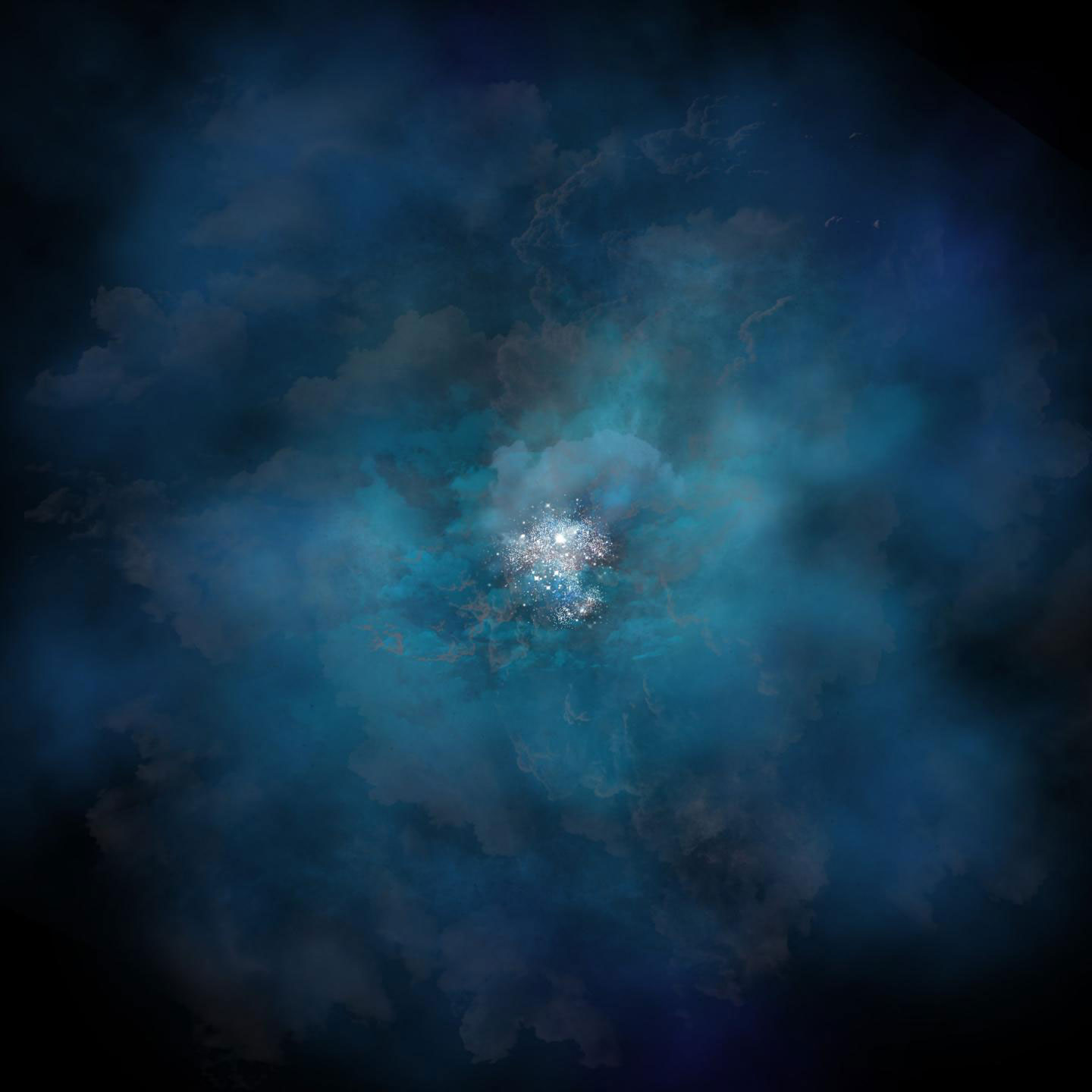
A team of astronomers has discovered a new way to unlock the mysteries of how the first galaxies formed and evolved.
In a study published today in The Astrophysical Journal Letters, lead author Dawn Erb of the University of Wisconsin-Milwaukee and her team – for the very first time – used new capabilities at W. M. Keck Observatory on Maunakea, Hawaii to examine Q2343-BX418, a small, young galaxy located about 10 billion light years away from Earth.
This distant galaxy is an analog for younger galaxies that are too faint to study in detail, making it an ideal candidate for learning more about what galaxies looked like shortly after the birth of the universe.
BX418 is also attracting astronomers’ attention because its gas halo is giving off a special type of light.
“In the last several years, we’ve learned that the gaseous halos surrounding galaxies glow with a particular ultraviolet wavelength called Lyman alpha emission. There are a lot of different theories about what produces this Lyman alpha emission in the halos of galaxies, but at least some of it is probably due to light that is originally produced by star formation in the galaxy being absorbed and re-emitted by gas in the halo,” said Erb.
Erb’s team, which includes Charles Steidel and Yuguang Chen of Caltech, used one of the observatory’s newest instruments, the Keck Cosmic Web Imager (KCWI), to perform a detailed spectral analysis of BX418’s gas halo; its properties could offer clues about the stars forming within the galaxy.
“Most of the ordinary matter in the universe isn’t in the form of a star or a planet, but gas. And most of that gas exists not in galaxies, but around and between them,” said Erb.
The halo is where gas enters and exits the system. The gas surrounding galaxies can fuel them; gas from within a galaxy can also escape into the halo. This inflow and outflow of gas influences the fate of stars.
“The inflow of new gas accreting into a galaxy provides fuel for new star formation, while outflows of gas limit a galaxy’s ability to form stars by removing gas,” says Erb. “So, understanding the complex interactions happening in this gaseous halo is key to finding out how galaxies form stars and evolve.”
This study is part of a large ongoing survey that Steidel has been leading for many years. Previously, Steidel’s team studied BX418 using other instruments at Keck Observatory.
This most recent study using KCWI adds detail and clarity to the image of the galaxy and its gas halo that was not possible before; the instrument is specifically engineered to study wispy currents of faint gas that connect galaxies, known as the cosmic web.
“Our study was really enabled by the design and sensitivity of this new instrument. It’s not just an ordinary spectrograph—it’s an integral field spectrograph, which means that it’s a sort of combination camera and spectrograph, where you get a spectrum of every pixel in the image,” said Erb.
The power of KCWI, combined with the Keck telescopes’ location on Maunakea where viewing conditions are among the most pristine on Earth, provides some of the most detailed glimpses of the cosmos.
Erb’s team used KCWI to take spectra of the Lyman alpha emission of BX418’s halo. This allowed them to trace the gas, plot its velocity and spatial extent, then create a 3-D map showing the structure of the gas and its behavior.
The team’s data suggests that the galaxy is surrounded by a roughly spherical outflow of gas and that there are significant variations in the density and velocity range of this gas.
Erb says this analysis is the first of its kind. Because it has only been tested on one galaxy, other galaxies need to be studied to see if these results are typical.
Now that the team has discovered a new way to learn about the properties of the gaseous halo, the hope is that further analysis of the data they collected and computer simulations modeling the processes will yield additional insights into the characteristics of the first galaxies in our universe.
“As we work to complete more detailed modeling, we will be able to test how the properties of Lyman alpha emission in the gas halo are related to the properties of the galaxies themselves, which will then tell us something about how the star formation in the galaxy influences the gas in the halo,” Erb said.
Erb is supported by the US National Science Foundation through the Faculty Early Career Development Program, grant AST-125591. Steidel and Chen acknowledge support from the Caltech/JPL President’s and Director’s Fund.
Reference: “The Kinematics of Extended Lyα Emission in a Low-mass, Low-metallicity Galaxy at z = 2.3*” by Dawn K. Erb, Charles C. Steidel and Yuguang Chen, 24 July 2018, The Astrophysical Journal Letters.
DOI: 10.3847/2041-8213/aacff6
Never miss a breakthrough: Join the SciTechDaily newsletter.
Follow us on Google and Google News.
2 Comments
There are some very complicated issues of galaxy formation. Unfortunately, here is the same problem as with the stars. The origin of galaxies remains unclear, in spite of huge activity in the field. What the “formation” means? It means that we have the material that is assembling into galaxies.
[Most of the ordinary matter in the universe isn’t in the form of a star or a planet, but gas. And most of that gas exists not in galaxies, but around and between them]
Yet again, more evidence that the big bang theory is incorrect, and that matter grows everywhere from that which is truly fundamental (no divisible entity such as a particle can be fundamental). Like a palindrome the universe expansion can be viewed in two ways to give the same result – currently they have it as expanding from A centre, but in fact it grows from ALL centres – galaxies are being pushed inwards by growth in space itself, much like a whirlpool.
It is also clear that the most fundamental form of existence must be self-causing energy – something that has the sole attribute of self-expansion – all it does is create more of itself. This is the true inflation theory. New self-growth is relative to all past growth causing layering (no where to grow but into itself) and this layering causes differentiation.
E=MC2 – just look at the massive expansion released when the atomic structure is broken. “The speed of light squared” is part of the equation because it represents the dimensional expansion. E = the energy that results from expansion. Continuous expansion is the continuous power source of the universe, enabling continuous causality.