
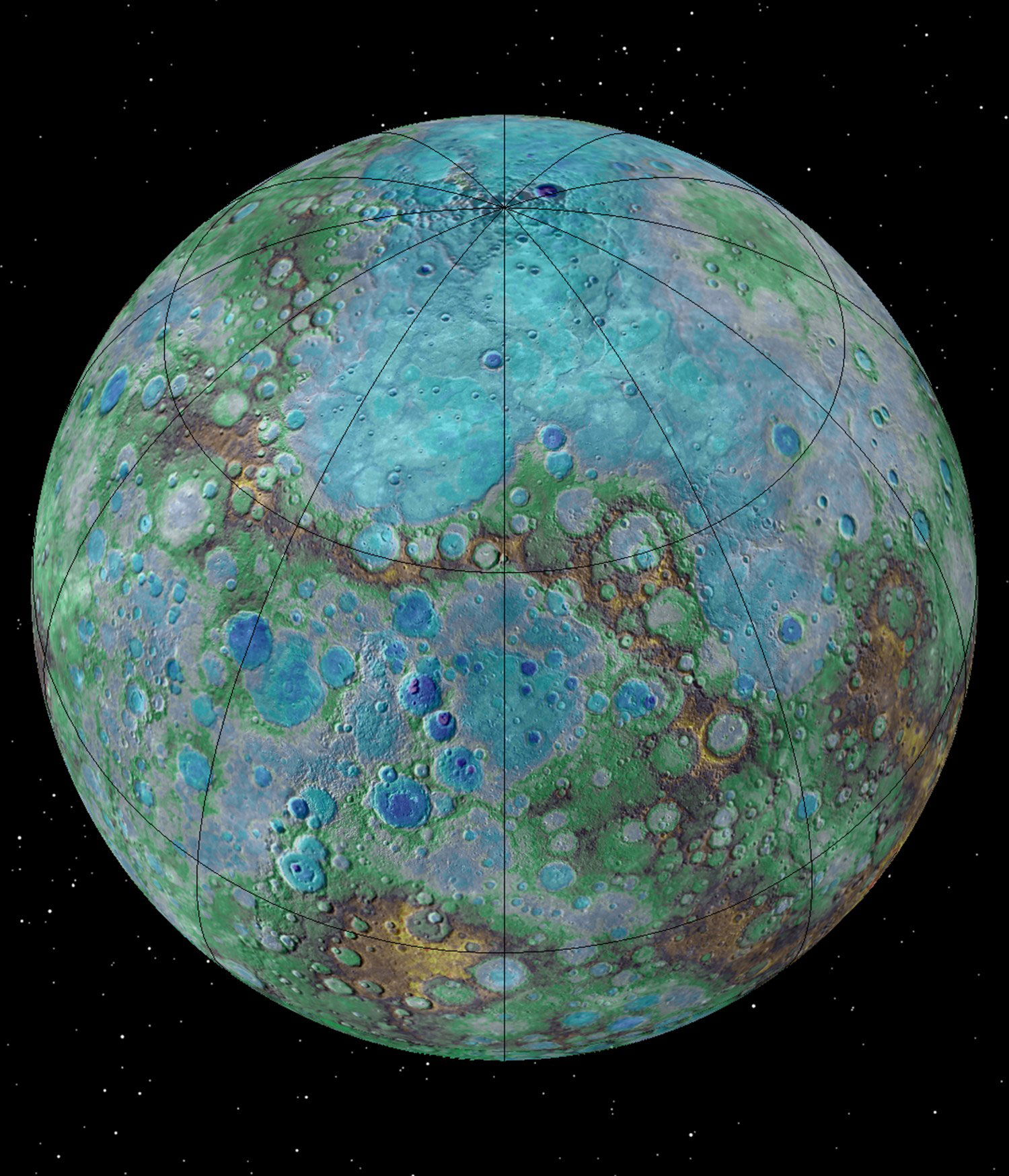
A hot, metallic, Earth-sized planet with a density similar to Mercury — situated 339 light years away — has been detected and characterized by a global team of astronomers, including the University of Warwick.
Named K2-229b, the planet is almost 20% larger than Earth but has a mass which is over two-and-a-half times greater — and reaches a dayside temperature of over 2,000°C or 3,600°F (2,330 °Kelvin).
It finds itself very close to its host star (0.012 AU, around a hundredth of the distance between the Earth and the Sun), which itself is a medium-sized active K dwarf in the Virgo Constellation. K2-229b orbits this star every fourteen hours.
Led overall by researchers at Aix-Marseille Université in France, Dr. David Armstrong and colleagues at the University of Warwick’s Astronomy and Astrophysics Group independently detected the planet in the first instance, alongside researchers at the Universidade do Porto.
Using the K2 telescope, Dr. Armstrong and colleagues employed the Doppler spectroscopy technique – also known as the ‘wobble method’ to discover and characterize this faraway planet.
The astronomers knew the planet was there due to dips in the light from its host star as it orbited, periodically blocking starlight.
They then calculated the size, position, and mass of K2-229b by measuring the radial velocity of the star, and finding out how much the starlight ‘wobbles’ during orbit, due to the gravitational tug from the planet, which changes depending on the planet’s size.
Dr. David Armstrong from the University of Warwick’s Astronomy and Astrophysics Group commented:
“Mercury stands out from the other Solar System terrestrial planets, showing a very high fraction of iron and implying it formed in a different way. We were surprised to see an exoplanet with the same high density, showing that Mercury-like planets are perhaps not as rare as we thought.”
“Interestingly K2-229b is also the innermost planet in a system of at least 3 planets, though all three orbit much closer to their star than Mercury. More discoveries like this will help us shed light on the formation of these unusual planets, as well as Mercury itself.”
The dense, metallic nature of K2-229b has numerous potential origins, and one hypothesis is that its atmosphere might have been eroded by intense stellar wind and flares, as the planet is so close to its star.
Another possibility is that K2-229b was formed after a huge impact between two giant astronomical bodies in space billions of years ago – much like the theory that the Moon was formed after Earth collided with a body the size of Mars.
Discovering details about far-flung planets across the universe gives us more clues as to how planets in our own solar system formed. As K2-229b is similar to Mercury, knowing more about the former can potentially reveal more about the latter.
Reference: “An Earth-sized exoplanet with a Mercury-like composition” by A. Santerne, B. Brugger, D. J. Armstrong, V. Adibekyan, J. Lillo-Box, H. Gosselin, A. Aguichine, J.-M. Almenara, D. Barrado, S. C. C. Barros, D. Bayliss, I. Boisse, A. S. Bonomo, F. Bouchy, D. J. A. Brown, M. Deleuil, E. Delgado Mena, O. Demangeon, R. F. Díaz, A. Doyle, X. Dumusque, F. Faedi, J. P. Faria, P. Figueira, E. Foxell, H. Giles, G. Hébrard, S. Hojjatpanah, M. Hobson, J. Jackman, G. King, J. Kirk, K. W. F. Lam, R. Ligi, C. Lovis, T. Louden, J. McCormac, O. Mousis, J. J. Neal, H. P. Osborn, F. Pepe, D. Pollacco, N. C. Santos, S. G. Sousa, S. Udry and A. Vigan, 26 March 2018, Nature Astronomy.
DOI: 10.1038/s41550-018-0420-5
Never miss a breakthrough: Join the SciTechDaily newsletter.
Follow us on Google and Google News.