
Close Menu
    Facebook X (Twitter) Instagram
    SciTechDaily
    • Biology
    • Chemistry
    • Earth
    • Health
    • Physics
    • Science
    • Space
    • Technology
    Facebook X (Twitter) Pinterest YouTube RSS
    SciTechDaily
    Home»Science»Archaeologists Reveal Evidence of Hidden Populations in the Amazon
    Science

    Archaeologists Reveal Evidence of Hidden Populations in the Amazon

    By Kerra Maddern, University of ExeterMarch 27, 2018No Comments5 Mins Read
    Facebook Twitter Pinterest Telegram LinkedIn WhatsApp Email Reddit
    Share
    Facebook Twitter LinkedIn Pinterest Telegram Email Reddit
    Archaeologists Uncover Evidence of Hidden Populations in the Amazon
    Ditched enclosures of the UTB. a Typical position of ditched enclosures in the landscape, on plateaus overlooking rivers (site Mt-05); b Example of a small enclosure (site Z-Mt-29). Scale bar = 50 m; c Compound structure with a small enclosure in the interior of a larger one (site Z-Mt-05). Scale bar = 100 m; d Part of the site Z-Mt-04, showing the wavy pattern of ditch construction. Scale bar = 50 m; e Plan of a major regional center, site Mt-07, with ditches outlined in black and mounds/walls outlined in white (Satellite image ©2018 Google, DigitalGlobe). Scale bar = 200 m; f Site Mt-04. Scale bar = 100 m. Nature Communications, volume 9, Article number: 1125 (2018) doi:10.1038/s41467-018-03510-7

    Parts of the Amazon previously thought to have been almost uninhabited were really home to thriving populations of up to a million people, new research shows.

    Archaeologists have uncovered evidence that there were hundreds of villages in the rainforest away from major rivers, and they were home to different communities speaking varied languages who had an impact on the environment around them.

    Huge parts of the Amazon are still unexplored by archaeologists, particularly areas away from major rivers. People had assumed ancient communities had preferred to live near these waterways, but the new evidence shows this was not the case.

    The discovery fills a major gap in the history of the Amazon, and provides further evidence that the rainforest – once thought to be untouched by human farming or occupation – has in fact been heavily influenced by those who lived in it.
    Archaeologists Reveal Hidden Populations in the Amazon
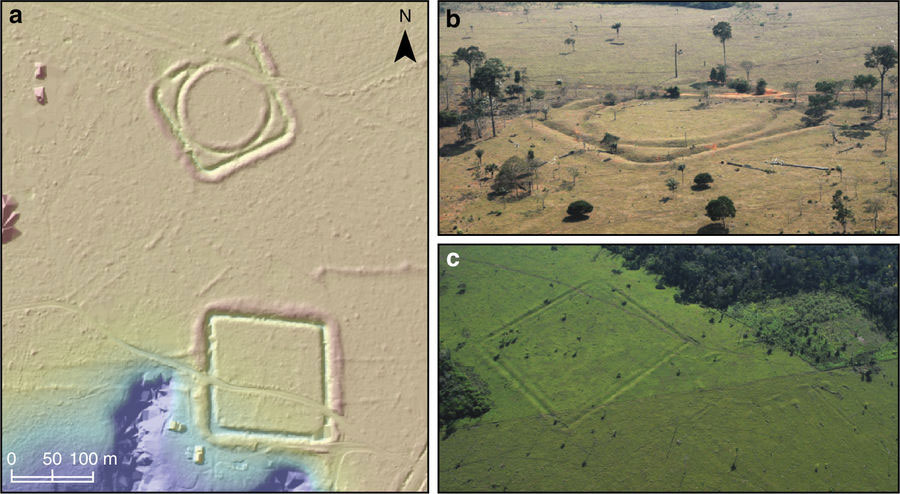
    Geoglyphs and mounded ring villages. a LiDAR digital terrain model of the Jacó Sá site showing geometric ditched enclosures, walled enclosures and avenues. Scale bar = 100 m. b Aerial photo of one of the structures at Jacó Sá site. c Aerial photo of Fonte Boa site showing a mounded ring village with radiating roads (right) built next to an earlier geometric enclosure (left). Aerial photographs are part of the collection of CNPq research group Geoglyphs of Western Amazonia directed by Denise Schaan. Nature Communications, volume 9, Article number: 1125 (2018) doi:10.1038/s41467-018-03510-7

    Archaeologists from the University of Exeter found the remains of fortified villages and mysterious earthworks called geoglyphs – man-made ditches with strange square, circular or hexagonal shapes. Experts still don’t know the purpose of these earthworks, as some show no evidence of being occupied. It is possible they were used as part of ceremonial rituals.

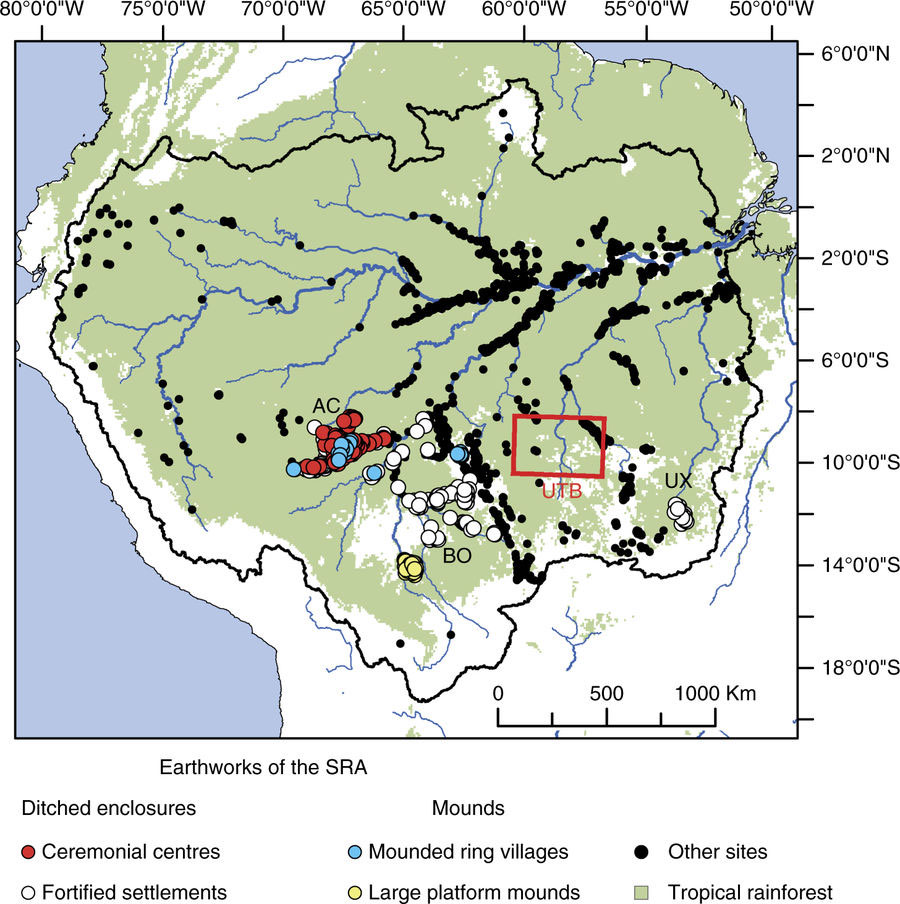
    Archaeologists uncovered the remains in the current Brazillian state of Mato Grosso. By analyzing charcoal remains and excavated pottery they have found a 1,800 km (1,100 mi) stretch of southern Amazonia was continuously occupied from 1250 until 1500 by people living in fortified villages. The experts estimate that there would have been between 1,000 and 1,500 enclosed villages, and two-thirds of these sites are yet to be found.

    The new study shows there are an estimated 1,300 geoglyphs across 400,000 km2 (154,000 mi2) of Southern Amazonia, with 81 found in the area surveyed as part of this research. Villages are often found nearby, or inside the geoglyphs. They are connected through a network of causeways and some have been elaborately constructed over many years.

    The earthworks were probably made during seasonal droughts, which allowed forests to be cleared. Drier areas still had fertile soils, where farmers would have been able to grow crops and fruit trees like Brazil nuts.

    Dr. Jonas Gregorio de Souza, from the University of Exeter’s Department of Archaeology, a member of the research team said: “There is a common misconception that the Amazon is an untouched landscape, home to scattered, nomadic communities. This is not the case. We have found that some populations away from the major rivers are much larger than previously thought, and these people had an impact on the environment which we can still find today.
    Archaeologists Reveal Hidden Populations
    Distribution of earthworks in the SRA and other sites in the Amazon. Different categories of earthworks as per Supplementary Note 1. Sub-regions of the SRA discussed in the text: AC Geoglyphs of Acre, BO Ring ditches of Bolivia, UX Upper Xingu, UTB survey area in the Upper Tapajós Basin. Scale bar = 1000 km. Nature Communications, volume 9, Article number: 1125 (2018) doi:10.1038/s41467-018-03510-7

    “The Amazon is crucial to regulating the Earth’s climate, and knowing more about its history will help everyone make informed decisions about how it should be cared for in the future.”

    Professor José Iriarte, from the University of Exeter, another member of the research team, said: “We are so excited to have found such a wealth of evidence. Most of the Amazon hasn’t been excavated yet, but studies such as ours mean we are gradually piecing together more and more information about the history of the largest rainforest on the planet

    “Our research shows we need to re-evaluate the history of the Amazon. It certainly wasn’t an area populated only near the banks of large rivers, and the people who lived there did change the landscape. The area we surveyed had a population of at least tens of thousands.”

    The research, funded by National Geographic and the European Research Council project PAST, is published in the journal Nature Communications and was carried out by academics from the University of Exeter, Federal University of Pará, Belém, National Institute for Space Research—INPE and the Universidade do Estado de Mato Grosso.

    Reference: “Pre-Columbian earth-builders settled along the entire southern rim of the Amazon” by Jonas Gregorio de Souza, Denise Pahl Schaan, Mark Robinson, Antonia Damasceno Barbosa, Luiz E. O. C. Aragão, Ben Hur Marimon Jr., Beatriz Schwantes Marimon, Izaias Brasil da Silva, Salman Saeed Khan, Francisco Ruji Nakahara and José Iriarte, 27 March 2018, Nature Communications.
    DOI: 10.1038/s41467-018-03510-7

    Never miss a breakthrough: Join the SciTechDaily newsletter.
    Follow us on Google and Google News.

    Amazon Archaeology University of Exeter
    Share. Facebook Twitter Pinterest LinkedIn Email Reddit

    Related Articles

    Archaeological Study Exposes Secrets of Medieval Horse Trading

    Rewriting History: New Research Reveals That There Are Thousands of Undiscovered Pre-Columbian Sites in the Amazon Rainforest

    Dark Earth Deciphered: Ancient Amazonians Intentionally Created Fertile “Dark Earth”

    New Evidence of Extreme Climate Change Thousands of Years Ago Revealed by Ancient Ostrich Eggshell

    Medieval Lawyers Wrote on Sheepskin Parchment Because It Helped Prevent Fraud

    Discovery of 66 New Roman Army Sites Reveals Clues About One of the Empire’s Most Infamous Conflicts

    “Sistine Chapel of the Ancients” Discovered: Amazon Rock Art Shows the Rainforest’s Earliest Inhabitants Living With Giant Ice Age Animals

    Mysterious Bone Circles Built by Humans From the Remains of Mammoths Reveal Clues About Ice Age

    New Discovery Suggests Humans Left Africa Earlier Than Previously Thought

    Leave A Reply Cancel Reply

    • Facebook
    • Twitter
    • Pinterest
    • YouTube

    Don't Miss a Discovery

    Subscribe for the Latest in Science & Tech!

    Trending News

    One of the Universe’s Largest Stars May Be Getting Ready To Explode

    Scientists Discover Enzyme That Could Supercharge Ozempic-Like Weight Loss Drugs

    Popular Sweetener Linked to DNA Damage – “It’s Something You Should Not Be Eating”

    Ancient “Rock” Microbes May Reveal How Complex Life Began

    Researchers Capture Quantum Interference in One of Nature’s Rarest Atoms

    “A Plague Is Upon Us”: The Mass Death That Changed an Ancient City Forever

    Scientists Discover Game-Changing New Way To Treat High Cholesterol

    This Small Change to Your Exercise Routine Could Be the Secret to Living Longer

    Follow SciTechDaily
    • Facebook
    • Twitter
    • YouTube
    • Pinterest
    • Newsletter
    • RSS
    SciTech News
    • Biology News
    • Chemistry News
    • Earth News
    • Health News
    • Physics News
    • Science News
    • Space News
    • Technology News
    Recent Posts
    • Scientists Rethink Extreme Warming After Surprising Ocean Discovery
    • The Surprising Role of Asteroids in the Origin of Life
    • Scientists Raise Concerns Over Newly Recognized Pollutant Found Everywhere in the Air
    • New Study Challenges 40-Year Puzzle About Childhood Body Fat
    • 20-Year Study Finds Daily Multivitamins Don’t Extend Lifespan
    Copyright © 1998 - 2026 SciTechDaily. All Rights Reserved.
    • Science News
    • About
    • Contact
    • Editorial Board
    • Privacy Policy
    • Terms of Use

    Type above and press Enter to search. Press Esc to cancel.