
Close Menu
    Facebook X (Twitter) Instagram
    SciTechDaily
    • Biology
    • Chemistry
    • Earth
    • Health
    • Physics
    • Science
    • Space
    • Technology
    Facebook X (Twitter) Pinterest YouTube RSS
    SciTechDaily
    Home»Space»Scientists Discover Surprising Amount of Dust and Gas in the Remnant of Supernova 1987A
    Space

    Scientists Discover Surprising Amount of Dust and Gas in the Remnant of Supernova 1987A

    By Royal Astronomical SocietyJuly 5, 2013No Comments3 Mins Read
    Facebook Twitter Pinterest Telegram LinkedIn WhatsApp Email Reddit
    Share
    Facebook Twitter LinkedIn Pinterest Telegram Email Reddit
    Supernova 1987A Helps Explain Why Space is so Abundant with Dust Grains and Molecules
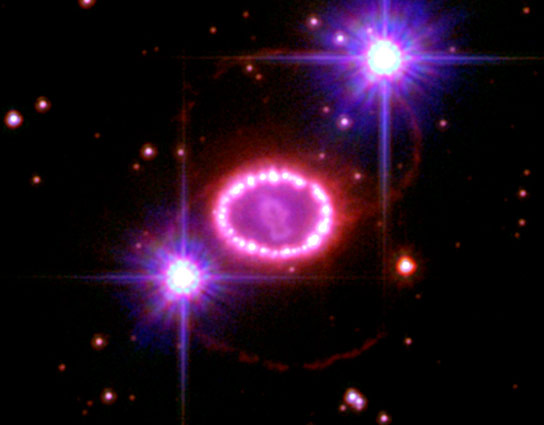
    The keyhole-like shape at the center is the remnant of the supernova explosion 1987A. This remnant is still expanding with a speed of 2,200 km (1,400 mi) per second. It is believed that the surrounding ring was formed before the explosion. Credit: ESA, NASA, P. Challis and R. Kirshner

    Using the Herschel Space Observatory and Atacama Millimeter and Submillimeter Array, researchers have discovered a vast reservoir of unexpectedly cold molecules and dust from the remnant of supernova 1987A.

    Surprisingly low temperatures detected in the remnant of the supernova 1987A may explain the mystery of why space is so abundant with dust grains and molecules. The results will be presented by Dr. Mikako Matsuura at the National Astronomy Meeting 2013 in St Andrews on Friday, July 5.

    In 1987, an explosion of a massive star was detected in our neighboring galaxy, the Large Magellanic Cloud, just 170,000 light-years away. This supernova, dubbed 1987A, released approximately a thousand million times more energy than that emitted by the Sun in one year. Twenty-five years later, an international team of astronomers has used the Herschel Space Observatory and Atacama Millimeter and Submillimeter Array (ALMA) to study the supernova remnant. They found a vast reservoir of unexpectedly cold molecules and dust.

    “The powerful explosion we saw in 1987 scattered elements made by star into space in the form of a very hot plasma. The gas has now cooled down to temperatures between -250 to -170 degrees Celsius. That’s surprisingly cold, comparable to the icy surface of Pluto at the edge of our Solar System. The gas has formed molecules and some has even condensed into solid grains of dust. The supernova has now become a super freezer!” said Dr. Matsuura.
    ALMA Composite Image of Supernova 1987A
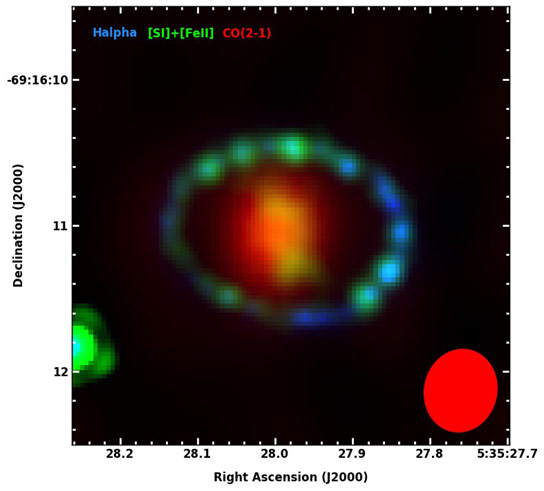
    The ALMA composite image of supernova 1987A, overlaid on the optical and near-infrared images. The ALMA image, indicated in red, captured the molecular reservoir in the remaining of supernova 1987A. Credit: Kamenetzky et al, Astrophysical Journal Letters (submitted)

    The Herschel observations show that the supernova produced dust and solid material equal to about 250,000 times the mass of the Earth, or three-quarters of the mass of the Sun. To date, scientists have believed that supernova remnants contain only very energetic atomic gas, detectable at optical X-ray wavelengths; the new observations show that this is not the case. The discovery of such a large mass of dust should help us to understand how supernovae slowly spread and fill galaxies with gas, dust, and small rocky particles, some of which may eventually end up in the next generation of stars and planets.

    “We were surprised by the amount of dust and molecular gas in the reservoir created by the supernova 1987A. The ALMA and Herschel observations show that the reservoir contains carbon monoxide molecules equaling one-tenth of the mass of the Sun. Herschel shows that the dust mass was even larger – about half the solar mass!” said Dr. Matsuura.

    “We don’t get many opportunities to study supernova. These events are very rare and the majority was found in very distant galaxies. Even with relatively close ones, like 1987A, it’s difficult – although they are very bright at the time of the explosion, the light from the supernovae fades very quickly making it very difficult to observe them a few years after the explosion,” said Dr. Matsuura. “Carl Sagan once said that: ‘We are all made of star-stuff’. These results will help us understand how that material reached us!”

    Never miss a breakthrough: Join the SciTechDaily newsletter.
    Follow us on Google and Google News.

    Astronomy Astrophysics Royal Astronomical Society Supernova
    Share. Facebook Twitter Pinterest LinkedIn Email Reddit

    Related Articles

    Supernova Death Blasts May Have Wiped Out Life on Earth – Twice

    Explosion Imminent: Massive Stars Sound Warning They Are About To Go Supernova

    Cosmic Rays Help Supernovae Explosions Pack a Dramatically More Massive Punch

    Mysterious Hydrogen-Free Supernova Sheds Light on Massive Stars’ Violent Death Throes

    Dark Energy Survey Reveals a Rare Superluminous Supernova

    Possible Evidence of Hadron Acceleration in Tycho Supernova Remnant

    Links Between Core Collapse Supernovae and Star Formation Established

    Lasers Mimic Supernova to Explain Cosmic Magnetic Fields

    SN Primo Is Farthest Type Ia Supernova Discovered

    Leave A Reply Cancel Reply

    • Facebook
    • Twitter
    • Pinterest
    • YouTube

    Don't Miss a Discovery

    Subscribe for the Latest in Science & Tech!

    Trending News

    Just a Few Breathless Minutes a Day Could Slash Your Risk of 8 Major Diseases

    This Simple Habit Could Cut Your Risk of Dementia by 30%

    Scientists Debunk Rattlesnake Myth That Fooled Hikers and Doctors for Decades

    Scientists Discover Plants Can “Count” – and May Be Smarter Than We Thought

    New Research Reveals Ancient Mars May Have Been Warm, Wet – and Possibly Alive

    This Surprising Daily Habit Could Cut Dementia Risk by 35%

    Just 10 Minutes a Day: Scientists Say This Ancient Chinese Practice Shows Powerful Blood Pressure Benefits

    Scientists Say This Popular Food Could Help Your Body Get Rid of Microplastics

    Follow SciTechDaily
    • Facebook
    • Twitter
    • YouTube
    • Pinterest
    • Newsletter
    • RSS
    SciTech News
    • Biology News
    • Chemistry News
    • Earth News
    • Health News
    • Physics News
    • Science News
    • Space News
    • Technology News
    Recent Posts
    • “We Were Truly Astonished”: New Discovery Rewrites Earth’s Origin Story
    • A Simple Nose Swab Could Detect Alzheimer’s Years Before Symptoms Appear
    • Scientists Warn: Vaping Likely Causes Cancer
    • Irregular Bedtimes Could Double Your Risk of Heart Attack and Stroke
    • Scientists Just Rewrote the Timeline of Complex Life on Earth
    Copyright © 1998 - 2026 SciTechDaily. All Rights Reserved.
    • Science News
    • About
    • Contact
    • Editorial Board
    • Privacy Policy
    • Terms of Use

    Type above and press Enter to search. Press Esc to cancel.