
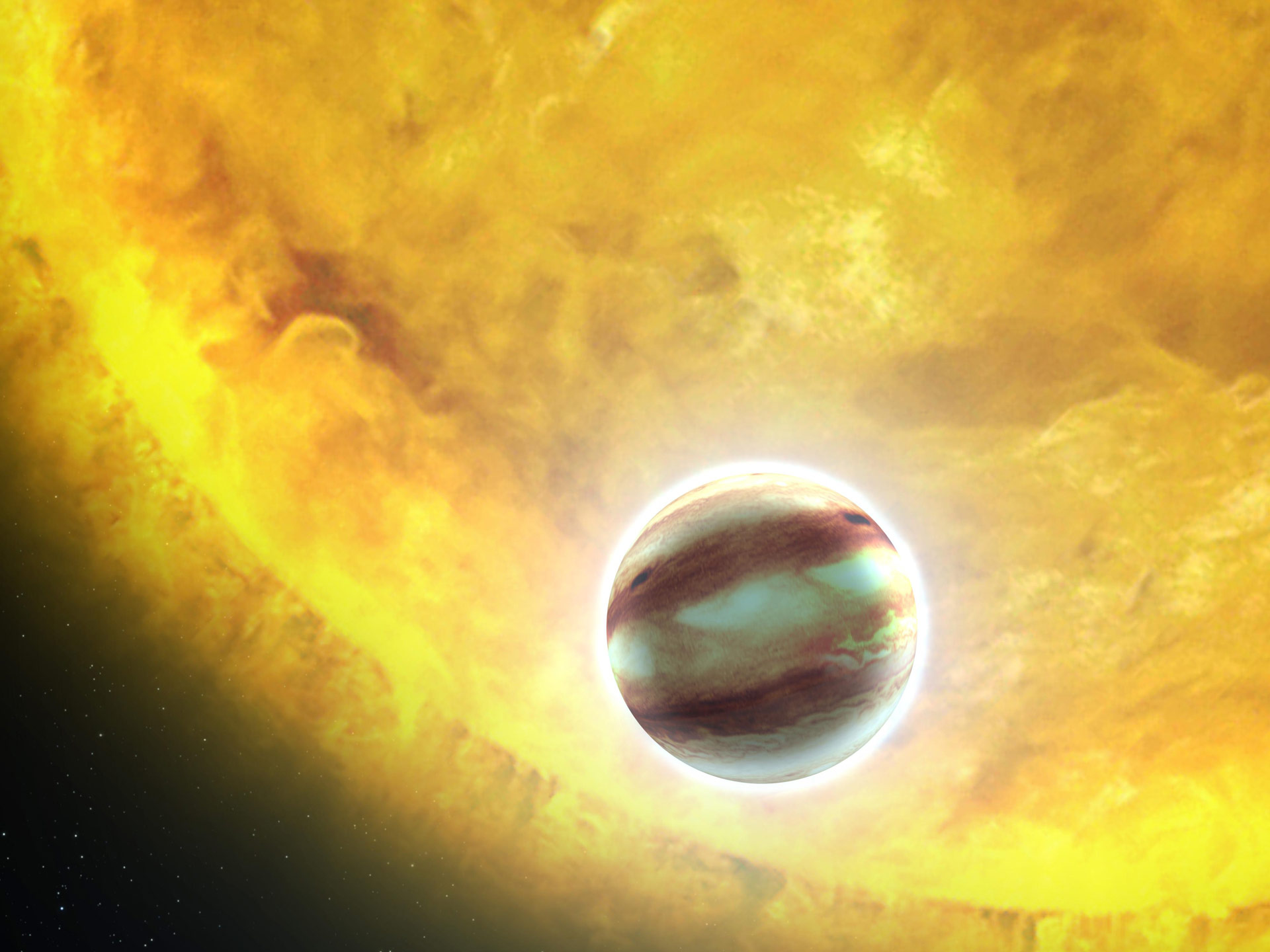
Researchers from the University of Exeter are presenting their first results from the analysis of eight ‘hot Jupiter’ exoplanets, finding that winds and clouds play an important role in the atmospheric make up of these planets.
Catherine Huitson from Physics and Astronomy at the University of Exeter will present the results at the National Astronomy Meeting in St Andrews on Friday 5 July 2013.
Hot Jupiters are giant exoplanets, similar in size to Jupiter, that orbit so close to their stars that their atmospheres can reach temperatures of 1000-3000 degrees Celsius. Astronomers can detect which gases are present in their atmospheres by analyzing the spectrum of starlight filtered through the planet’s atmosphere when the planet passes in front of the star. Last year, a team led by the University of Exeter was awarded nearly 200 hours on the NASA/ESA Hubble Space Telescope to examine eight planets using this technique – the largest survey of its type to date.
Catherine Huitson said: “These hot Jupiter planets are expected to have a vastly different composition from planets in our own Solar System like Jupiter, where temperatures at the cloud tops are around -150 degrees Celsius. The first planet we measured is one of the hottest to be observed, with a temperature of over 2000 degrees. The early results of the survey are now in, and they present a diverse range of puzzling properties.”
The first, very hot planet observed showed an unexpected absence of titanium oxide. Current 3D models of hot Jupiter atmospheres suggest that grains of this heavy molecule should be circulated by fast winds, allowing gaseous titanium oxide to reach the observable upper atmosphere. The non-detection of the gas suggests that either the winds are not as strong as expected or the molecule is forming much larger grains that are too heavy be lifted.
Huitson explained, “Titanium oxide is a solid on Earth, but we expect it to be present in the atmosphere of the hottest hot Jupiters because of the extreme temperatures. This molecule is important because it could trap atmospheric heat high up forming a stratosphere – the same role ozone plays on Earth. However, our results show that this molecule is not present in the upper atmosphere, meaning that we need to revise our understanding of how wind processes distribute materials.”
The team also made a confirmed detection of water vapor in the atmosphere of two planets. Importantly, the water was found in the quantities predicted by theory, contrasting with previously observed planets.
“While our models tell us that water (as steam) should be present in hot Jupiter atmospheres, until now the molecule has only been seen in limited quantities and in fewer planets than expected,” said Huitson.
“Seeing steam in two exoplanets is a great confirmation of current theory. Our new findings suggest that previous non-detections were caused by opaque, high-up clouds obscuring the parts of the atmosphere where steam is present.”
The results presented at the National Astronomy Meeting represent initial findings and work by the team is still ongoing to analyze all the data from the eight-planet Hubble survey.
“A surprising diversity is emerging from the continuing observations among planets with similar temperatures, and the remaining results are sure to present even more surprises as we try to understand such extreme and unknown objects,” said Huitson.
Reference: “Temperature–pressure profile of the hot Jupiter HD 189733b from HST sodium observations: detection of upper atmospheric heating” by C. M. Huitson, D. K. Sing, A. Vidal-Madjar, G. E. Ballester, A. Lecavelier des Etangs, J.-M. Désert and F. Pont, 10 May 2012, Monthly Notices of the Royal Astronomical Society.
DOI: 10.1111/j.1365-2966.2012.20805.x
arXiv:1202.4721
Never miss a breakthrough: Join the SciTechDaily newsletter.
Follow us on Google and Google News.