
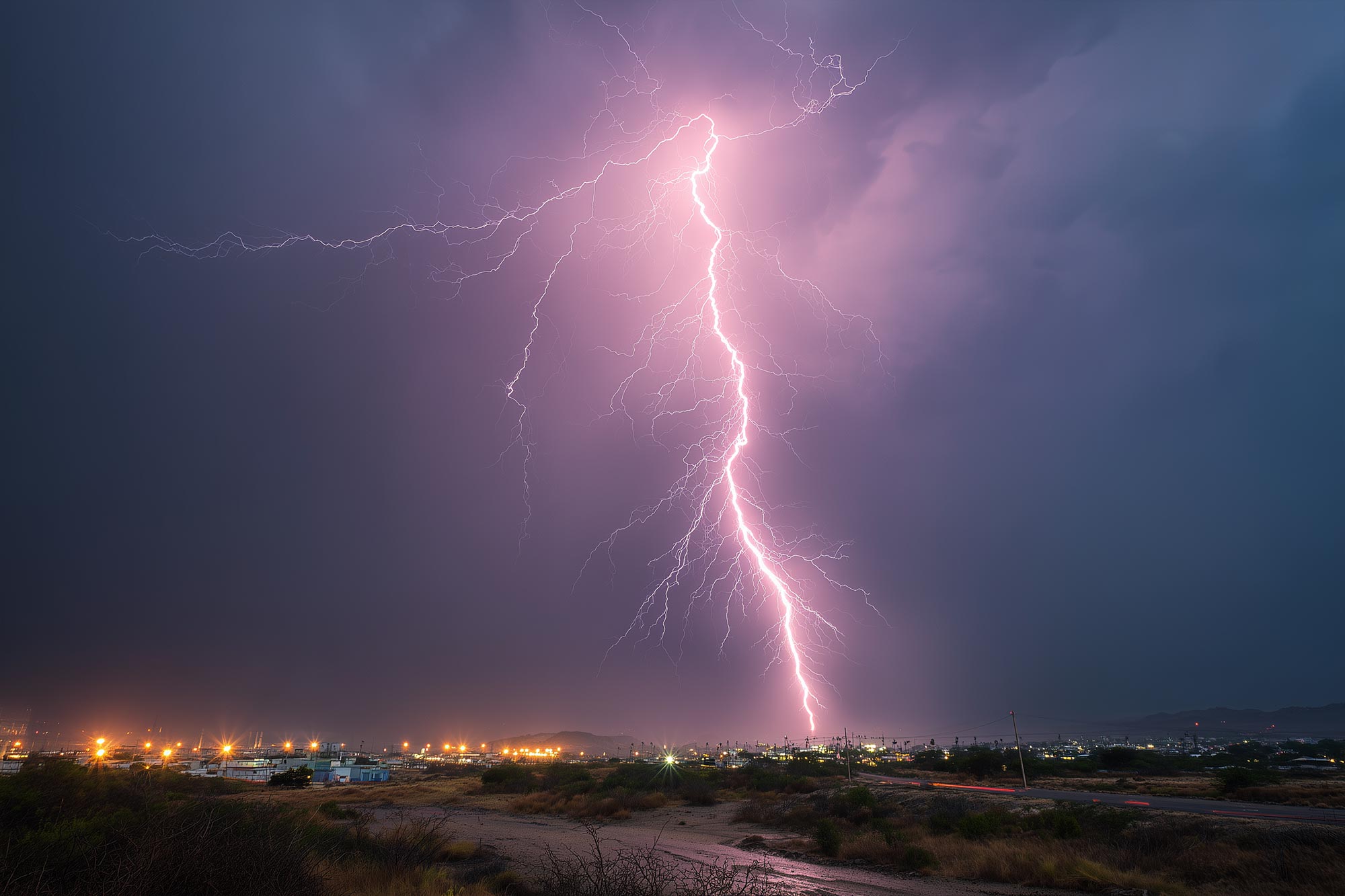
Lightning may look like a sudden burst from the clouds, but its true origin lies in an invisible storm of cosmic rays, X-rays, and high-energy electrons.
A breakthrough study led by Penn State researchers has finally decoded this hidden process: when cosmic rays strike thunderclouds, they trigger avalanches of particles and bursts of radiation that ignite lightning from within. This chain reaction, known as photoelectric feedback, happens in eerie silence, often without light or sound, before the bolt ever strikes.
How Lightning Begins: Cracking a Centuries-Old Mystery
For decades, scientists have understood the mechanics of a lightning strike, but exactly what sets it off inside thunderclouds remained a lingering mystery. That mystery may now be solved. A research team led by Victor Pasko, professor of electrical engineering at Penn State’s School of Electrical Engineering and Computer Science, has identified the powerful chain of events responsible for triggering lightning.
In a study published July 28 in the Journal of Geophysical Research, the researchers explained how intense electric fields within thunderclouds accelerate electrons. These fast-moving electrons collide with molecules such as nitrogen and oxygen, generating X-rays and sparking a rapid surge of new electrons and high-energy photons. This chain reaction creates the ideal conditions for a lightning bolt to form.
Connecting the Physics: X-Rays, Electric Fields, and Avalanches
“Our findings provide the first precise, quantitative explanation for how lightning initiates in nature,” Pasko said. “It connects the dots between X-rays, electric fields, and the physics of electron avalanches.”
To validate their explanation, the team used mathematical modeling to simulate atmospheric events that match what scientists have observed in the field. These observations involve photoelectric processes in Earth’s atmosphere, where high-energy electrons—triggered by cosmic rays from space—multiply within the electric fields of thunderstorms and release short bursts of high-energy photons. This process, known as a terrestrial gamma-ray flash, consists of invisible but naturally occurring bursts of X-rays and associated radio signals.
“By simulating conditions with our model that replicated the conditions observed in the field, we offered a complete explanation for the X-rays and radio emissions that are present within thunderclouds,” Pasko said. “We demonstrated how electrons, accelerated by strong electric fields in thunderclouds, produce X-rays as they collide with air molecules like nitrogen and oxygen, and create an avalanche of electrons that produce high-energy photons that initiate lightning.”
Matching Models to Field Observations
Zaid Pervez, a doctoral student in electrical engineering, used the model to match field observations — collected by other research groups using ground-based sensors, satellites, and high-altitude spy planes — to the conditions in the simulated thunderclouds.
“We explained how photoelectric events occur, what conditions need to be in thunderclouds to initiate the cascade of electrons, and what is causing the wide variety of radio signals that we observe in clouds all prior to a lightning strike,” Pervez said. “To confirm our explanation on lightning initiation, I compared our results to previous modeling, observation studies and my own work on a type of lightning called compact intercloud discharges, which usually occur in small, localized regions in thunderclouds.”
Published by Pasko and his collaborators in 2023, the model, Photoelectric Feedback Discharge, simulates physical conditions in which a lightning bolt is likely to originate. The equations used to create the model are available in the paper for other researchers to use in their own work.

Gamma-Ray Flashes Without the Flash
In addition to uncovering lightning initiation, the researchers explained why terrestrial gamma-ray flashes are often produced without flashes of light and radio bursts, which are familiar signatures of lightning during stormy weather.
“In our modeling, the high-energy X-rays produced by relativistic electron avalanches generate new seed electrons driven by the photoelectric effect in air, rapidly amplifying these avalanches,” Pasko said. “In addition to being produced in very compact volumes, this runaway chain reaction can occur with highly variable strength, often leading to detectable levels of X-rays, while accompanied by very weak optical and radio emissions. This explains why these gamma-ray flashes can emerge from source regions that appear optically dim and radio silent.”
Reference: “Photoelectric Effect in Air Explains Lightning Initiation and Terrestrial Gamma Ray Flashes” by Victor P. Pasko, Sebastien Celestin, Anne Bourdon, Reza Janalizadeh, Zaid Pervez, Jaroslav Jansky and Pierre Gourbin, 28 July 2025, Journal of Geophysical Research: Atmospheres.
DOI: 10.1029/2025JD043897
In addition to Pasko and Pervez, the co-authors include Sebastien Celestin, professor of physics at the University of Orléans, France; Anne Bourdon, director of research at École Polytechnique, France; Reza Janalizadeh, ionosphere scientist at NASA Goddard Space Flight Center and former postdoctoral scholar under Pasko at Penn State; Jaroslav Jansky, assistant professor of electrical engineering and communication at Brno University of Technology, Czech Republic; and Pierre Gourbin, postdoctoral scholar of astrophysics and atmospheric physics at the Technical University of Denmark.
The U.S. National Science Foundation, the Centre National d’Etudes Spatiales (CNES), the Institut Universitaire de France and the Ministry of Defense of the Czech Republic supported this research.
Never miss a breakthrough: Join the SciTechDaily newsletter.
Follow us on Google and Google News.
2 Comments
So, if true then the 515 mile strike that just happen needed a lot of ” cosmic rays strike thunderclouds, they trigger avalanches of particles and bursts of radiation that ignite lightning from within. This chain reaction, known as photoelectric feedback, happens in eerie silence, often without light or sound, before the bolt ever strikes.” Just saying…
It’s quite odd that in an article reporting on research on lightning, the word “plasma” is never used. Why? It’s largely the same story in cosmology and astronomy. This is an institutionally ideological shadow plaguing science.
In case anyone would care to read more, I cite the following: How Lightning Forms Plasma:**
* **Voltage Buildup:** Charge separation within a thundercloud creates an enormous voltage difference.
* **Air Breakdown:** When this voltage difference becomes too large, it overcomes the insulating properties of the air.
* **Ionization:** The intense electric field tears electrons away from air molecules (mostly Nitrogen and Oxygen) along a path. This process is called ionization.
* **Plasma Channel Formation:** The ionized air becomes a highly conductive plasma channel. This channel allows the massive electrical current (the lightning bolt) to flow.
* **Intense Heat:** The current flowing through this narrow channel heats the air plasma to extreme temperatures (around 30,000 Kelvin / 53,540 °F) – far hotter than the surface of the sun. This intense heat sustains and expands the plasma state and is what causes the brilliant flash of light we see.
**Key Characteristics of Lightning that Confirm it’s Plasma:**
* **Ionized Gas:** The air along the lightning path is completely ionized.
* **Electrically Conductive:** The ionized channel allows massive electrical current to flow.
* **Response to Magnetic Fields:** Lightning channels can be deflected by strong magnetic fields, a behavior characteristic of plasma.
* **Emission of Light:** The extreme heat of the plasma causes it to emit intense visible light.
**In short:** The immense electrical energy of a lightning discharge violently rips electrons from air molecules, transforming that section of air into a superheated, electrically conductive plasma channel – the visible lightning bolt.