
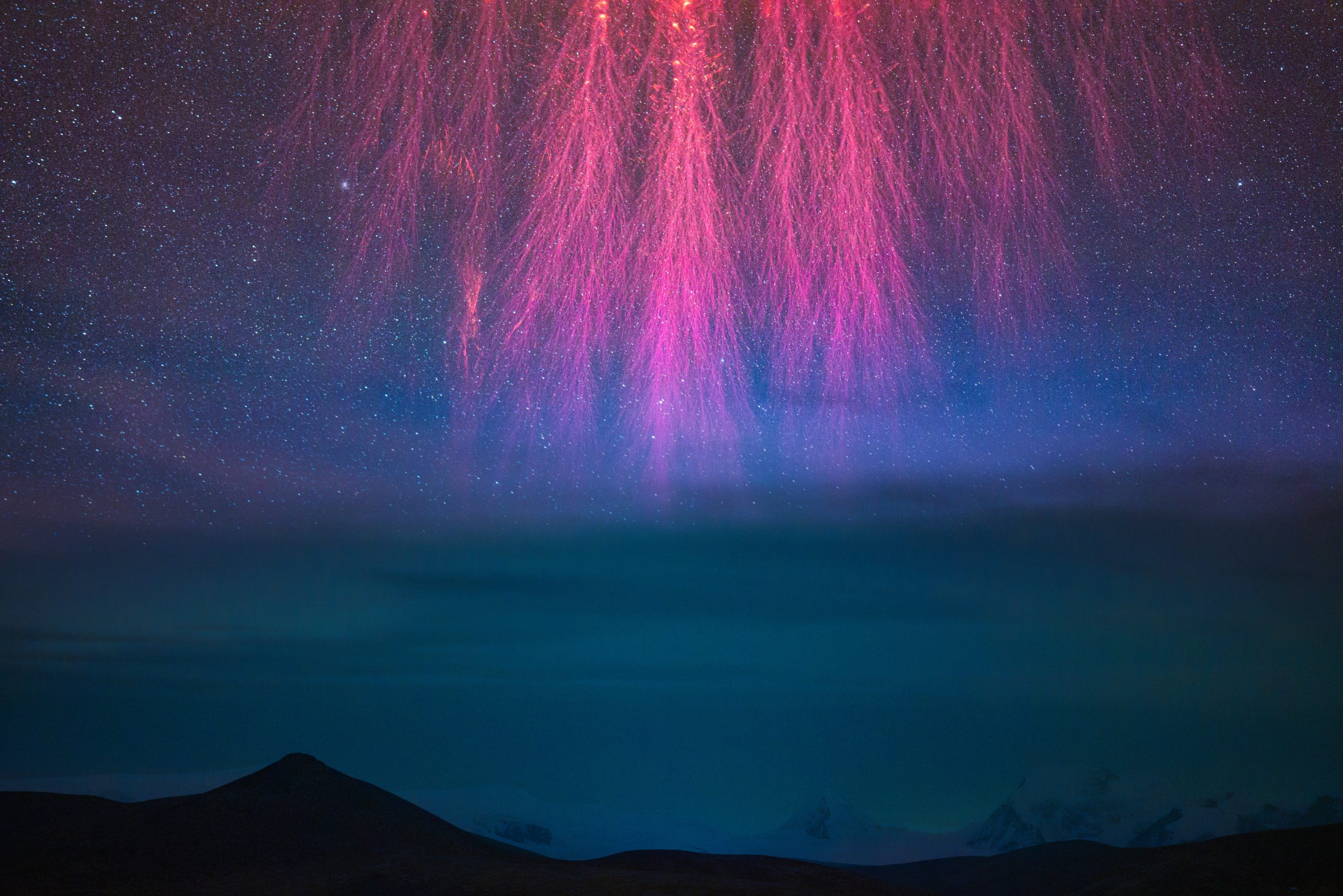
Over 100 red sprites were captured above the Himalayas in 2022. A study linked them to strong lightning strikes in a large thunderstorm system and introduced a new timing method for analysis.
Have you ever heard of or seen red lightning? These are not animated characters, but real atmospheric phenomena called electrical discharges that occur high above thunderstorms. Scientists refer to them as “red sprites,” named for their jellyfish-like shape and vivid red flashes. Now, imagine witnessing these mesmerizing displays above the world’s highest mountain range: the Himalayas.
On the night of May 19, 2022, two Chinese astrophotographers, Angel An and Shuchang Dong, captured a spectacular display of more than one hundred red sprites over the Himalayas. The observation site was located on the southern Tibetan Plateau near Pumoyongcuo Lake, one of the region’s three sacred lakes. What they recorded was a breathtaking celestial event. Among the phenomena captured were dancing sprites, rare secondary jets, and the first-ever recorded instance in Asia of green airglow at the base of the nighttime ionosphere, known as “ghost sprites.” This extraordinary event gained international attention and was widely reported by major media outlets.
Scientific Investigation into the Sprites
A recent study published in Advances in Atmospheric Sciences by Professor Gaopeng Lu and his team at the University of Science and Technology of China sheds light on the driving force behind this grand “sprite fireworks”—lightning and thunderstorms.
Massive outbreak of red Sprites in South Asia observed from the Tibetan Plateau. Credit: Angel An and Shuchang Dong
“This event was truly remarkable,” said Professor Gaopeng Lu. “By analyzing the parent lightning discharges, we discovered that the sprites were triggered by high-peak current positive cloud-to-ground lightning strikes within a massive mesoscale convective system. This suggests that thunderstorms in the Himalayan region have the potential to produce some of the most complex and intense upper-atmospheric electrical discharges on Earth.”
Innovative Timing Method for Analysis
Lacking precise timestamps for detailed analysis, the research team developed an innovative method to synchronize video time using satellite trajectories and star field analysis. This innovative approach allowed them to determine the exact occurrence times of the sprites and link them to their parent lightning discharges. One of the anonymous reviewers praised the technique, highlighting its potential as a reliable timing tool for citizen scientists contributing to scientific observations.
The study revealed that the parent lightning discharges occurred within stratiform precipitation regions of a mesoscale convective complex stretching from the Ganges Plain to the southern foothills of the Tibetan Plateau. This event recorded the highest number of sprites during a single thunderstorm in South Asia, suggesting that thunderstorms in this region possess upper-atmospheric discharge capabilities comparable to those in the U.S. Great Plains and offshore European storms. Moreover, the findings indicate that these storms may generate even more complex discharge structures, potentially influencing atmospheric coupling processes with significant physical and chemical effects.
Reference: “Massive Outbreak of Red Sprites in South Asia Observed from the Tibetan Plateau” by Hailiang Huang, Gaopeng Lu, Angel An, Di Xu, Zhengwei Cheng, Yongping Wang, Yazhou Chen and Xin Huang, 17 March 2025, Advances in Atmospheric Sciences.
DOI: 10.1007/s00376-024-4143-5
Never miss a breakthrough: Join the SciTechDaily newsletter.
Follow us on Google and Google News.
1 Comment
Note 2504291219_Source1. Analyzing【
1-1.
More than 100 red Sprite were spotted over the Himalayas in 2022. One study believed that the red Sprite was associated with strong lightning strikes in large-scale thunderstorm systems, and introduced a new timing method to analyze them.
_[3, 3-1, 3-2] One of the amazing things about natural phenomena on Earth is the Sprite thunderstorm of the Himalayan Red Fairy. Of course, on other planets, more than 10 billion Sprite flash instantaneously, which is a common phenomenon that transforms the natural environment into a whole body. To put it more extreme, the vixx.neutron_stars supernova explosion would be a kind of Sprite, nqvixer.qms.electromagnetism_energy. Huh.
You can set up my f(*)qlinear.qvix.qms domain function to describe these sights.
Why does the atmosphere of planets, cosmic_ray, and lightning bundles of black holes occur in space? This is likely due to the sequential separation of msbase.qpeoms multidimensional>4d>3d>2d, similar to a multi-layered moire pattern.
In any case, an analysis of this Sprite suggests that in terms of parent lightning discharge, a high-peak current cloud within a large medium-scale convection system has an upper atmospheric discharge capacity similar to that of the American Great Plains and European coastal thunderstorms with high or extensive ground in the Himalayas.
Furthermore, in a low, narrow area close to the atmosphere, the number of Sprite will be as small as that. Some will unite into one or two and appear as large lightning strikes.
≈≈≈===========
Source 1.
https://scitechdaily.com/scientists-unveil-secrets-of-mysterious-red-sprite-lightning-strikes-over-the-worlds-highest-mountain-range/
1.
Scientists have discovered the secret of the mysterious “red Sprite” lightning that falls over the world’s highest mountain range.
Titled “Cosmic Fireworks,” the photo won the Sky Landscape category at the 2023 Astronomical Photographer of the Year competition hosted by the Royal Observatory of Greenwich.
Not only does this breathtakingly beautiful photograph show the awe-inspiring beauty of Sprite emission, but it also sparks public interest in extreme weather events and their scientific significance.
2.
Have you ever heard of or seen red lightning? It is not an animated character, but a real atmospheric phenomenon called an electric discharge over a thunderstorm. Scientists call it the “red fairy” because of its jellyfish-like shape and vivid red flashes. So, let’s imagine witnessing this fascinating spectacle over the Himalayas, the world’s highest mountain range.
2-1.
On the night of May 19, 2022, Chinese astrophotographer Angel An and Xu Chang-dong captured spectacular sight of more than a hundred red Sprite over the Himalayas. The observation site was located in the south of the Tibetan Plateau, near Lake Fumoyongchuo, one of the three major holy lakes in the region.
What they captured was a breathtakingly beautiful celestial phenomenon. Among the phenomena captured were a dancing Sprite, a rare secondary jet, and Asia’s first observation of a green atmospheric light known as a “ghost Sprite” on the floor of the ionosphere at night. This surprising phenomenon has received international attention and has been widely reported by major media outlets.
2-2. Scientific investigation into Sprite
A recent study by Professor Lu Kaofeng and his team at the Chinese University of Science and Technology in Atmospheric Science Development revealed information about lightning and thunderstorms, the driving force behind this huge ‘Sprite fireworks’.
3.
Red Sprite Mass in South Asia Observed in Tibetan Plateau
This incident is truly remarkable. [Analysis of the mother lightning discharge] found that the Sprite was caused by a high-peak current positive cloud-ground lightning bolt within a massive medium-scale convection system. This suggests that thunderstorms in the Himalayan region have the potential to produce some of the most complex and intense upper atmospheric discharges on Earth.
3-1. Innovative Timing Method for Analysis
The research team, which lacked accurate timestamps for detailed analysis, developed an innovative method to synchronize image time using satellite trajectories and villa analysis. This innovative approach allowed us to determine the exact time of occurrence of a Sprite and link it to the parent lightning discharge.
One of the anonymous judges praised the technology, highlighting its potential as a reliable timing tool for citizen scientists who contribute to scientific observations.
3-2.
The study revealed that the Monak Loe discharge occurred in a stratified precipitation region of a medium-scale convection complex extending from the Ganges Plain to the southern foothills of the Tibetan Plateau. The event recorded the most Sprite of any single thunderstorm in South Asia, suggesting that the region’s thunderstorms have an upper atmospheric discharge capacity similar to those in the U.S. Great Plains and offshore European thunderstorms. Furthermore,
[These thunderstorms produce a much more complex discharge structure, suggesting that they can have significant physical and chemical effects on the atmospheric coupling process].