
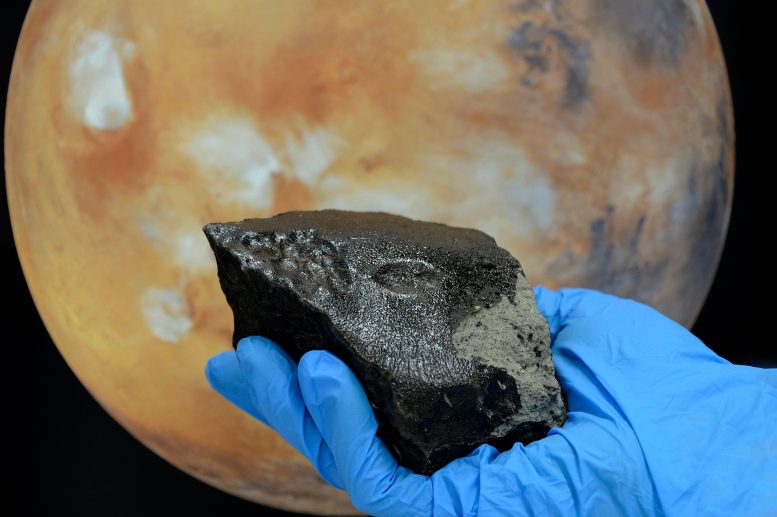
Tissint, a Martian meteorite that plummeted to Earth and crash-landed in Morocco over 11 years ago, is one of only five such meteorites that have been observed during their descent to our planet.
An international team of researchers, led by Philippe Schmitt-Kopplin from the Technical University of Munich and Helmholtz Munich and including Andrew Steele from Carnegie, has discovered a vast diversity of organic compounds in the Martian meteorite Tissint. Their findings have recently been published in the journal Science Advances.
Tissint, a Martian meteorite that impacted Earth over 11 years ago and crash-landed in Morocco, is one of only five such meteorites that have been observed while falling to our planet. Fragments of it were located scattered in the desert, about 30 miles (50 kilometers) from the town for which it is named.
This sample of Martian rock was formed hundreds of millions of years ago on our next-door planetary neighbor and was launched into space by a violent event. Unraveling the origin stories of the Tissint meteorite’s organic compounds can help scientists understand whether the Red Planet ever hosted life, as well as Earth’s geologic history.
Parallel Evolutionary Journeys
“Mars and Earth share many aspects of their evolution,” said lead author Schmitt-Kopplin. “And while life arose and thrived on our home planet, the question of whether it ever existed on Mars is a very hot research topic that requires deeper knowledge of our neighboring planet’s water, organic molecules, and reactive surfaces.”
Organic molecules contain carbon, hydrogen, oxygen, nitrogen, sulfur, and sometimes other elements. Organic compounds are commonly associated with life, although previous Martian meteorite research demonstrated that they can be created by non-biological processes, referred to as abiotic organic chemistry.
“Understanding the processes and sequence of events that shaped this rich organic bounty will reveal new details about Mars’ habitability and potentially about the reactions that could lead to the formation of life,” added Steele, who has done extensive research on organic material in Martian meteorites, including Tissint, and is a member of both the Perseverance and Curiosity rovers’ science teams.
Comprehensive Analysis of Tissint’s Organic Diversity
The researchers were able to thoroughly analyze the meteorite’s organic inventory, revealing a link between the type and diversity of organic molecules and specific mineralogy. Their efforts resulted in the most comprehensive catalog ever made of the diversity of organic compounds found in a Martian meteorite or in a sample collected and analyzed by a rover. This work uncovered details about how the processes occurring in Mars’ mantle and crust evolved, especially with regard to abiotic organics that formed from water-rock interactions.
Of particular interest was the abundance of organic magnesium compounds, a suite of organic molecules not previously seen on Mars, which offer new insights about the high-pressure, high-temperature geochemistry that shaped the Red Planet’s deep interior and indicate a connection between its carbon cycle and its mineral evolution.
The researchers say that samples returned from Mars by future missions should provide an unprecedented amount of information about the formation, stability, and dynamics of organic compounds in real Martian environments.
Reference: “Complex carbonaceous matter in Tissint martian meteorites give insights into the diversity of organic geochemistry on Mars” by Philippe Schmitt-Kopplin, Marco Matzka, Alexander Ruf, Benedicte Menez, Hasnaa Chennaoui Aoudjehane, Mourad Harir, Marianna Lucio, Jasmine Hertzog, Norbert Hertkorn, Régis D. Gougeon, Victor Hoffmann, Nancy W. Hinman, Ludovic Ferrière, Ansgar Greshake, Zelimir Gabelica, László Trif and Andrew Steele, 11 January 2023, Science Advances.
DOI: 10.1126/sciadv.add6439
The study was funded by the German Research Foundation.
Never miss a breakthrough: Join the SciTechDaily newsletter.
Follow us on Google and Google News.
5 Comments
I’m not abundant C3-7 aliphatic branched carboxylic acids and aldehydes, olefins, and polyaromatics with and without heteroatoms in a homologous oxidation structural continuum, you’re abundant C3-7 aliphatic branched carboxylic acids and aldehydes, olefins, and polyaromatics with and without heteroatoms in a homologous oxidation structural continuum.
Is this site which I have not again used search on again asking for search feedback at the top of the visible page as a nuisance? It is a nuisance.
If pieces of the surface rocks on Mars were delivered to Earth (and remarkably didn’t miss)… and contain a large variety of organic molecules this should be a good indication that they are NOT from Mars. To date, no such organic molecules have been found by any rover. But carbonaceous chondrites have landed on Earth with similar amino acids.
Hello, I found a rare meteorite that scientists need this type. If you need, contact my email
Hello, I found a rare meteorite that scientists need this type. If you need, contact my ema