
Close Menu
    Facebook X (Twitter) Instagram
    SciTechDaily
    • Biology
    • Chemistry
    • Earth
    • Health
    • Physics
    • Science
    • Space
    • Technology
    Facebook X (Twitter) Pinterest YouTube RSS
    SciTechDaily
    Home»Science»Scientists Explore How Fire Ants’ Raft Building Skills React As Fluid Forces Change
    Science

    Scientists Explore How Fire Ants’ Raft Building Skills React As Fluid Forces Change

    By American Physical SocietyDecember 8, 2019No Comments2 Mins Read
    Facebook Twitter Pinterest Telegram LinkedIn WhatsApp Email Reddit
    Share
    Facebook Twitter LinkedIn Pinterest Telegram Email Reddit
    Fire Ants Raft Building Skills
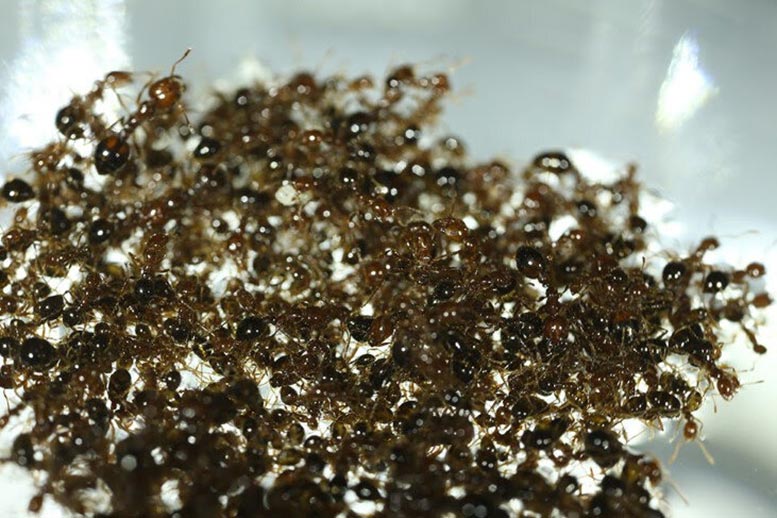
    Spinning fire ant raft. Credit: Hungtang Ko

    How Fire Ants Build Rafts to Adapt in a Very Wet Environment

    Fire ants build living rafts to survive floods and rainy seasons. Georgia Tech scientists are studying if a fire ant colony’s ability to respond to changes in their environment during a flood is an instinctual behavior and how fluid forces make them respond.

    Hungtang Ko and David Hu presented the science behind this insect behavior, focusing their discussion on how the living raft changes size under various environmental conditions at the American Physical Society’s Division of Fluid Dynamics 72nd Annual Meeting on November 26, 2019.

    The red imported fire ant (Solenopsis invicta) can optimize its ability to repel water by linking its body together with tens of thousands of its peers to build massive floating colonies.

    “We think the response is an active process. Fire ants are able to sense the change in force when different fluid conditions are applied,” Ko said.

    The researchers found different fluid behaviors, such as vortexes, could change the size of the fire ant raft in several ways. They discovered rotation of water can inhibit exploratory behaviors of individual fire ants, while centrifugal motion does not influence the colony.

    “Our current hypothesis is that they explore less, because they need to form a stronger bond with their neighbors. We are still working on testing the hypothesis,” Ko said. “We think the independent response in individuals is enough in leading to the system-level deformation that we observe.”

    Stronger physical bonds between individual fire ants lead to durable and safer rafts. The individual ant’s ability to respond to environmental changes is crucial to the sustainability of their raft and the survival of the colony.

    The session, “Shrinking spinning fire ant rafts,” was presented as part of a session on biological fluid dynamics and collective behavior.

    Never miss a breakthrough: Join the SciTechDaily newsletter.
    Follow us on Google and Google News.

    American Physical Society Biomechanics Biophysics Fluid Dynamics
    Share. Facebook Twitter Pinterest LinkedIn Email Reddit

    Related Articles

    Knotty by Nature: Blackworms and the Secrets of Rapid Untangling

    Mathematicians Solve a Knotty Mystery: How To Untangle a Worm Ball

    Moisture Farming: Harvesting Fog Can Provide Fresh Water in Desert Regions

    Researchers Use Wind-Tunnel Experiments to Uncover the Secret to Sneaky Float Serves

    Researchers Take a Series of First-Time Measurements of Turbulent Mixing

    Ocean Eddies Are Mathematically Equivalent to Black Holes

    The Benefits of Backward Running

    Researchers Create 30-Minute Video Demonstrating Fluid Dynamics

    How Mosquitoes Manage to Fly in the Rain

    Leave A Reply Cancel Reply

    • Facebook
    • Twitter
    • Pinterest
    • YouTube

    Don't Miss a Discovery

    Subscribe for the Latest in Science & Tech!

    Trending News

    Giant Crocodylians Ruled South America’s Ancient Food Chain

    Breakthrough in a Bizarre Galaxy Could Help Unlock the Mystery of Dark Matter

    Just 4 Minutes of Daily Strength Training Can Quadruple Fitness in Older Adults

    Almost All Plant-Based Meat Alternatives Contain Mycotoxins, Study Finds

    Astronomers Detect a Record-Breaking “Cosmic Laser” From 8 Billion Light-Years Away

    A 47-Year-Old Scientist Tracked Himself for Months – His Biological Age Fell to 32

    Construction Crew Uncovers Giant 20-Meter Dinosaur in Brazil

    30 Years of Hurricane Data Reveal 4 Warning Signs Before Storms Strengthen

    Follow SciTechDaily
    • Facebook
    • Twitter
    • YouTube
    • Pinterest
    • Newsletter
    • RSS
    SciTech News
    • Biology News
    • Chemistry News
    • Earth News
    • Health News
    • Physics News
    • Science News
    • Space News
    • Technology News
    Recent Posts
    • Scientists Find a Clue to Making Brain Stimulation More Reliable
    • A Hidden Gut Reaction May Explain Why Vegetables Are So Good for You
    • New “Invisible” Cell Therapy Could Provide Side-Effect-Free Diabetes Treatment
    • Researchers Solve Two Major Problems Holding Back SiC Electronics
    • Physicists Hunted a Mysterious Particle – and Found Two Unexpected Structures Instead
    Copyright © 1998 - 2026 SciTechDaily. All Rights Reserved.
    • Science News
    • About
    • Contact
    • Editorial Board
    • Privacy Policy
    • Terms of Use

    Type above and press Enter to search. Press Esc to cancel.