
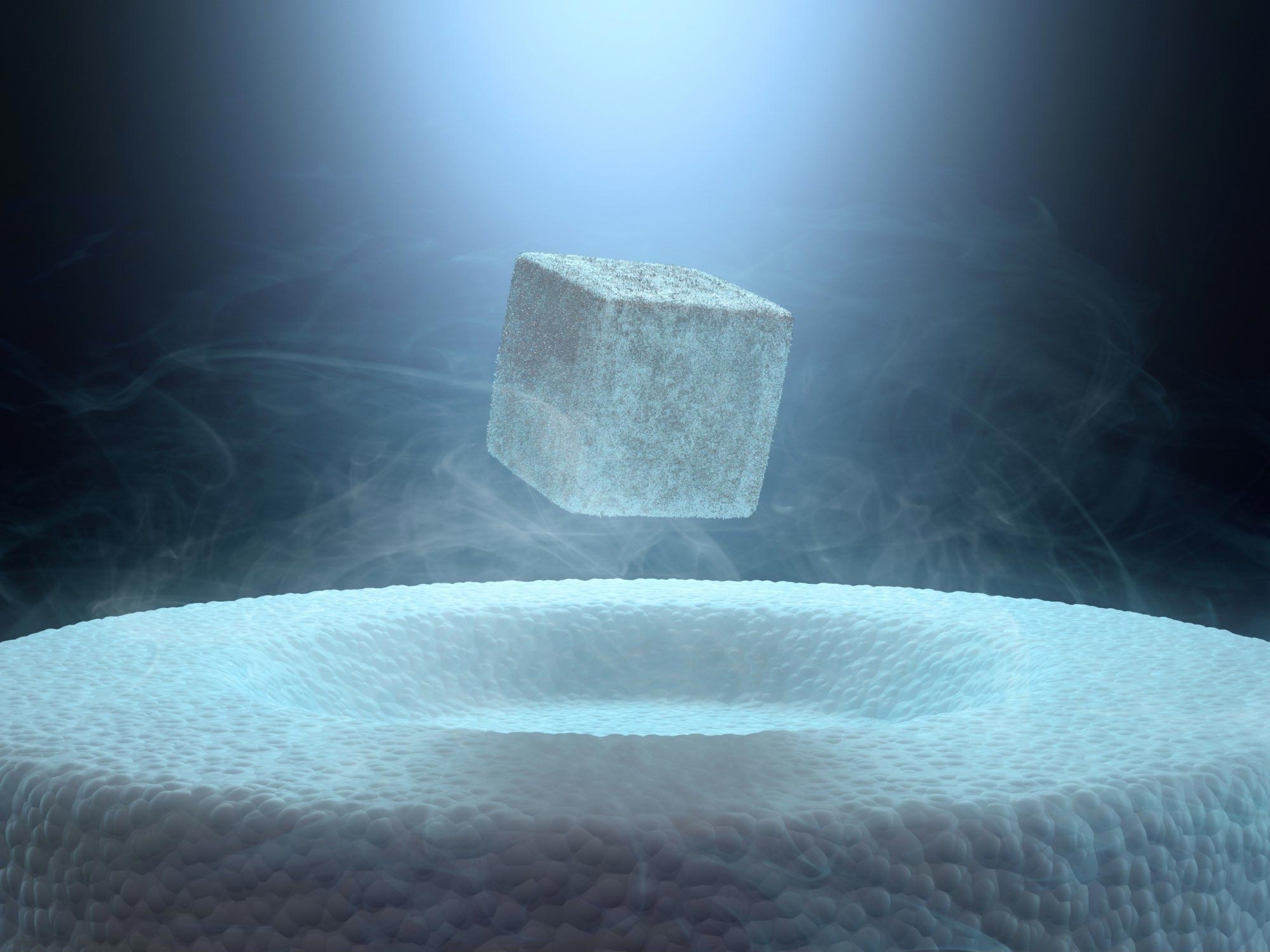
High-pressure electron tunneling spectroscopy reveals the presence of a superconducting gap in H₃S and D₃S.
Superconductors are special materials that allow electricity to flow without any resistance, making them essential for advanced technologies such as power transmission, energy storage, magnetic levitation, and quantum computing.
Until recently, this remarkable behavior was only observed at extremely low temperatures, far below what we experience in daily life. That changed with the discovery of superconductivity in hydrogen-rich compounds like hydrogen sulfide (H3S), which becomes superconductive at 203 Kelvin (-70 °C), and lanthanum decahydride (LaH10), which becomes superconductive at 250 Kelvin (-23 °C).
These findings represented a major step toward realizing superconductivity at or near room temperature. Because these materials operate at temperatures far above the boiling point of liquid nitrogen, they are often classified as high temperature superconductors.
At the heart of this phenomenon is the superconducting gap, a crucial feature that reveals how electrons pair together to create the superconducting state. Identifying this gap allows scientists to distinguish superconductors from ordinary metals.
However, studying this gap in hydrogen-rich compounds such as H3S has proven to be a significant challenge. These materials can only be created in situ under immense pressures, over a million times greater than atmospheric pressure, which makes traditional measurement techniques like scanning tunneling spectroscopy and angle-resolved photoemission spectroscopy impossible to use.
Tunneling technique provides direct insight into the superconducting state of hydrogen-rich compounds
To overcome this barrier, researchers at the Max Planck Institute in Mainz developed a planar electron tunneling spectroscopy capable of operating under such extreme conditions. This achievement has enabled them to probe the superconducting gap in H3S for the first time, offering direct insight into the superconducting state of hydrogen-rich compounds.
Using this technique, the researchers discovered that H3S exhibits a fully open superconducting gap with a value of approximately 60 millielectronvolt (meV), while its deuterium analog, D3S, shows a gap of about 44 meV. Deuterium is a hydrogen isotope and has one more neutron. The fact that the gap in D3S is smaller than in H3S confirms that the interaction of electrons with phonons – quantized vibrations of the atomic lattice of a material – causes the superconducting mechanism of H3S, supporting long-standing theoretical predictions.
For the Mainz researchers, this breakthrough is not just a technical achievement – it also lays the foundation for fully unraveling the origin of high-temperature superconductivity in hydrogen-rich materials. “We hope that by extending this tunneling technique to other hydride superconductors, the key factors that enable superconductivity at even higher temperatures can be pinpointed. This should ultimately enable the development of new materials that can operate under more practical conditions,” states Dr. Feng Du, first author of the now-published study.
Dr. Mikhail Eremets, a pioneer in the field of high-pressure superconductivity who passed away in November 2024, described the study as “the most important work in the field of hydride superconductivity since the discovery of superconductivity in H3S in 2015.” Vasily Minkov, project leader of High-Pressure Chemistry and Physics at the Max Planck Institute for Chemistry commented: “Mikhail’s vision of superconductors operating at room temperature and moderate pressures comes a step closer to reality through this work.”
About Superconductivity
Superconductivity is a remarkable property of materials to conduct electrical current without resistance. Discovered in pure mercury by Heike Kamerlingh Onnes in 1911, this phenomenon was long believed to exist at extremely low temperatures, close to absolute zero (–273 °C). That paradigm shifted in the late 1980s when Georg Bednorz and Karl Alexander Müller discovered a new family of cupper-oxide (cuprate) superconductors that exhibited high-temperature superconductivity under atmospheric pressure.
A wave of global research followed, eventually reaching a critical temperature (Tc), the temperature at which a material loses its resistance, of approximately 133 K at ambient pressure and 164 K under high pressure. However, no superconductor with a higher Tc had been discovered – until the advent of hydrogen-rich compounds.
The discovery of superconductivity in H3S at megabar pressures, with a Tc = 203 K by the research group led by Dr. Mikhail Eremets, thus marked a revolutionary advance towards achieving superconductivity near room temperature. This breakthrough was soon followed by discoveries of even higher Tc values in hydrogen-rich metal hydrides, such as YH9 (Tc ≈ 244 K) und LaH10 (Tc ≈ 250 K). Theoretical models now predict superconductivity above room temperature in several hydrogen-dominated systems under extreme pressures.
About Cooper pairs and Superconducting gap
In ordinary metals, electrons with energy states near the Fermi level can flow freely. The Fermi level corresponds to the highest energy level that electrons can occupy in a solid at absolute zero. However, when a material becomes superconducting, electrons form so-called Cooper pairs, entering a collective quantum state.
As a highly correlated state, the Cooper pair of electrons moves like a single entity without scattering with phonons or impurities in the crystal structure of the material and therefore has no resistance. This pairing is characterized by an energy gap near the Fermi level – the superconducting gap – which is the minimum energy needed to break a Cooper pair of electrons. The existence of the gap protects the superconducting state from disturbances like scattering.
The superconducting gap is the defining feature of a superconductor’s quantum state. Its value and symmetry offer critical insights into how electrons interact and pair, serving as a fingerprint of the superconducting mechanism.
Reference: “Superconducting gap of H3S measured by tunnelling spectroscopy” by Feng Du, Alexander P. Drozdov, Vasily S. Minkov, Fedor F. Balakirev, Panpan Kong, G. Alexander Smith, Jiafeng Yan, Bin Shen, Philipp Gegenwart and Mikhail I. Eremets, 23 April 2025, Nature.
DOI: 10.1038/s41586-025-08895-2
Never miss a breakthrough: Join the SciTechDaily newsletter.
Follow us on Google and Google News.
7 Comments
The superconducting gap is the defining feature of a superconductor’s quantum state. Its value and symmetry offer critical insights into how electrons interact and pair, serving as a fingerprint of the superconducting mechanism.
VERY GOOD!
Please ask researchers to think deeply:
How do you understand the symmetry of a superconducting gap?
Based on the Topological Vortex Theory (TVT), the Möbius structures of topological vortex rings bring infinite possibilities for energy formation and transfer.
Based on the Topological Vortex Theory (TVT), parity has global properties, and asymmetry is one local manifestation of global parity conservation. We should have a correct understanding for the symmetry of the Möbius structures.
When we pursue the ultimate truth of all things, the space in which our bodies and all things exist may itself be the final and deepest puzzle we need to explore. This is not only the pursuit of physics, but also the most magnificent exploration of the origin of the universe by human reason.
Based on the Topological Vortex Theory (TVT), space is an uniformly incompressible physical entity. Space-time vortices are the products of topological phase transitions of the tipping points in space, are the point defects in spacetime. Point defects do not only impact the thermodynamic properties, but are also central to kinetic processes. They create all things and shape the world through spin and self-organization.
In today’s physics, some so-called peer-reviewed journals—including Physical Review Letters, Nature, Science, and others—stubbornly insist on and promote the following:
1. Even though θ and τ particles exhibit differences in experiments, physics can claim they are the same particle. This is science.
2. Even though topological vortices and antivortices have identical structures and opposite rotational directions, physics can define their structures and directions as entirely different. This is science.
3. Even though two sets of cobalt-60 rotate in opposite directions and experiments reveal asymmetry, physics can still define them as mirror images of each other. This is science.
4. Even though vortex structures are ubiquitous—from cosmic accretion disks to particle spins—physics must insist that vortex structures do not exist and require verification. Only the particles that like God, Demonic, or Angelic are the most fundamental structures of the universe. This is science.
5. Even though everything occupies space and maintains its existence in time, physics must still debate and insist on whether space exists and whether time is a figment of the human mind. This is science.
6. Even though space, with its non-stick, incompressible, and isotropic characteristics, provides a solid foundation for the development of physics, physics must still insist that the ideal fluid properties of space do not exist. This is science.
and go on.
Is this the counterintuitive science they widely promote? Compromising with pseudo academic publications and peer review by pseudo scholars is an insult to science and public intelligence. Some so-called scholars no longer understand what shame is. The study of Topological Vortex Theory (TVT) reminds us that the most profound problems in physics often lie at the intersection of different theories. By exploring these border regions, we can not only resolve contradictions in existing theories but also discover new physical phenomena and application possibilities.
Under the topological vortex architecture, it is highly challenging for even two hydrogen atoms or two quarks to be perfectly symmetrical, let alone counter-rotating two sets of cobalt-60. Contemporary physics and so-called peer-reviewed publications (including Physical Review Letters, Science, Nature, etc.) stubbornly believe that two sets of counter rotating cobalt-60 are two mirror images of each other, constructing a more shocking pseudoscientific theoretical framework in the history of science than the “geocentric model”. This pseudo scientific framework and system have seriously hindered scientific progress and social development.
For nearly a century, physics has been manipulated by this pseudo scientific theoretical system and the interest groups behind it, wasting a lot of manpower, funds, and time. A large amount of pseudo scientific research has been conducted, and countless pseudo scientific papers have been published, causing serious negative impacts on scientific and social progress, as well as humanistic development.
Complexity does not necessarily mean that there is no logical and architectural framework to follow. Mathematics is the language and tool that reveals the motion of spacetime, rather than the motion itself. Although the physical form of spacetime vortices is extremely simple, their interaction patterns are highly complex, and we must develop more and richer mathematical languages to describe and understand them.
The development of the Topological Vortex Theory (TVT) reflects a progression from concrete physical phenomena to abstract mathematical modeling and, ultimately, to interdisciplinary unification.
——Excerpted from https://t.pineal.cn/blogs/4569/An-Overview-of-the-Development-of-Topological-Vortex-Theory-TVT.
Incommensurability is a core concept introduced by American philosophers of science Thomas Kuhn and Paul Feyerabend to describe the incomparability between successive paradigms during scientific revolutions. This theory emphasizes the fundamental differences between paradigms in their linguistic systems, taxonomic categories, and value judgments, which prevent them from being directly compared or translated through a common standard. In his work The Structure of Scientific Revolutions, Kuhn used this concept alongside “paradigm” to construct a discontinuous model of scientific development.
Incommensurability is a core concept introduced by American philosophers of science Thomas Kuhn and Paul Feyerabend to describe the incomparability between successive paradigms during scientific revolutions. This theory emphasizes the fundamental differences between paradigms in their linguistic systems, taxonomic categories, and value judgments, which prevent them from being directly compared or translated through a common standard. In his work The Structure of Scientific Revolutions, Kuhn used this concept alongside “paradigm” to construct a discontinuous model of scientific development.
my best guess is to study the atom at the state of being boiled. right at the state of becoming liquid to gasseus state