
Scientists have uncovered hidden magnetic order inside the pseudogap, bringing us closer to engineering high-temperature superconductors.
Physicists have identified a connection between magnetism and an unusual state of matter known as the pseudogap. This phase appears in some quantum materials at temperatures just above where they become superconductors. The discovery may help scientists design new materials with valuable properties, including high-temperature superconductivity, where electrical current moves with no resistance.
To uncover this link, researchers used a quantum simulator cooled to temperatures barely above absolute zero. They observed a consistent pattern in how electrons affect the magnetic orientation of nearby electrons as the system cools. Since electrons can have spin up or down, these interactions shape the material’s magnetic behavior. The work marks an important advance in understanding unconventional superconductivity and involved close collaboration between experimental physicists at the Max Planck Institute of Quantum Optics in Germany and theorists, including Antoine Georges, director of the Center for Computational Quantum Physics (CCQ) at the Simons Foundation’s Flatiron Institute in New York City.
The team published its findings during the week of January 19 in the Proceedings of the National Academy of Sciences.
Why the Pseudogap Matters
Superconductivity has been studied for decades because of its potential to transform technologies ranging from power grids to quantum computers. Despite that effort, scientists still do not fully understand how superconductivity arises, especially in materials that operate at relatively high temperatures.
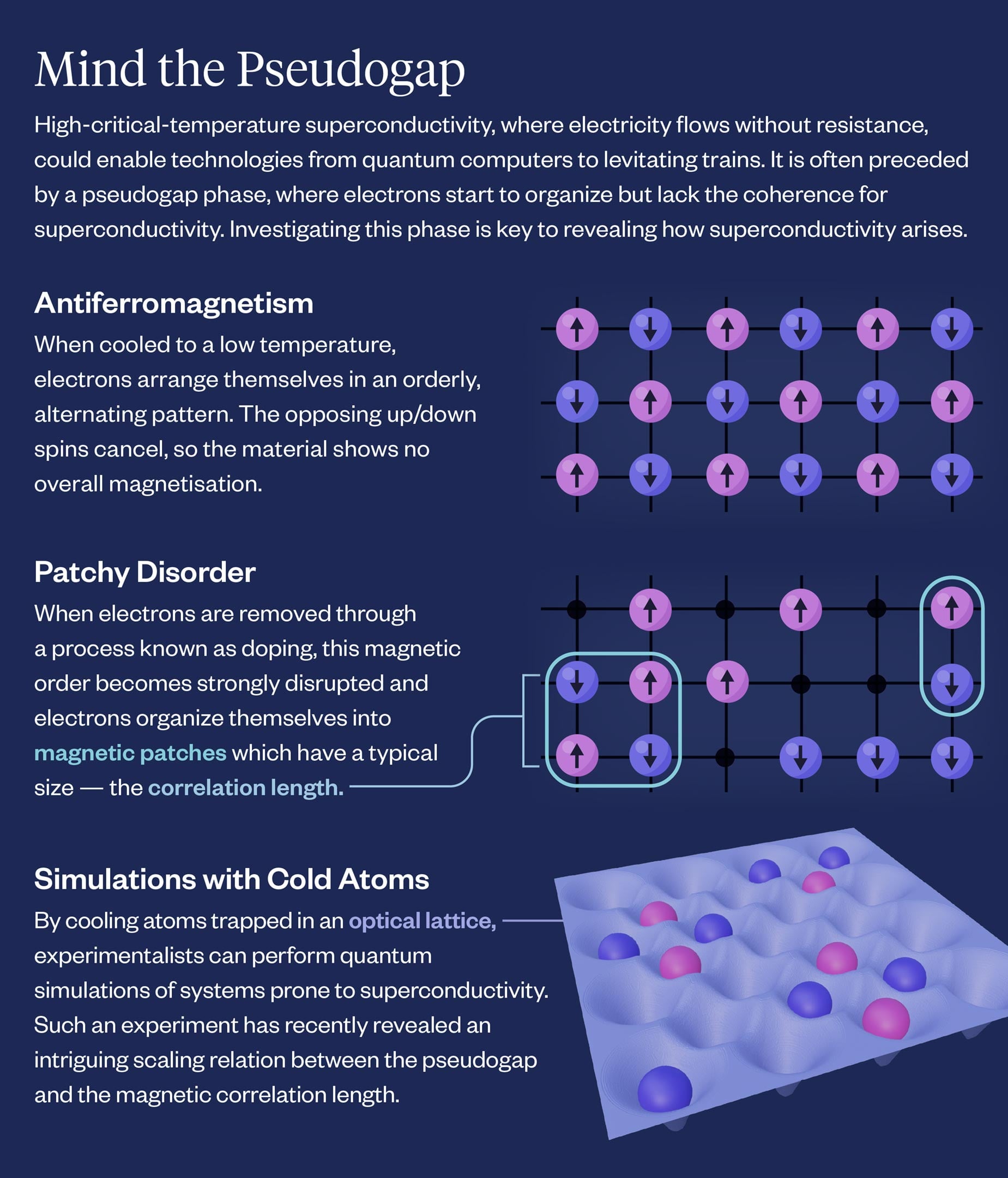
In many high-temperature superconductors, the superconducting phase does not emerge directly from a typical metallic state. Instead, the material first enters the pseudogap phase. During this stage, electrons behave in unexpected ways, and the number of available states for electrical flow decreases. Researchers widely believe that understanding the pseudogap is essential for explaining how superconductivity forms and for developing materials with better performance.
Magnetism Under Disruption
When a material contains the usual number of electrons, those electrons tend to form a neat magnetic arrangement called antiferromagnetism. In this pattern, neighboring electron spins point in opposite directions, similar to a perfectly coordinated left right sequence.
That order is disrupted when electrons are removed through a process called doping. For many years, scientists assumed that doping completely eliminated long-range magnetic order. The new PNAS study challenges that assumption. At extremely low temperatures, the researchers found that a subtle form of organization persists, even though the system appears disordered. This experimental work was guided by earlier theoretical research on the pseudogap carried out at the CCQ, which led to a 2024 paper in Science.
From Chaos to Universal Order
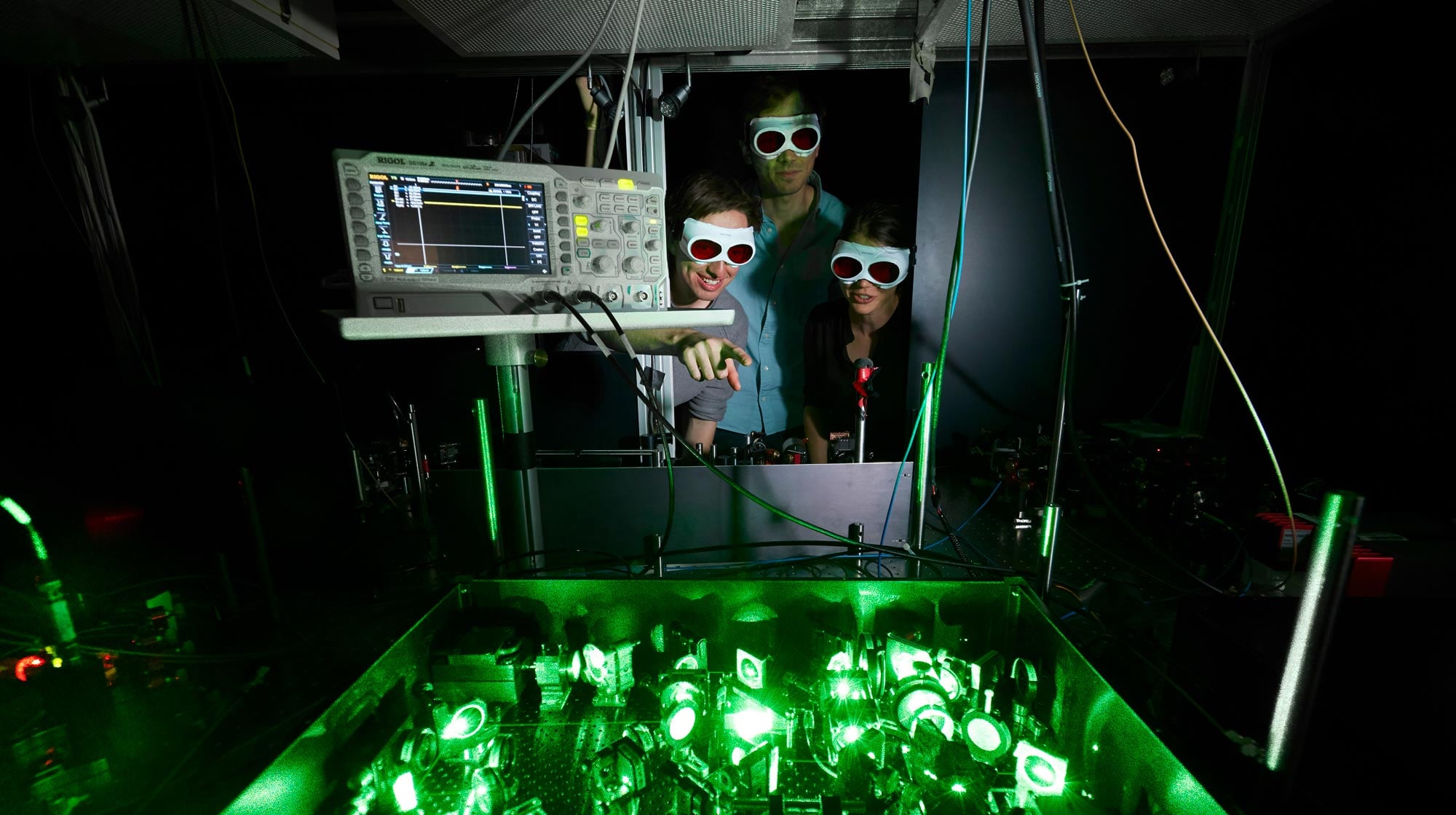
To explore these effects, the team relied on the Fermi-Hubbard model, a widely used theoretical description of how electrons interact inside solids. Instead of studying real materials, the researchers recreated the model using lithium atoms cooled to billionths of a degree above absolute zero. These atoms were held in a precisely controlled optical lattice formed by laser light.
Ultracold atom quantum simulators allow scientists to reproduce complex material behavior under conditions that cannot be achieved in conventional solid-state experiments. Using a quantum gas microscope, which can image individual atoms and detect their magnetic orientation, the team collected more than 35,000 detailed images. These snapshots captured both atomic positions and magnetic correlations across many temperatures and doping levels.
“It is remarkable that quantum analog simulators based on ultracold atoms can now be cooled down to temperatures where intricate quantum collective phenomena show up,” says Georges.
A Universal Magnetic Signature
The researchers observed a striking result. “Magnetic correlations follow a single universal pattern when plotted against a specific temperature scale,” explains lead author Thomas Chalopin of the Max Planck Institute of Quantum Optics. “And this scale is comparable to the pseudogap temperature, the point at which the pseudogap emerges.” This finding shows that the pseudogap is closely tied to subtle magnetic structures hidden beneath what looks like randomness.
The study also revealed that electrons in this regime interact in more complex ways than previously thought. Rather than forming simple pairs, they organize into larger, multiparticle correlated groups. The presence of even one dopant can disturb magnetic order across a surprisingly wide region. Unlike earlier experiments that measured interactions between two electrons at a time, this work captured correlations involving up to five particles simultaneously, a level of detail reached by only a few laboratories worldwide.
Revealing Hidden Correlations
For theorists, the results offer a new standard for testing models of the pseudogap. More broadly, the findings move scientists closer to understanding how high-temperature superconductivity arises from the collective motion of interacting, dancing electrons. “By revealing the hidden magnetic order in the pseudogap, we are uncovering one of the mechanisms that may ultimately be related to superconductivity,” Chalopin explains.
The research also underscores the value of tight coordination between theory and experiment. By pairing detailed predictions with carefully controlled quantum simulations, the team was able to uncover patterns that would otherwise remain invisible.
This international collaboration combined experimental precision with theoretical insight. Future experiments aim to cool the system even further, search for additional forms of order, and develop new ways to observe quantum matter from fresh perspectives.
“Analog quantum simulations are entering a new and exciting stage, which challenges the classical algorithms that we develop at CCQ,” says Georges. “At the same time, those experiments require guidance from theory and classical simulations. Collaboration between theorists and experimentalists is more important than ever.”
Reference: “Observation of emergent scaling of spin–charge correlations at the onset of the pseudogap” by Thomas Chalopin, Petar Bojović, Si Wang, Titus Franz, Aritra Sinha, Zhenjiu Wang, Dominik Bourgund, Johannes Obermeyer, Fabian Grusdt, Annabelle Bohrdt, Lode Pollet, Alexander Wietek, Antoine Georges, Timon Hilker and Immanuel Bloch, 23 January 2026, Proceedings of the National Academy of Sciences.
DOI: 10.1073/pnas.2525539123
Never miss a breakthrough: Join the SciTechDaily newsletter.
Follow us on Google and Google News.
4 Comments
Why the Pseudogap Matters From Chaos to Universal Order?
VERY GOOD! VERY GOOD! VERY GOOD!
Please ask researchers to think deeply:
Have you really thought about this question?
Is the Proceedings of the National Academy of Sciences a publication that respects science?
Have you considered the following two examples?
Any so-called evidence tainted by human intervention risks distorting our understanding and cognition of the intrinsic dynamics of natural laws.
—— Excerpted from https://zhuanlan.zhihu.com/p/1996561896279667777.
Example 1: Two sets of cobalt-60 are manually rotated in opposite directions, and even without detection, people around the world know that they will not be symmetrical because these two objects are not mirror images of each other at all. However, a group of so-called physicists and so-called academic publications do not believe it. They conducted experiments and the results were indeed asymmetric, but they still firmly believed that these two objects were mirror images of each other, and the asymmetry was due to a violation of the previous natural laws (CP violation). In the history of science, there can never be a dirtier and uglier operation and explanation than this. These people and the so-called academic publications they manipulate no longer know what shame is.
—— Excerpted from https://scitechdaily.com/what-happens-when-light-gains-extra-dimensions/#comment-947619.
Example 2: Please see how the so-called “mystery of θ – τ” is explained: θ and τ are completely identical in all measurable physical properties such as mass, lifetime, charge, spin, etc. However, experimental observations have shown that the θ meson decays into two π mesons, while the τ meson decays into three π mesons, making it difficult for physicists to explain why they are so similar. Physicist Martin Block proposed a highly challenging idea: θ and τ are the same particle, but in weak interactions, parity is not conserved. An easy to understand explanation is the following analogy:: There are two boxes of apples with identical weight, color, and taste. However, when one box is opened, there are two apples, while when the other box is opened, there are three apples. This confuses the old farmer who buys apples. He circled around the orchard and came up with a highly challenging idea: these two boxes of apples are not from the same tree, so they are the same.
—— Excerpted from https://scitechdaily.com/what-happens-when-light-gains-extra-dimensions/#comment-947686.
When we pursue the ultimate truth of all things, the space in which our bodies and all things exist may itself be the final and deepest puzzle we need to explore. This is not only the pursuit of physics, but also the most magnificent exploration of the origin of the universe by human reason.
Based on the Topological Vortex Theory (TVT), space is an uniformly incompressible physical entity. Space-time vortices are the products of topological phase transitions of the tipping points in space, are the point defects in spacetime. Point defects do not only impact the thermodynamic properties, but are also central to kinetic processes. They create all things and shape the world through spin and self-organization.
In today’s physics, some so-called peer-reviewed journals—including Physical Review Letters, Nature, Science, and others—stubbornly insist on and promote the following:
1. Even though θ and τ particles exhibit differences in experiments, physics can claim they are the same particle. This is science.
2. Even though topological vortices and antivortices have identical structures and opposite rotational directions, physics can define their structures and directions as entirely different. This is science.
3. Even though two sets of cobalt-60 rotate in opposite directions and experiments reveal asymmetry, physics can still define them as mirror images of each other. This is science.
4. Even though vortex structures are ubiquitous—from cosmic accretion disks to particle spins—physics must insist that vortex structures do not exist and require verification. Only the particles that like God, Demonic, or Angelic are the most fundamental structures of the universe. This is science.
5. Even though everything occupies space and maintains its existence in time, physics must still debate and insist on whether space exists and whether time is a figment of the human mind. This is science.
6. Even though space, with its non-stick, incompressible, and isotropic characteristics, provides a solid foundation for the development of physics, physics must still insist that the ideal fluid properties of space do not exist. This is science.
and go on.
Is this the counterintuitive science they widely promote? Compromising with pseudo academic publications and peer review by pseudo scholars is an insult to science and public intelligence. Some so-called scholars no longer understand what shame is. The study of Topological Vortex Theory (TVT) reminds us that the most profound problems in physics often lie at the intersection of different theories. By exploring these border regions, we can not only resolve contradictions in existing theories but also discover new physical phenomena and application possibilities.
Under the topological vortex architecture, it is highly challenging for even two hydrogen atoms or two quarks to be perfectly symmetrical, let alone counter-rotating two sets of cobalt-60. Contemporary physics and so-called peer-reviewed publications (including Physical Review Letters, Science, Nature, etc.) stubbornly believe that two sets of counter rotating cobalt-60 are two mirror images of each other, constructing a more shocking pseudoscientific theoretical framework in the history of science than the “geocentric model”. This pseudo scientific framework and system have seriously hindered scientific progress and social development.
For nearly a century, physics has been manipulated by this pseudo scientific theoretical system and the interest groups behind it, wasting a lot of manpower, funds, and time. A large amount of pseudo scientific research has been conducted, and countless pseudo scientific papers have been published, causing serious negative impacts on scientific and social progress, as well as humanistic development.
Complexity does not necessarily mean that there is no logical and architectural framework to follow. Mathematics is the language and tool that reveals the motion of spacetime, rather than the motion itself. Although the physical form of spacetime vortices is extremely simple, their interaction patterns are highly complex, and we must develop more and richer mathematical languages to describe and understand them.
The development of the Topological Vortex Theory (TVT) reflects a progression from concrete physical phenomena to abstract mathematical modeling and, ultimately, to interdisciplinary unification. Its core innovation lies in forging the continuous spacetime geometry of general relativity with the discrete interactions of quantum field theory within the same topological dynamical system. The core idea of TVT — space is physical, and matter is its topological excitation—already provides a solid and elegant scientific path for understanding the origin of all things.
——Excerpted from https://scitechdaily.com/microscope-spacecrafts-most-precise-test-of-key-component-of-the-theory-of-general-relativity/#comment-909171 and https://t.pineal.cn/blogs/6255/A-Mathematical-and-Physical-Analysis-On-the-Origin-of-Objects.
Those experiments require guidance from theory and classical simulations. Collaboration between theorists and experimentalists is more important than ever.
VERY GOOD!
This sentence should be heard more by editors of so-called peer-reviewed publications, including the Proceedings of the National Academy of Sciences, Physical Review Letters, Nature, Science, Science Bulletin, and others. It’s like black humor and jokes that make people laugh.
PLEASE 🙏 OFFER AN EDUCATED & INFORMED OPINION and/or SPECULATION ON THE POSSIBILITY OF ALEDGED U.A.P.’s & N.H.I.s “INSTRUMENTALIZING” SUPERCONDUCTING TECH and ANBSOLUTE ZERO TECHNICAL APPLICATION WHICH APPEARS TO (1) NEUTRALIZE THE WAY GRAVITY INTERACTS WITH (3) DIMENSIONAL EARTH MATERIAL 🌎 OBJECTS.
MOST OF THE U.A.P.’s and N.H.I.’s ACCOMPANYING THEM APPEAR TO HAVE FOUND A TECHNOLOGY FIX TO LOWER OR RAISE THE MOLECULAR WEIGHT OF VERY TO EXTREMELY HEAVY OBJECTS FOR PURPOSES OF LEVITATING THEM AND MOVING THEM THROUGH (4) DIMENSIONAL SPACE/TIME FOR SOME,YET TO BE DETERMINED, REASON.
BY-THE-WAY THIS INCLUDES CATTLE,HUMANS AND OTHER ALEDGED LIFE FORMS.
WHAT ABOUT THIS ALEDGED “REVERSE ENGINEERING” FOR INDUSTRY AND PLANETATARY SURVIVAL,etc?
JUST ASKINNN ❤️ .