
Close Menu
    Facebook X (Twitter) Instagram
    SciTechDaily
    • Biology
    • Chemistry
    • Earth
    • Health
    • Physics
    • Science
    • Space
    • Technology
    Facebook X (Twitter) Pinterest YouTube RSS
    SciTechDaily
    Home»Space»Scientists Find No Evidence of Cosmic Textures in Space
    Space

    Scientists Find No Evidence of Cosmic Textures in Space

    By University College LondonJune 13, 20121 Comment3 Mins Read
    Facebook Twitter Pinterest Telegram LinkedIn WhatsApp Email Reddit
    Share
    Facebook Twitter LinkedIn Pinterest Telegram Email Reddit
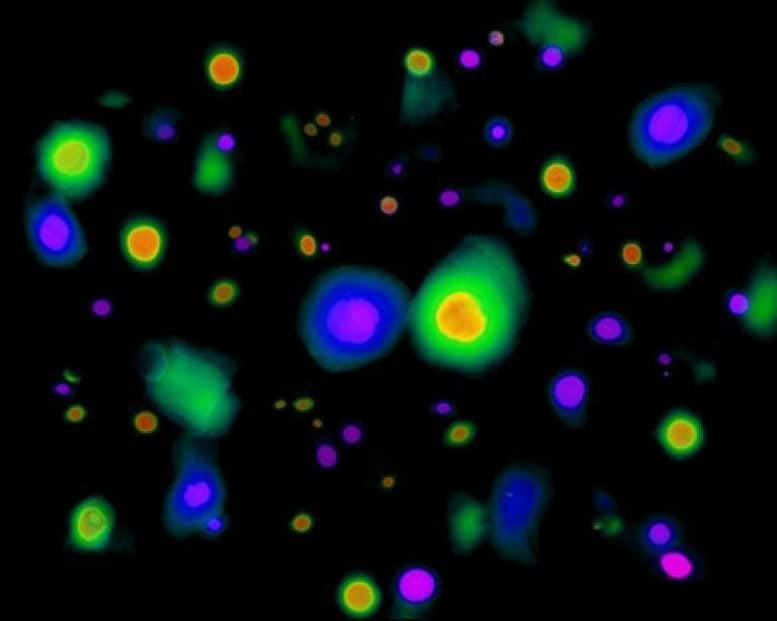
    Random Collection of Textures
    A random collection of textures taken from high-resolution, supercomputer simulations. Red indicates a positive twist in the topological charge density and blue a negative twist. Credit: V. Travieso and N. Turok

    Scientists have completed their search for the existence of knots in the fabric of space using data from NASA’s WMAP satellite, finding no evidence of these cosmic textures.

    Theories of the primordial Universe predict the existence of knots in the fabric of space – known as cosmic textures – which could be identified by looking at light from the cosmic microwave background (CMB), the relic radiation left over from the Big Bang.

    Using data from NASA’s Wilkinson Microwave Anisotropy Probe (WMAP) satellite, researchers from University College London (UCL), Imperial College London, and the Perimeter Institute have performed the first search for textures on the full sky, finding no evidence for such knots in space.

    As the Universe cooled it underwent a series of phase transitions, analogous to water freezing into ice. Many transitions cannot occur consistently throughout space, giving rise in some theories to imperfections in the structure of the cooling material known as cosmic textures.

    If produced in the early Universe, textures would interact with light from the CMB to leave a set of characteristic hot and cold spots. If detected, such signatures would yield invaluable insight into the types of phase transitions that occurred when the Universe was a fraction of a second old, with drastic implications for particle physics.

    A previous study, published in Science in 2007, provided a tantalizing hint that a CMB feature known as the “Cold Spot” could be due to a cosmic texture. However, the CMB Cold Spot only comprises around 3% of the available sky area, and an analysis using the full microwave sky had not been performed.

    The new study, published today in Physical Review Letters, places the best limits available on theories that produce textures, ruling out at 95% confidence theories that produce more than six detectable textures on our sky.

    Stephen Feeney, from the UCL Department of Physics and Astronomy and lead author, said: “If textures were observed, they would provide invaluable insight into the way nature works at tremendous energies, shedding light on the unification of the physical forces. The tantalizing hints found in a previous small-scale search meant it was extremely important to carry out this full-sky analysis.”

    Co-author Matt Johnson, from the Perimeter Institute, Canada, said: “Although there is no evidence for these objects in the WMAP data, this is not the last word: in a few months we will have access to much better data from the Planck satellite. Whether we find textures in the Planck data or further constrain the theories that produce them, only time will tell!”

    Reference: “Robust Constraint on Cosmic Textures from the Cosmic Microwave Background” by Stephen M. Feeney, Matthew C. Johnson, Daniel J. Mortlock and Hiranya V. Peiris, 12 June 2012, Physical Review Letters.
    DOI: 10.1103/PhysRevLett.108.241301

    Never miss a breakthrough: Join the SciTechDaily newsletter.
    Follow us on Google and Google News.

    Astronomy NASA Particle Physics University College London
    Share. Facebook Twitter Pinterest LinkedIn Email Reddit

    Related Articles

    “Completely Unexpected” – Scientists Discover a Magnetized Dead Star With a Solid Surface

    NASA’s Swift Helps Tie “Ghost Particle” to Star-Shredding Black Hole

    Chandra Observations Show Solar Storms Trigger Jupiter’s ‘Northern Lights’

    Sun’s Magnetic Field Weaker Than a Normal Fridge Magnet

    The Bolshoi Simulation: Boxing the Universe

    Earth’s Van Allen Radiation Belt’s Charged Electrons Heading for Space Not Surface

    NASA’s Kepler Mission Discovers 11 New Extrasolar Systems with 26 Exoplanets

    NASA’s NuSTAR is One Step Closer to Launching

    Hubble Observes Rare Blue Stars in Andromeda’s Core

    1 Comment

    1. kamir bouchareb st on November 3, 2020 6:20 am

      nice topic

      Reply
    Leave A Reply Cancel Reply

    • Facebook
    • Twitter
    • Pinterest
    • YouTube

    Don't Miss a Discovery

    Subscribe for the Latest in Science & Tech!

    Trending News

    Monster Storms on Jupiter Unleash Lightning Beyond Anything on Earth

    Scientists Create “Liquid Gears” That Spin Without Touching

    The Simple Habit That Could Help Prevent Cancer

    Millions Take These IBS Drugs, But a New Study Finds Serious Risks

    Scientists Unlock Hidden Secrets of 2,300-Year-Old Mummies Using Cutting-Edge CT Scanner

    Bread Might Be Making You Gain Weight Even Without Eating More Calories

    Scientists Discover Massive Magma Reservoir Beneath Tuscany

    Europe’s Most Active Volcano Just Got Stranger – Here’s Why Scientists Are Rethinking It

    Follow SciTechDaily
    • Facebook
    • Twitter
    • YouTube
    • Pinterest
    • Newsletter
    • RSS
    SciTech News
    • Biology News
    • Chemistry News
    • Earth News
    • Health News
    • Physics News
    • Science News
    • Space News
    • Technology News
    Recent Posts
    • Simple Blood Test May Predict Alzheimer’s Years Before Brain Scans Show Signs
    • Scientists Say Adding This Unusual Seafood to Your Diet Could Reverse Signs of Aging
    • U.S. Waste Holds $5.7 Billion Worth of Crop Nutrients
    • Scientists Say a Hidden Structure May Exist Inside Earth’s Core
    • Doctors Surprised by the Power of a Simple Drug Against Colon Cancer
    Copyright © 1998 - 2026 SciTechDaily. All Rights Reserved.
    • Science News
    • About
    • Contact
    • Editorial Board
    • Privacy Policy
    • Terms of Use

    Type above and press Enter to search. Press Esc to cancel.