
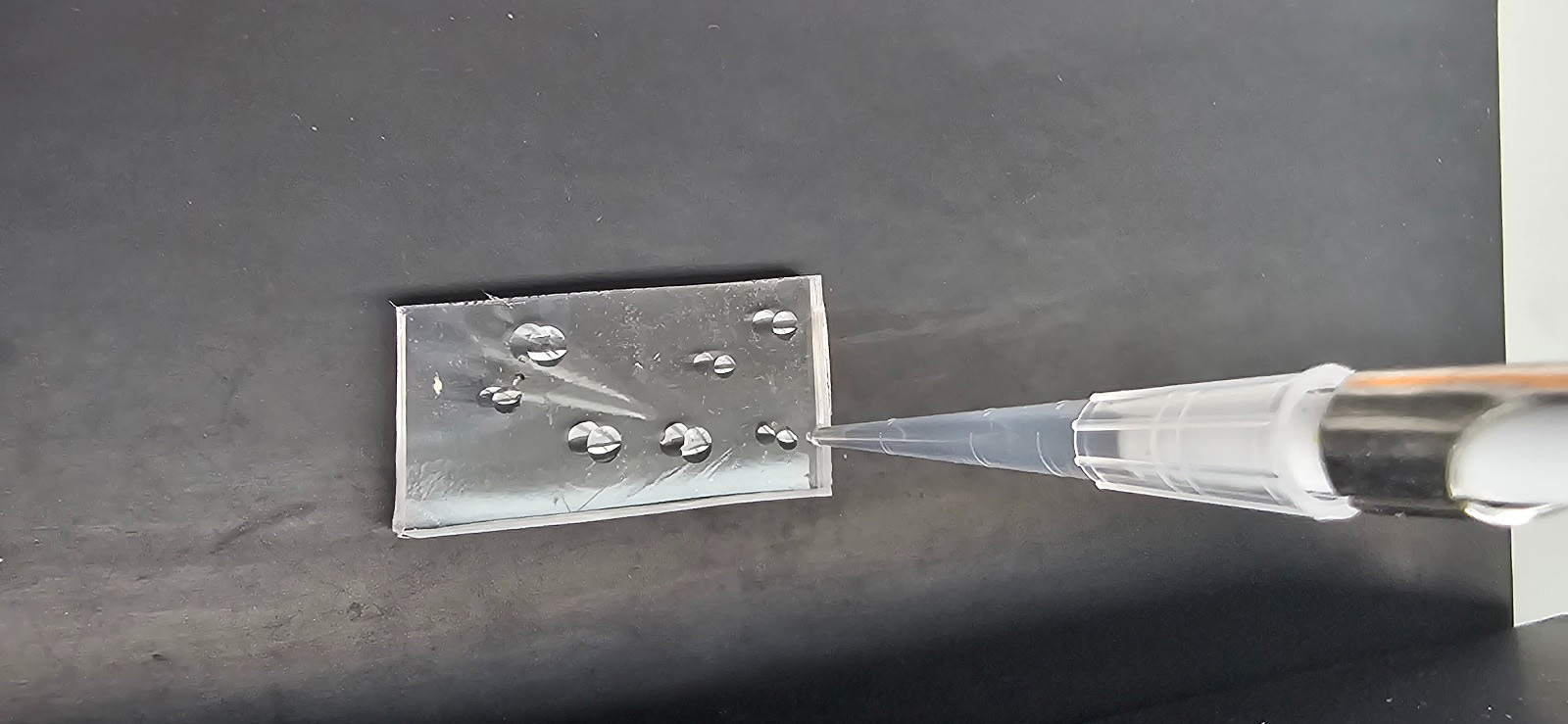
Tel Aviv University researchers have created a unique glass that is both an effective adhesive and highly transparent. This spontaneously forming glass could significantly influence multiple high-tech industries.
Researchers from Tel Aviv University (TAU) have created a new type of glass with unique and even contradictory properties, such as being a strong adhesive (sticky) and incredibly transparent at the same time. The glass, which forms spontaneously when comes in contact with water at room temperature, could bring about a revolution in an array of different and diverse industries such as optics and electro-optics, satellite communication, remote sensing and biomedicine.
The glass was discovered by a team of researchers from Israel and the world, led by PhD student Gal Finkelstein-Zuta and Prof. Ehud Gazit from the Shmunis School of Biomedicine and Cancer Research at the Faculty of Life Sciences and the Department of Materials Science and Engineering at the Faculty of Engineering at TAU. The results of the research were recently published in the prestigious scientific journal Nature.

Process and Properties of the New Glass
“In our laboratory, we study bio-convergence and specifically use the wonderful properties of biology to produce innovative materials,” explains Prof. Gazit. “Among other things, we study sequences of amino acids, which are the building blocks of proteins. Amino acids and peptides have a natural tendency to connect to each other and form ordered structures with a defined periodic arrangement, but during the research, we discovered a unique peptide that behaves differently from anything we know: it didn’t form any ordered pattern but an amorphous, disordered one, that describes glass.”
At the molecular level, glass is a liquid-like substance that lacks order in its molecular structure, but its mechanical properties are solid-like. Glass is usually manufactured by rapidly cooling molten materials and “freezing” them in this state before they are allowed to crystallize, resulting in an amorphous state that allows unique optical, chemical and mechanical properties – alongside durability, versatility, and sustainability. The researchers from TAU discovered that the aromatic peptide, which consists of a three-tyrosine sequence (YYY), forms a molecular glass spontaneously, upon evaporation of an aqueous solution, under room-temperature conditions.

“The commercial glass we all know is created by the rapid cooling of molten materials, a process called vitrification” says Gal Finkelstein-Zuta. “The amorphous liquid-like organization should be fixed before it arranges in a more energy-efficient way as in crystals, and for that energy is required – it should be heated to high temperatures and cooled down immediately. On the other hand, the glass we discovered, which is made of biological building blocks, forms spontaneously at room temperature, without the need of energy such as high heat or pressure. Just dissolve a powder in water – just like making kool-aid, and the glass will form. For example, we made lenses from our new glass. Instead of undergoing a lengthy process of grinding and polishing, we simply dripped a drop onto a surface, where we control its curvature – and hence its focus – by adjusting the solution volume alone.”
The properties of the innovative glass from TAU are unique in the world – and even contradict each other: it is very hard, but it can repair itself at room temperature; It is a strong adhesive, and at the same time, it is transparent in a wide spectral range, ranging from the visible light to the mid-infrared range.
Potential Impact and Uses
“This is the first time anyone has succeeded in creating molecular glass under simple conditions,” says Prof. Gazit, “but not less important than that are the properties of the glass we created. It is a very special glass. On the one hand, it is very strong and on the other hand, very transparent – much more transparent than ordinary glass. The normal silicate glass we all know is transparent in the visible light range, the molecular glass we created is transparent deep into the infrared range. This has many uses in fields such as satellites, remote sensing, communications, and optics. It is also a strong adhesive, it can glue different glasses together, and at the same time, it can repair cracks that are formed in it. It is a set of properties that does not exist in any glass in the world, which has great potential in science and engineering, and we got all this from a single peptide – one little piece of protein.”
Reference: “A self-healing multispectral transparent adhesive peptide glass” by Gal Finkelstein-Zuta, Zohar A. Arnon, Thangavel Vijayakanth, Or Messer, Orr Simon Lusky, Avital Wagner, Galit Zilberman, Ruth Aizen, Lior Michaeli, Sigal Rencus-Lazar, Sharon Gilead, Sudha Shankar, Mariela Jorgelina Pavan, Dor Aaron Goldstein, Shira Kutchinsky, Tal Ellenbogen, Benjamin A. Palmer, Amir Goldbourt, Maxim Sokol and Ehud Gazit, 12 June 2024, Nature.
DOI: 10.1038/s41586-024-07408-x
Never miss a breakthrough: Join the SciTechDaily newsletter.
Follow us on Google and Google News.
3 Comments
https://www.nature.com/articles/s41467-021-25508-4
Self healing glass was invented by Corning a while ago.
It is an excellent scientific discovery that should benefit mankind. Thanks.
@ King Anfalas The two types of glass have almost nothing in common. The Corning process is complicated and has several layers.
It certainly does not occur spontaneously in its whole form