
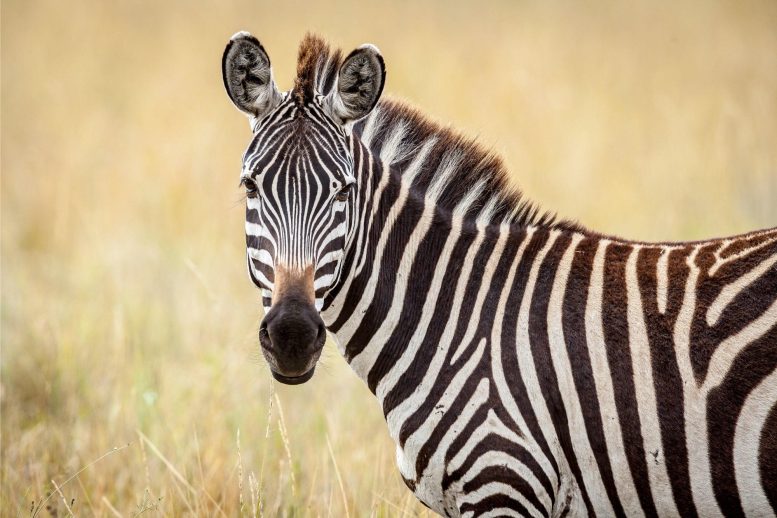
Experiments showed that horseflies favor solid dark objects over striped patterns, revealing how zebra stripes help reduce parasite attacks.
The University of Bristol researchers have uncovered the reason behind zebra fur being thinly striped and clearly defined.
Their findings, published in the Journal of Experimental Biology, reveal that the strong black-white contrast and small dark patches in zebra fur are particularly effective in deterring horsefly attacks. These specific characteristics eliminate the outline of large monochrome dark areas that are attractive to horseflies at close range.
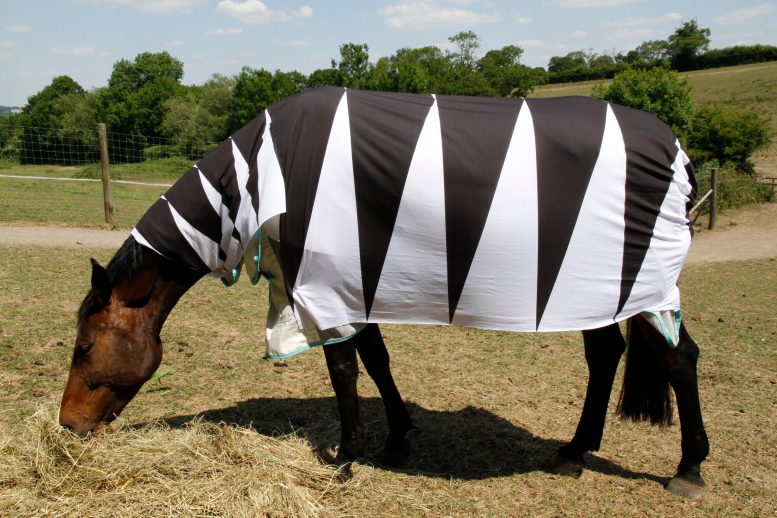
The team theorizes that the thin back stripes serve to minimize the size of local features on a zebra that are appealing to the biting flies.
The research was led by Professor Tim Caro and Dr. Martin How both from the University of Bristol’s School of Biological Sciences.
Prof Caro explained: “We knew that horseflies are averse to landing on striped objects – a number of studies have now shown this, but it is not clear which aspects of stripes they find aversive.
“Is it the thinness of the stripes? The contrast of black and white? The polarized signal that can be given off objects? So we set out to explore these issues using different patterned cloths draped over horses and filmed incoming horseflies.”
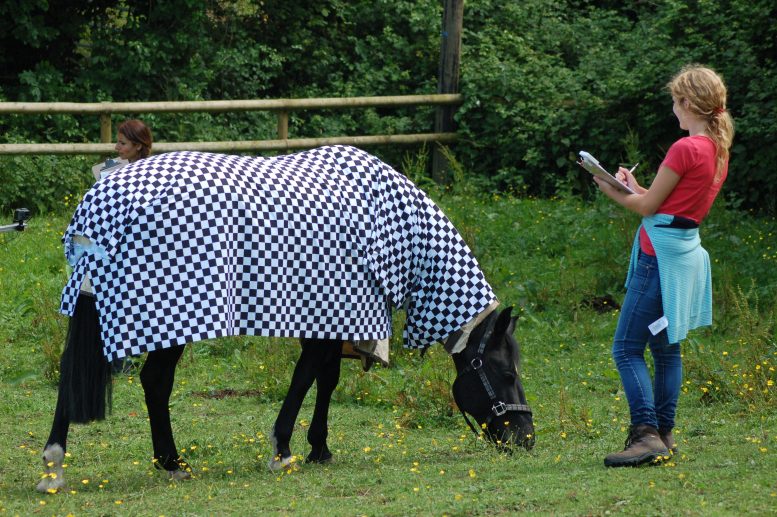
The team found that tabanid horseflies are attracted to large dark objects in their environment but less to dark broken patterns. All-grey coats were associated with by far the most landings, followed by coats with large black triangles placed in different positions, then small checkerboard patterns in no particular order. In another experiment, they found contrasting stripes attracted few flies whereas more homogeneous stripes were more attractive.
Professor Caro added: “This suggests that any hoofed animal that reduces its overall dark outline against the sky will benefit in terms of reduced ectoparasite attack.”
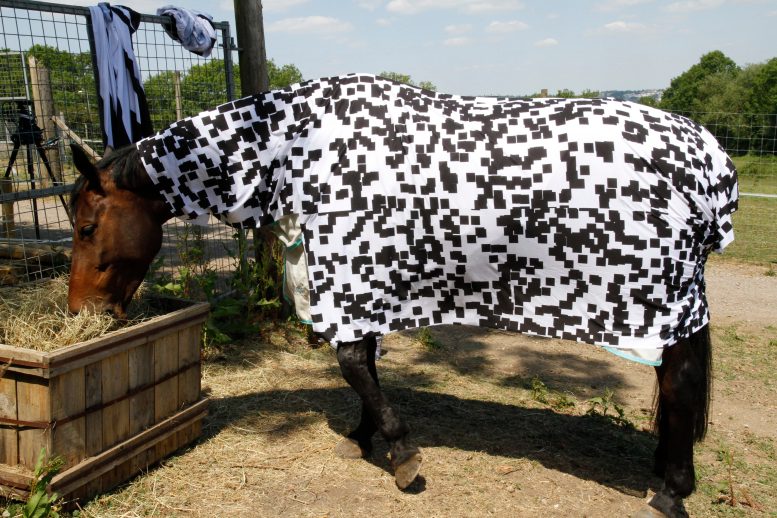
The team found little evidence for other issues that they tested, namely polarization or optical illusions confusing accurate landings such as the so-called ‘wagon-wheel effect’ or ‘the barber-pole effect’.
Now the team wants to determine why natural selection has driven striping in equids – the horse family -but not other hoofed animals.
Professor Caro added: “We know that zebra pelage – fur – is short, enabling horsefly mouthparts to reach the skin and blood capillaries below, which may make them particularly susceptible to fly annoyance, but more important, perhaps, is that the diseases that they carry are fatal to the horse family but less so to ungulates. This needs investigation.”
Reference: “Why don’t horseflies land on zebras?” by Tim Caro, Eva Fogg, Tamasin Stephens-Collins, Matteo Santon and Martin J. How, 17 February 2023, Journal of Experimental Biology.
DOI: 10.1242/jeb.244778
Never miss a breakthrough: Join the SciTechDaily newsletter.
Follow us on Google and Google News.
1 Comment
It is not evolution being a -purposeful- thing that was looking for a way to perpetuate itself – no such deliberate purpose unless you think it was God experimenting or there is actual intelligence & collusion at the cellular level ? It’s time you spelt this out correctly – it ‘happened’ because the fact of stripy fur patterns was a deterrent to flies biting and therefore more stripy animals survived to old age & produced more stripy animals than the not-so-stripy version who died out from illnesses produced by biting flies. NO DELIBERATE PURPOSE INVOLVED !!!