
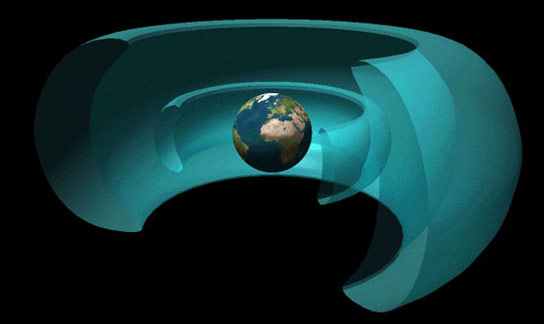
In a newly published study, NASA’s Van Allen Probes reveal that a persistent pattern of high-energy electrons in the inner radiation belt, which resembles slanted zebra stripes, are caused by the rotation of Earth.
Scientists have discovered a new, persistent structure in one of two radiation belts surrounding Earth. NASA’s twin Van Allen Probes spacecraft have shown that high-energy electrons in the inner radiation belt display a persistent pattern that resembles slanted zebra stripes. Surprisingly, this structure is produced by the slow rotation of Earth, previously considered incapable of affecting the motion of radiation belt particles, which have velocities approaching the speed of light.
Scientists had previously believed that increased solar wind activity was the primary force behind any structures in our planet’s radiation belts. However, these zebra stripes were shown to be visible even during low solar wind activity, which prompted a new search for how they were generated. That quest led to the unexpected discovery that the stripes are caused by the rotation of Earth. The findings are reported in the March 20, 2014, issue of Nature.
“It is because of the unprecedented resolution of our energetic particle experiment, RBSPICE, that we now understand that the inner belt electrons are, in fact, always organized in zebra patterns,” said Aleksandr Ukhorskiy, lead author of the paper at The Johns Hopkins Applied Physics Laboratory, or APL, in Laurel, Maryland. “Furthermore, our modeling clearly identifies Earth’s rotation as the mechanism creating these patterns. It is truly humbling, as a theoretician, to see how quickly new data can change our understanding of physical properties.”
As material moves through Earth’s radiation belts, it can fold over on itself like taffy, creating zebra stripes of electrons with different energies. Credit: APL
Because of the tilt in Earth’s magnetic field axis, the planet’s rotation generates an oscillating, weak electric field that permeates through the entire inner radiation belt. To understand how that field affects the electrons, Ukhorskiy suggested imagining that the electrons are like a viscous fluid. The global oscillations slowly stretch and fold the fluid, much like taffy is stretched and folded in a candy store machine. The stretching and folding process results in the striped pattern observed across the entire inner belt, extending from above Earth’s atmosphere, about 500 miles above the planet’s surface up to roughly 8,000 miles.
The radiation belts are dynamic doughnut-shaped regions around our planet, extending high above the atmosphere, made up of high-energy particles, both electrons and charged particles called ions, which are trapped by Earth’s magnetic field. Radiation levels across the belts are affected by solar activity that causes energy and particles to flow into near-Earth space. During active times, radiation levels can dramatically increase, which can create hazardous space weather conditions that harm orbiting spacecraft and endanger humans in space. It is the goal of the Van Allen Probes mission to understand how and why radiation levels in the belts change with time.
“The RBSPICE instrument has remarkably fine resolution and so it was able to bring into focus a phenomena that we previously didn’t even know existed,” said David Sibeck, the mission scientist for the Van Allen Probes at NASA’s Goddard Space Flight Center in Greenbelt, Md. “Better yet, we have a great team of scientists to take advantage of these unprecedented observations: We couldn’t have interpreted this data without analysis from strong theoreticians.”
NASA launched the Van Allen Probes in the summer of 2012. APL built and operates the probes for NASA’s Science Mission Directorate. This is the second mission in NASA’s Living With a Star program, which Goddard manages. The program explores aspects of the connected sun-Earth system that directly affect life and society.
Reference: “Rotationally driven ‘zebra stripes’ in Earth’s inner radiation belt” by A. Y. Ukhorskiy, M. I. Sitnov, D. G. Mitchell, K. Takahashi, L. J. Lanzerotti and B. H. Mauk, 19 March 2014, Nature.
DOI: 10.1038/nature13046
Never miss a breakthrough: Join the SciTechDaily newsletter.
Follow us on Google and Google News.
2 Comments
All I have to say is fantastic.
“The RBSPICE instrument has remarkably fine resolution and so it was able to bring into focus a phenomena that we previously didn’t even know existed…”
That goof again. “Phenomenon” is singular,”phenomena” plural.