
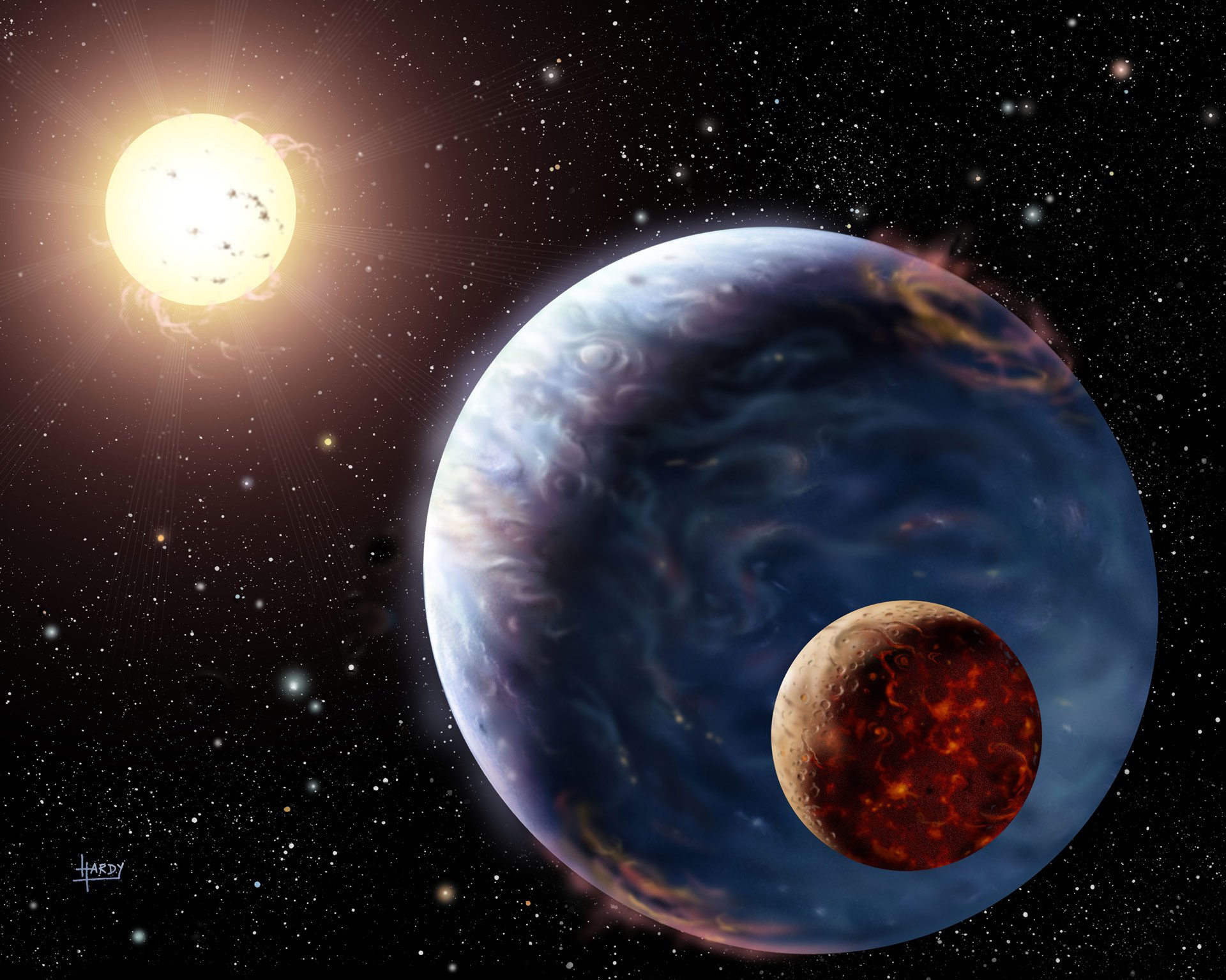
The senior astronomer at the Search for Extra-Terrestrial Intelligence Institute believes that researchers will find life in space in this century.
Are we alone in the universe? It’s a question that has always fired the human imagination. The more we learn, the more unlikely it seems that Earth is a lone miracle inhabiting life amid galaxies of lifeless planets. Many eminent scientists are positive that it is just a matter of time before we find other life in the universe. But exactly how we’ll encounter our inter-galactic neighbors, and whether they’ll be just a few cells or full-blown ET lookalikes, they are less sure.
“We are going to find life in space in this century,” Dr. Seth Shostak, Senior Astronomer at the Search for Extra-Terrestrial Intelligence Institute (SETI) said emphatically at last week’s European Commission Innovation Convention. “There are 150 billion galaxies other than our own, each with a few tens of billions of Earth-like planets. If this is the only place in the universe where anything interesting happening then this is a miracle. And 500 years of astronomy has taught us that whenever you believe in a miracle, you’re probably wrong.”
How will discover life in space? Dr. Shostak sees it as a “three-horse race” which will probably be won over the next 25 years. We will either find it nearby, in microbial form, on Mars or one of the moons of Jupiter; we will find evidence for gases produced by living processes (for example photosynthesis) in the atmospheres of planets around other stars; or Dr. Shostak and his team at SETI will pick up signals from intelligent life via huge antennas.
Dr. Suzanne Aigrain, Lecturer in Astrophysics at Oxford University, who studies extrasolar planets or exoplanets (planets around other stars than the sun), represents horse number two in the race. Speaking at the Convention, Dr. Aigrain noted that, based on her studies, she would also bet that we are not alone. “We are very close to being able to say with a good degree of certainty that planets like the Earth, what we call habitable planets, are quite common [in the universe] … That’s why when asked if I believe there’s life on other planets, I raise my hand and I do so as a scientist because the balance of probability is overwhelmingly high.”
Dr. Aigrain, and the groups that she works with, have so far been using light – electromagnetic radiation – as their primary tool to look for planets around stars other than the sun. Habitable planets are defined as those that are roughly the size of the Earth where the surface temperature is suitable for liquid water to exist on the surface. The life “biomarkers” that Dr. Aigrain and her colleagues look for are trace gases in the atmospheres of the exoplanets that they think can only be there if they are being produced by a biological source like photosynthesis.
Dr Shostak and SETI, meanwhile, seek evidence of life in the universe by looking for some signature of its technology. If his team does discover radio transmissions from space, Dr. Shostak is quite certain that they will be coming from a civilization more advanced than our own. “Why do I insist that if we find ET, he/she/it will be more advanced than we are? The answer is that you’re not going to hear the Neanderthals. The Neanderthal Klingons are not building radio transmitters that will allow you to get in touch.”
If we do find life on other planets or intercept a radio signal, what are the consequences? Finding a microbe that isn’t an earthly microbe will tell us a lot about biology, but there will also be huge philosophical consequences. In Dr. Shostak’s words, “It literally changes everything.”
Never miss a breakthrough: Join the SciTechDaily newsletter.
Follow us on Google and Google News.
6 Comments
talk to the cia they already hired some.
The probability of finding microbial form or gases of photosynthesis may be possible within this century, but never can SETI find the signals of other intelligent beings in exo-planets. Please go through my article “UFO’s are not mathematically possible”- which can be browsed through internet, by typing ‘vcmadan2’ or “Science Frontiers by Madan”. The sheer mathematics of intelligent living beings existing simultaneously in two ensembles in this universe at the same time, is ruled out. We exist only for a miniscule proportion of the age of the universe till now, and same is applicable to other planet systems also. The combined probability of both the systems to interfere with one other even by signals are only remote and very much remote. Thank You.
HOW DOES SETH SHOSTAK GET TO TESTIFY BEFORE “CONGRESS” ABOUT ALIEN LIFE?
WHEN, IN FACT, OVER ((500))
WITNESSES INCLUDING MILITARY MEN AND WOMEN WHO HAVE SERVED THIS COUNTRY WITH DISTINCTION, ARE ((NOT ALLOWED)) TO TESTIFY?? THERE ARE MILITARY WHISTLE BLOWERS, SCIENTISTS PhD’s, RESEARCHERS, PILOTS, ASTRONAUTS FOR GODS SAKE, WHO HAVE COME FORWARD WITH THE TRUTH ABOUT THE EXISTENCE OF ALIEN LIFE…..HOW COME ((“THEY”)) ARE “DENIED ACCESS” TO CONGRESS.??… .. HOW COME THEY ARE NOT ALLOWED TO SPEAK?
THESE PEOPLE, AND ESPECIALLY OUR BRAVE SERVICE MEN AND WOMEN WHO HAVE COME FORTH TO TELL THE TRUTH…. TO TESTIFY ABOUT THEIR EXPERIENCES,
THESE WONDERFUL PEOPLE ARE WORTHLESS IN THE EYES OF A LYING, CORRUPT CONGRESS?…
BUT…………….
SETH SHOSTAK IS “ALLOWED” TO VOMIT UP HIS CRAP
TESTIMONY BEFORE CONGRESS??? JUST WHO ARRANGED / PAID OFF CONGRESSIONAL STAFFERS AND THE REPRESENTATIVES THEMSELVES TO ALLOW THIS TESTIMONY..???
WILL SOMEONE ON THIS PLANET EXPLAIN THIS TRAVESTY..??????
JUST WHAT THE HELL IS GOING ON HERE??
Apparently Scitechdaily.com CHERRYPICKS their comments to align with
their political agenda.
Thanks for your message. We do not cherry-pick our comments and don’t block comments we disagree with, so I was initially baffled by this comment. Then I was able to find the other message that was filtered as spam.
We get a ton of spam comments and work hard to block all of them, but rarely real comments can be blocked as well. I have now restored and published the previous comment. The all uppercase writing was likely a major factor in why it was considered spam, so I believe it is unlikely you’ll be blocked again if you avoid using all uppercase in your comments.
“We exist only for a miniscule proportion of the age of the universe till now, and same is applicable to other planet systems also. The combined probability of both the systems to interfere with one other even by signals are only remote and very much remote.”
It’s actually the other way around; the older the universe is, the HIGHER the odds that enough time has passed for alien civilizations to develop and potentially detect each other.
What you’re suggesting would only make sense if there were a fixed, pre-determined number of alien civilizations, which are THEN are distributed throughout the universe’s history. But obviously that’s not the case. That number is a variable (not a constant) and could be anywhere from one to virtually infinite.