
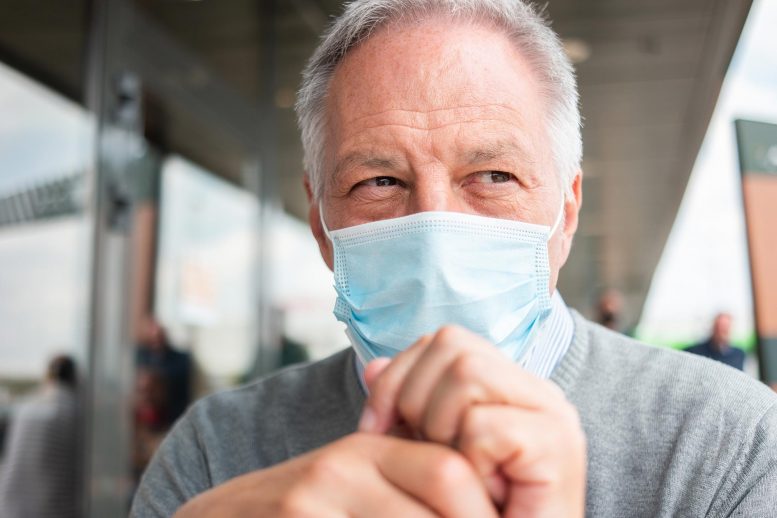
New research shows how face masks reduce the effective reproduction number of COVID-19, and why their efficacy varies between different environments under virus-limited and virus-rich conditions.
‘Don’t forget the mask’ — although most people follow this advice nowadays, professionals express differing opinions about the effectiveness of face masks. An international team led by researchers from the Max Planck Institute for Chemistry in Mainz, Germany, has now combined observational data and model calculations to answer open questions. The study demonstrates under which conditions and in which way masks actually reduce individual and population-average risks of being infected with COVID-19 and help mitigate the corona pandemic. In most environments and situations, even simple surgical masks effectively reduce the transmission of SARS-CoV-2 and the effective reproduction number for COVID-19. In environments with potentially high airborne virus concentrations such as medical settings and densely occupied indoor spaces, however, masks with higher filtration efficiency (N95/FFP2) should be used and combined with other protective measures such as extensive ventilation.
Face masks are among the most basic, easy-to-use, and effective measures against the airborne transmission of infectious respiratory diseases, however, their usefulness against COVID-19 is still being debated. Some earlier scientific investigations found that masks were apparently not effective under certain conditions. Others found high efficacies, but a conclusive explanation for the apparent contradictions and inconsistencies had not been provided.
Scientists from the Max Planck Institute for Chemistry (MPIC), the Medical Center of the Johannes Gutenberg University Mainz, and the Charité – Universitätsmedizin Berlin together with partners from China and the USA used observational data and a novel quantitative model of airborne virus exposure to elucidate how the efficacy of face masks depends on characteristic regimes of airborne virus concentration.
In Most Situations, Even Simple Surgical Masks Are Effective
“For the airborne transmission of SARS-CoV-2, we find that usually just a minor fraction of exhaled respiratory particles contains viruses. Most environments and contacts are under virus-limited conditions, where face masks, including simple surgical masks, have a high efficacy in preventing the spread of COVID-19,” explains Yafang Cheng, the head of a Minerva Research Group at the MPIC. “Our study provides a detailed and novel mechanistic understanding of population-average mask efficacy, which explains why regions with a higher percentage of the population wearing masks have better control of the pandemic.”
In virus-rich indoor environments with high infection probability, however, more advanced masks (N95/FFP2) and other protective equipment are required to prevent airborne transmission. The strong dependence of mask efficacy on airborne virus concentration highlights the importance of combining masks with other protective measures such as ventilation and distancing to keep the infection probability low.
“The combination of high-efficiency masks with other protective measures is particularly important for hospitals, medical centers, and other indoor environments, where high-risk patients may encounter high virus concentrations,” says Christian Witt, head of the Research Area Pneumology at the Charité – Universitätsmedizin Berlin. “Masks will remain an important protective measure against SARS-Cov-2 infection — even for vaccinated persons, especially when the protection provided by vaccination decreases over time.”
The Approach Can Be Used To Assess Protection Against More Infectious Mutants
“Our approach and results of relating the effectiveness of protective measures to the infection probability and basic reproduction number are applicable to a wide range of respiratory viruses and diseases, including coronaviruses, rhinoviruses, and influenza. They can also be used to assess the efficacy of masks and other preventive measures against new and more infectious mutants of SARS-CoV-2,” says Hang Su, research group leader at the MPIC. “Our investigations also show that aerosol transmission does not necessarily lead to very high reproduction numbers as observed for measles, and that relatively low reproduction numbers do not rule out airborne transmission.”
Moreover, the study demonstrates how important high compliance and correct use of masks are to ensure their effectiveness in reducing the reproduction number of COVID-19. To reduce the reproduction number from ~3 as originally observed to below 1, at least 60-70% compliance would be required for surgical masks (~40% for N95/FFP2 masks). Higher rates of compliance would be required for more infectious variants of SARS-CoV-2, which re-emphasizes that masks should be combined with other protective measures like ventilation and distancing for efficient reduction of infection probabilities and reproduction numbers.
“Our study explains quantitatively why and how face masks are highly effective in virus-limited environments and less effective in virus-rich environments – both at the individual and the population average level related to observed infection rates and effective reproduction numbers. This has not been achieved before and is essential to overcome inconclusive earlier results, arguments, and discussions. We are confident, that the mechanistic insights and quantitative results gained in our study constitute a scientific breakthrough that will help to settle the ongoing debate about the usefulness of masks and promote efficient mitigation of the COVID pandemic,” summarizes Ulrich Pöschl, director of the MPIC Multiphase Chemistry Department.
Reference: “Face masks effectively limit the probability of SARS-CoV-2 transmission” by Yafang Cheng, Nan Ma, Christian Witt, Steffen Rapp, Philipp S. Wild, Meinrat O. Andreae, Ulrich Pöschl and Hang Su, 20 May 2021, Science.
DOI: 10.1126/science.abg6296
Never miss a breakthrough: Join the SciTechDaily newsletter.
Follow us on Google and Google News.
7 Comments
So… Let me get this straight: One does not have to wear a mask if one is vaccinated but one should still wear a mask? IDK straddling that fence could be a confusing (and potentially PAINFUL) incidence of the Tail wagging the Dog. Excuse, please my mixing metaphors. Sometimes the language English forces instantaneous reversal of intention, tense (do I appear TENSE?) and syntax.
Few wear the mask ‘properly.’ Too many ‘ifs’ in this study. And I have 12 studies at hand, large and peer-reviewed, that maintain the opposite finding. You have, what — one?
Well I’m still wearing my mask because the people that have not been vaccinated will take their mask off as well. So how do we know who is vaccinated and who is not that’s the million dollar question because some of us will not be fair. So my mask stays for now until they can answer they question.
Title: “New Research Shows Face Masks Effectively Limit COVID-19 Transmission”
What they say: “Our study explains quantitatively why and how face masks are highly effective in virus-limited environments and less effective in virus-rich environments”
Face Masks… Effectively…
> Anti-Propaganda mode engaged
> Generalization detected
> error 404
> brainwashing unsuccessful
They never make it clear that once a mask is wet with exhaled secretions it is a conduit for the bacteria or viral particles around us. We changed masks frequently in the hospital for this very reason. People wear the same mask all day and then the next day as well. At least dry them out and rotate them for increased efficacy.
I really fail to see how this settles anything. The science seems pretty clear to me: the relative benefit of surgical masks in preventing virus transmission is negligible.
There are also major questions as to the actual extent of asymptomatic spread. It is clearly not a driver of infection regardless.
It’s too bad they couldn’t rely upon observational data and actual results as opposed to an imaginary math equation.
For those who believe cloth stops aerosolized viruses, is there any area (city, state, or country) that can be shown as evidence that masking effectively reduced the spread?