
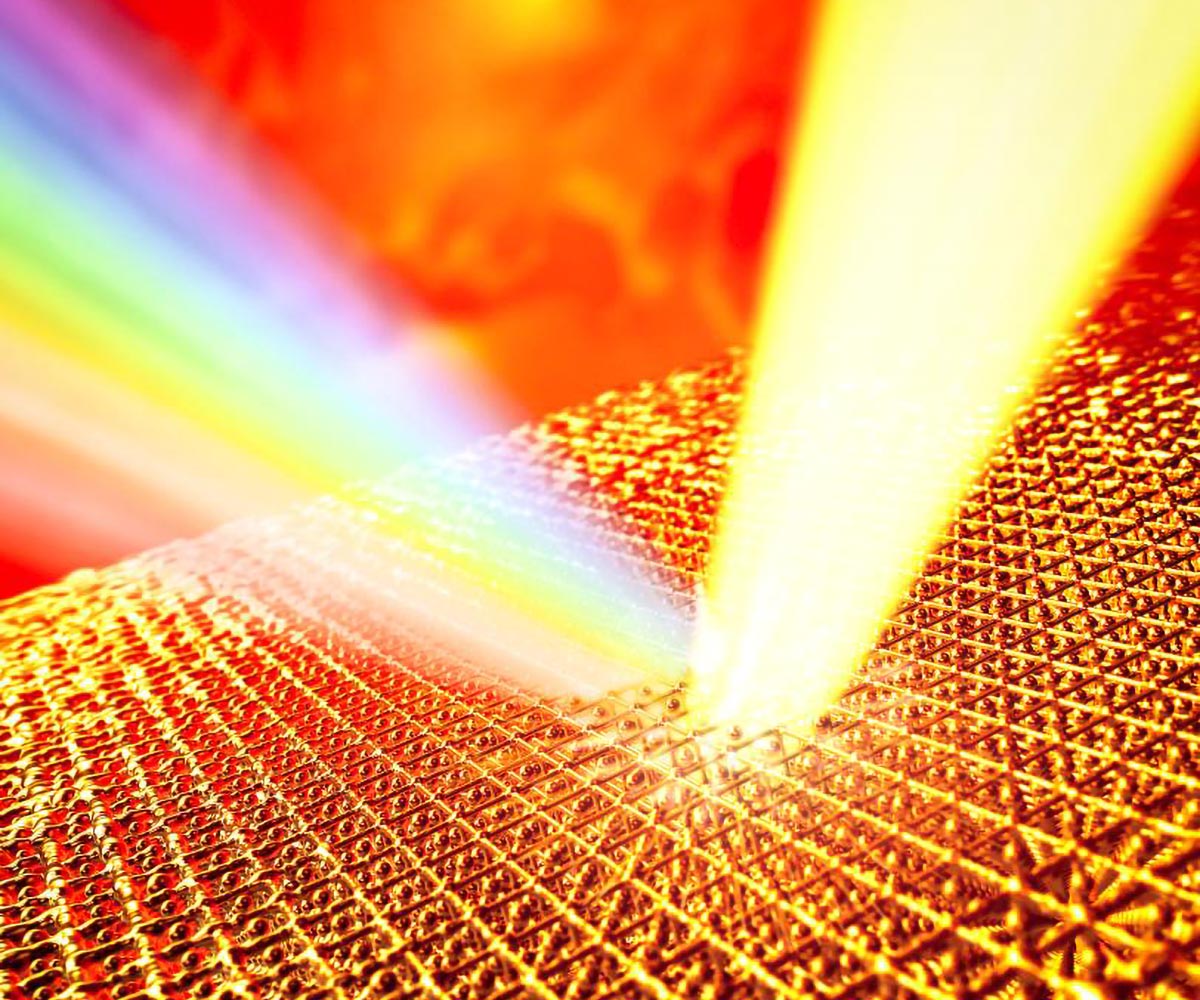
Researchers heated gold to unprecedented temperatures without melting it, overturning a century-old theory and paving the way for breakthroughs in fusion and planetary science.
Record-Breaking Heat and Shattered Theories
Scientists have achieved a remarkable feat, setting a new temperature record, challenging a long-accepted theory, and applying an advanced laser spectroscopy technique to dense plasmas. Their findings were recently published in Nature.
In the study, titled “Superheating gold beyond the predicted entropy catastrophe threshold,” researchers reported that they were able to heat gold to more than 19,000 Kelvin (33,740 degrees Fahrenheit). This is over 14 times its normal melting point, yet the gold astonishingly retained its solid, crystalline form.
“This is possibly the hottest crystalline material ever recorded,” Thomas White, lead author and Clemons-Magee Endowed Professor in Physics at the University of Nevada, Reno, said.
Defying the Entropy Catastrophe
The experiment directly challenges the long-standing theory known as the entropy catastrophe. According to this theory, solids cannot remain intact at temperatures greater than about three times their melting point and should instead melt on their own. Gold’s melting point is 1,337 Kelvin (1,947 degrees Fahrenheit), yet in this experiment at Stanford University’s SLAC National Accelerator Laboratory, the metal remained solid far beyond that threshold when blasted with a powerful laser.
“I was expecting the gold to heat quite significantly before melting, but I wasn’t expecting a fourteen-fold temperature increase,” White said.
Lightning-Fast Laser Experiment
To heat the gold, researchers at the University of Nevada, Reno, SLAC National Accelerator Laboratory, the University of Oxford, Queen’s University Belfast, the European XFEL, and the University of Warwick designed an experiment to heat a thin gold foil using a laser fired for 50 quadrillionths of a second (one millionth of a billionth). The speed with which the gold was heated seems to be the reason the gold remained solid.
The findings suggest that the limit of superheating solids may be far higher – or nonexistent – if heating occurs quickly enough. The new methods used in this study open the field of high-energy density physics to further exploration, including in areas of planetary physics and fusion energy research.
White and his team expected that the gold would melt at its melting point, but to measure the temperature inside the gold foil, they would need a very special thermometer.
“We used the Linac Coherent Light Source, a 3-kilometer-long X-ray laser at SLAC, as essentially the world’s largest thermometer,” White said. “This allowed us to measure the temperature inside the dense plasma for the first time, something that hasn’t been possible before.”
“I’m incredibly grateful for the opportunity to contribute to such cutting-edge science using billion-dollar experimental platforms alongside world-class collaborators.”
Doctoral student Travis Griffin
Fusion Research Potential
“This development paves the way for temperature diagnostics across a broad range of high-energy-density environments,” Bob Nagler, staff scientist at SLAC and coauthor on the paper, said. “In particular, it offers the only direct method currently available for probing the temperature of warm dense states encountered during the implosion phase of inertial fusion energy experiments. As such, it is poised to make a transformative contribution to our understanding and control of fusion-relevant plasma conditions.”
Along with the experimental designers, the research article is the result of a decade of work and collaboration between Columbia University, Princeton University, the University of Padova and the University of California, Merced.
“It’s extremely exciting to have these results out in the world, and I’m really looking forward to seeing what strides we can make in the field with these new methods,” White said.
Expanding High-Energy Physics Frontiers
The research, funded by the National Nuclear Security Administration, will open new doors in studies of superheated materials.
“The National Nuclear Security Administrations’ Academics Program is a proud supporter of the groundbreaking innovation and continued learning that Dr. White and his team are leading for furthering future critical research areas beneficial to the Nuclear Security Enterprise,” Jahleel Hudson, director at the Techology and Partnerships Office of the NNSA said.
Probing Planetary Interiors
White and his colleagues returned to the Linac Coherent Light Source in July to measure the temperature inside hot compressed iron and are using those results to gain insights into the interiors of planets.
Several of White’s graduate students and one undergraduate student were coauthors on the study, including doctoral student Travis Griffin, undergraduate student Hunter Stramel, Daniel Haden, a former postdoctoral scholar in White’s lab, Jacob Molina, a former undergraduate student currently pursuing his doctoral degree at Princeton University and Landon Morrison, a former undergraduate student pursuing his master’s degree at the University of Oxford. Jeremy Iratcabal, research assistant professor in the Department of Physics, was also a coauthor on the paper.
“I’m incredibly grateful for the opportunity to contribute to such cutting-edge science using billion-dollar experimental platforms alongside world-class collaborators,” Griffin said. “This discovery highlights the power of this technique, and I’m excited by the possibilities it opens for the future of high-energy-density physics and fusion research. After graduation, I’ll be continuing this work as a staff scientist at the European XFEL.”
Reference: “Superheating gold beyond the predicted entropy catastrophe threshold” by Thomas G. White, Travis D. Griffin, Daniel Haden, Hae Ja Lee, Eric Galtier, Eric Cunningham, Dimitri Khaghani, Adrien Descamps, Lennart Wollenweber, Ben Armentrout, Carson Convery, Karen Appel, Luke B. Fletcher, Sebastian Goede, J. B. Hastings, Jeremy Iratcabal, Emma E. McBride, Jacob Molina, Giulio Monaco, Landon Morrison, Hunter Stramel, Sameen Yunus, Ulf Zastrau, Siegfried H. Glenzer, Gianluca Gregori, Dirk O. Gericke and Bob Nagler, 23 July 2025, Nature.
DOI: 10.1038/s41586-025-09253-y
Never miss a breakthrough: Join the SciTechDaily newsletter.
Follow us on Google and Google News.
2 Comments
The experiment directly challenges the long-standing theory known as the entropy catastrophe.
WHY???
Please ask researchers to think deeply:
1. Why is there a entropy catastrophe?
2. Is the fundamental theory of physics today scientific?
Based on the Topological Vortex Theory (TVT), the entropy catastrophe is one of the ways in which topological vortices interact.
An entire generation has been severely misled and poisoned by so-called peer-reviewed publications. In today’s physics, the so-called peer-reviewed journals—including Physical Review Letters, Nature, Science, and others—stubbornly insist on and promote the following:
1. Even though θ and τ particles exhibit differences in experiments, physics can claim they are the same particle. This is science.
2. Even though topological vortices and antivortices have identical structures and opposite rotational directions, physics can define their structures and directions as entirely different. This is science.
3. Even though two sets of cobalt-60 rotate in opposite directions and experiments reveal asymmetry, physics can still define them as mirror images of each other. This is science.
4. Even though vortex structures are ubiquitous—from cosmic accretion disks to particle spins—physics must insist that vortex structures do not exist and require verification. Only the particles that like God, Demonic, or Angelic are the most fundamental structures of the universe. This is science.
5. Even though everything occupies space and maintains its existence in time, physics must still debate and insist on whether space exists and whether time is a figment of the human mind. This is science.
6. Even though space, with its non-stick, incompressible, and isotropic characteristics, provides a solid foundation for the development of physics, physics must still insist that the ideal fluid properties of space do not exist. This is science.
And so on.
The so-called peer-reviewed journals—including Physical Review Letters, Nature, Science, and others openly define differences as sameness, sameness as differences, existence as nonexistence, and nonexistence as existence—all while deceiving and fooling the public with so-called “impact factors (IF),” never knowing what shame is.
The universe is not a God, nor is it merely Particles. Moreover, it is not Algebra, Formulas, or Fractions. The universe is the superposition, deflection, entanglement, and locking of spacetime vortex geometries, the interaction and balance of topological vortices and their fractal structures. Topological invariants are the identical intrinsic properties between two isomorphic topological spaces. Different civilizations may create distinct mathematical codes or tools to describe the universality and specificity of these topological invariants under different physical laws.
Topology provides stability blueprints, but specific physics (spatial features, gravitational collapse, fluid viscosity, quantum measurement) dictates vortex generation, evolution, and decay. If researchers are interested in this, please visit https://zhuanlan.zhihu.com/p/1933484562941457487 and https://zhuanlan.zhihu.com/p/1925124100134790589.
To melt gold, it needs to be heated to its melting point of 1064 degrees Celsius (1947 degrees Fahrenheit)
We have been melting gold down for a long time