
Physicists in Japan have developed streamlined formulas to measure quantum entanglement, revealing surprising quantum interactions in nanoscale materials.
Their research offers fresh insights into strongly correlated electron systems and potential applications in quantum technology.
Einstein’s “Spooky Action” Revisited
Einstein once called quantum entanglement “spooky action at a distance,” but new research is making this strange phenomenon easier to understand.
Physicists at Osaka Metropolitan University have developed simplified formulas to measure quantum entanglement in strongly correlated electron systems. They tested these formulas on various nanoscale materials, revealing new insights into how quantum entanglement behaves in different physical environments. Their findings could help advance quantum technologies.
What is Quantum Entanglement
Quantum entanglement occurs when two particles become linked in a way that keeps them connected, no matter how far apart they are. This effect is central to emerging technologies like quantum computing and quantum cryptography.
Despite major progress in understanding entanglement, many aspects remain complex and difficult to untangle.
Shifting Focus to Local Quantum Interactions
“Previous studies have largely focused on the universal properties of quantum entanglement in materials exhibiting magnetism or superconductivity,” said Yunori Nishikawa, a lecturer at Osaka Metropolitan University’s Graduate School of Science and lead author of the study.
The team, instead, went local: They zeroed in on quantum entanglement between one or two arbitrarily selected atoms within a strongly correlated electron system and their surrounding environment (the rest of the system).
Strongly Correlated Electron Systems and Their Complexity
Strongly correlated electron systems are materials in which electron-electron interactions dominate the system’s behavior, leading to rich, complex and often highly entangled quantum states. These systems serve as fertile grounds for exploring quantum entanglement.
The researchers derived formulas to calculate key quantum informative quantities, including entanglement entropy (which quantifies how entangled a system is), mutual information (which measures shared information between two parts of the system), and relative entropy (which gauges differences between quantum states). These quantities are critical for understanding how different parts of a quantum system interact with and influence each other.
A Surprising Discovery in Simplified Equations
“It was a pleasant surprise when we found that the formula[1] for entanglement entropy could be rendered in a surprisingly simple expression,” Nishikawa said.
To test their approach, the team applied their formulas to different material systems, including nanoscale artificial magnetic materials arranged in a linear chain and dilute magnetic alloys. Their analysis revealed counterintuitive patterns of quantum entanglement in the nanoscale artificial magnetic systems. In the dilute magnetic alloys, they successfully identified quantum relative entropy as a key quantity for capturing the Kondo effect, a phenomenon in which a magnetic impurity is screened by conduction electrons.
Uncovering Unexpected Quantum Behaviors
“The behavior of quantum entanglement in nanoscale artificial magnetic materials defied our initial expectations, opening new avenues for understanding quantum interactions,” Nishikawa said.
The study paves the way for deeper explorations of quantum entanglement that could drive advancements in quantum technologies.
“Our formulas can also be applied to systems with various other physical properties,” Nishikawa said. “We hope to inspire further research and provide new insights into quantum behaviors in different materials.”
Notes
- The formula to calculate entanglement entropy is as follows:
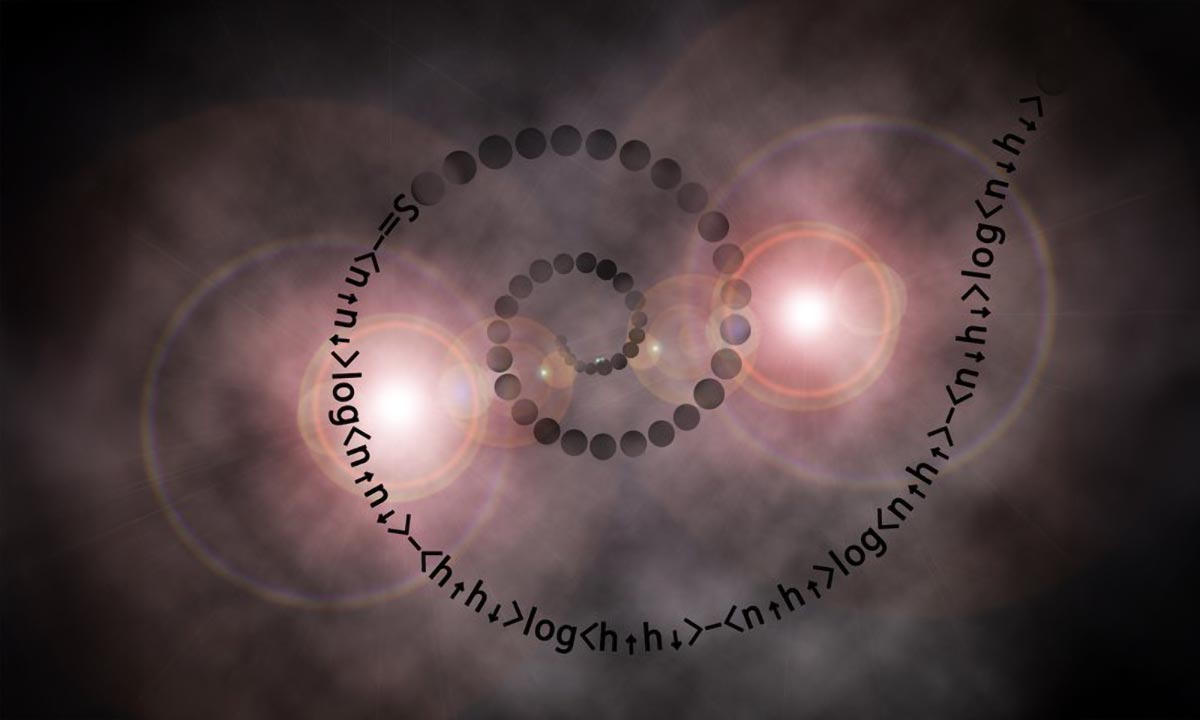
S=-n↑n↓logn↑n↓–h↑h↓logh↑h↓–n↑h↑logn↑h↑–n↓h↓logn↓h↓
in which 𝑛↑, 𝑛↓ are the numbers of up- and down-spin electrons and h↑, h↓ are the numbers of up and down holes (operators) within the target atom.
Reference: “Quantum entanglement in a pure state of strongly correlated quantum impurity systems” by Yunori Nishikawa and Tomoki Yoshioka, 7 January 2025, Physical Review B.
DOI: 10.1103/PhysRevB.111.035112
The study was published in Physical Review B.
Never miss a breakthrough: Join the SciTechDaily newsletter.
Follow us on Google and Google News.
2 Comments
This same formula gets you 30 lives in Contra.
This is a demonstration work for the quantum operator and entropy,in classical computational background,is a typical exercise to derive present formulation for entanglement and related quantum property.Here,the system is closed,as artificial.