
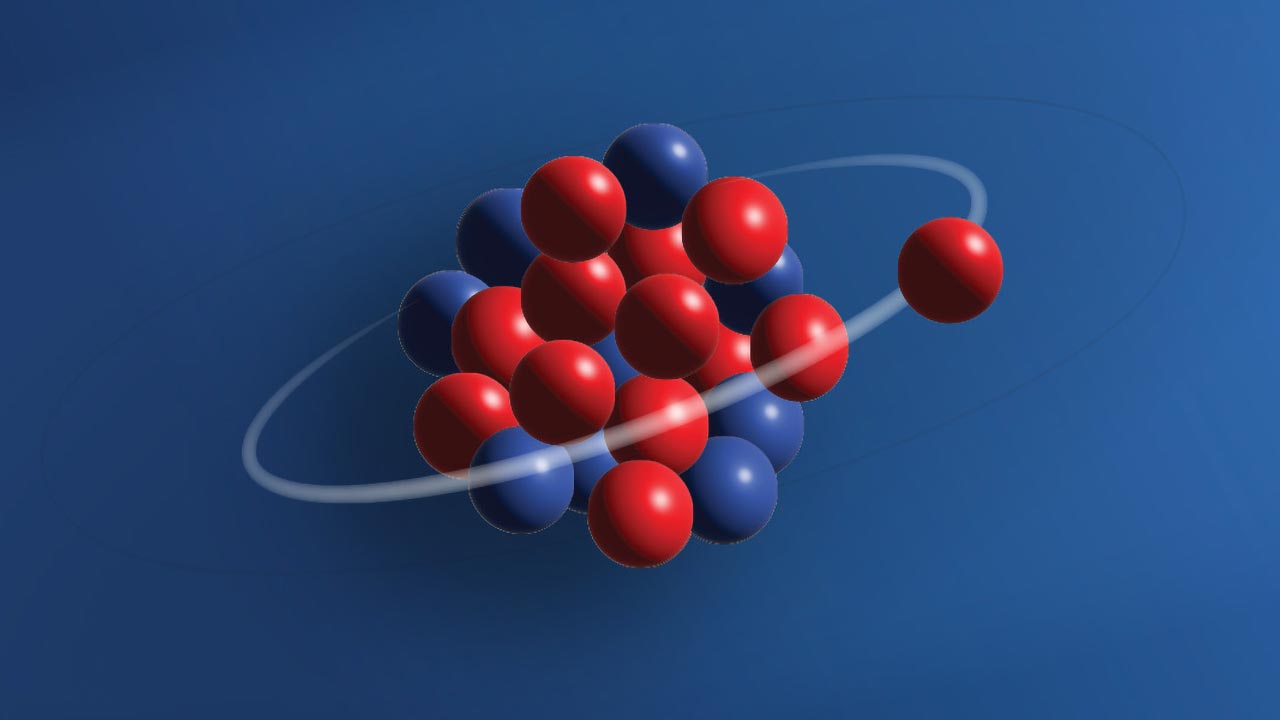
At the cutting-edge Facility for Rare Isotope Beams, researchers have precisely measured the mass of aluminum-22, revealing insights into the “proton dripline” and the delicate balance of nuclear forces.
Their findings offer a deeper understanding of how atomic nuclei behave at their stability limits and provide a critical test of nuclear theories through the observation of phenomena like proton halos.
Pioneering Discoveries in Nuclear Physics
Researchers at the Facility for Rare Isotope Beams (FRIB) have achieved a high-precision measurement of aluminum-22’s mass, reaching the “proton dripline” — a critical boundary in the nuclear chart. The proton dripline marks the edge where protons and neutrons can form stable atomic nuclei. Beyond this boundary, additional protons cannot remain bound to the nucleus and are quickly ejected.
This unique limit challenges our understanding of nuclear structure and stability. Close to the dripline, exotic phenomena like “nuclear halos” occur, where a dense core nucleus is surrounded by loosely bound protons or neutrons forming a halo. Measurements like this one of aluminum-22 are vital for revealing how tightly atomic nuclei hold together as they approach these extreme limits.
Enhancing Rare Isotope Research
FRIB has delivered 270 rare-isotope beams to experiments since the start of user operation in May 2022. As FRIB enhances capability based on scientific needs, it provides rare isotopes not available at any other facility. Measurements of very rare isotopes are key to testing nuclear theory. The best test cases exhibit exotic characteristics that challenge a theory’s predictive capabilities; nuclear halos are one of these test cases.
Researchers used this mass measurement of aluminum-22 to determine the energy required to remove the outermost proton in the isotope. For a nucleus to form a proton halo, the last proton added must be very loosely bound to that nucleus. The research found this to be the case for aluminum-22.
Advanced Techniques in Isotope Measurement
Researchers used the Advanced Rare Isotope Separator at FRIB, a Department of Energy Office of Science user facility, to produce, separate, and identify a beam of aluminum-22 at relativistic energies. The researchers then sent the beam to the Beam Stopping Facility, where the beam was stopped and extracted at low energy using the Advanced Cryogenic Gas Stopper (ACGS).
Next, the beam was sent to the Low Energy Beam and Ion Trap (LEBIT) facility, where the ions were injected into a device known as a Penning trap, which uses electric and magnetic fields to store the ions in space. The researchers then measured the mass of the ions with high precision by observing the ions’ motion in the trap.
The team used a detection technique newly implemented at LEBIT called the Phase Imaging Ion Cyclotron Resonance (PI-ICR) technique. This enabled a measurement with a precision of better than 20 parts per billion, a challenge given the very short half-life of aluminum-22, at only 91 milliseconds.
Future Prospects at FRIB
This work demonstrates the potential of FRIB when combined with state-of-the-art beam stopping, using ACGS and mass measurements with LEBIT. In the future, FRIB will ultimately provide two orders of magnitude more beam current, increasing the reach of LEBIT to even more exotic areas of the nuclear landscape.
For more on this research, see Inside the Proton Halo: Precision Measurements Unravel Nuclear Puzzles.
Reference: “Precision Mass Measurement of the Proton Dripline Halo Candidate 22Al” by S. E. Campbell, G. Bollen, B. A. Brown, A. Dockery, C. M. Ireland, K. Minamisono, D. Puentes, B. J. Rickey, R. Ringle, I. T. Yandow, K. Fossez, A. Ortiz-Cortes, S. Schwarz, C. S. Sumithrarachchi and A. C. C. Villari, 9 April 2024, Physical Review Letters.
DOI: 10.1103/PhysRevLett.132.152501
This material is based upon work supported by the Department of Energy Office of Science, Office of Nuclear Physics, and the U.S. National Science Foundation.
Never miss a breakthrough: Join the SciTechDaily newsletter.
Follow us on Google and Google News.
1 Comment
Give the poor atom on the brink of existence something to eat and a place to stay.