
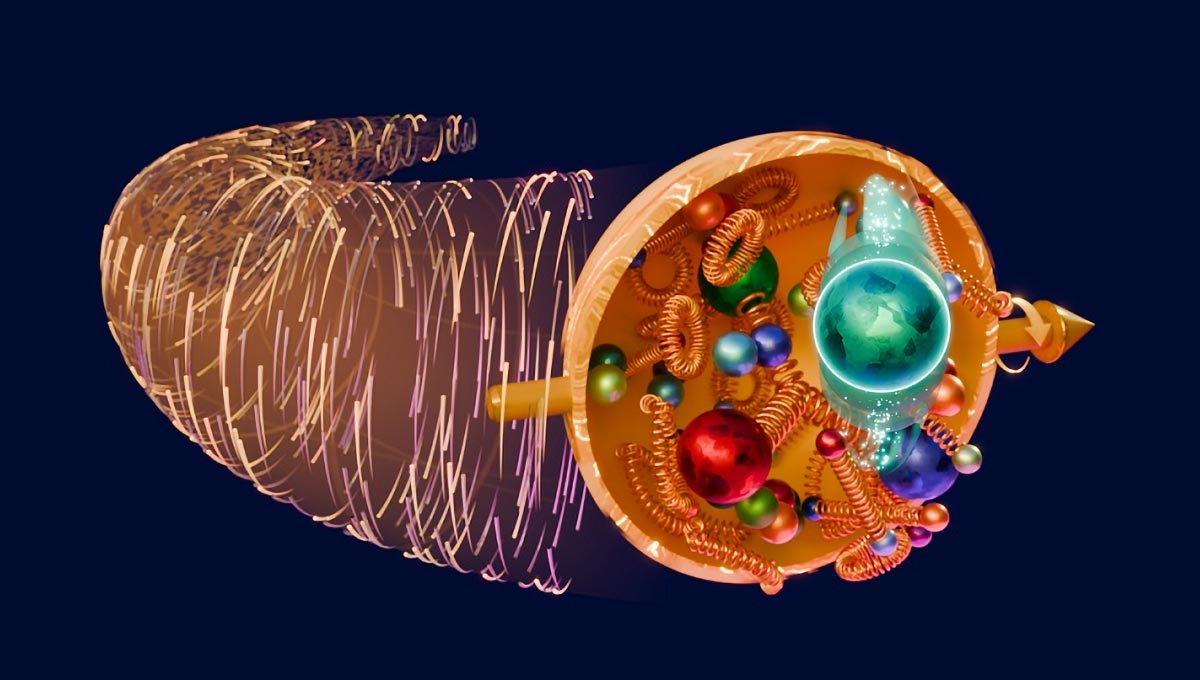
Nuclear scientists have developed a new theoretical approach that offers a more precise calculation of the 3D motion of quarks within a proton, significantly enhancing the understanding of these particles’ transverse motions.
This breakthrough enables predictions of quark and gluon behavior for future collider experiments at facilities like the upcoming Electron-Ion Collider and the European Large Hadron Collider, ultimately aiming to better understand proton spin dynamics.
New Theoretical Approach in Nuclear Physics
Implications for Future Collider Experiments
Unraveling the origin of proton spin is a central goal of the future Collider (EIC). The EIC’s collisions of spin-aligned protons with high-energy electrons will accurately measure the transverse motion of quarks and gluons within protons. This precise 3D imaging will reveal how the transverse motion of quarks and gluons contributes to a proton’s overall spin.
This new theory-based approach provides the first accurate calculations of how the distribution of quarks’ transverse momentum within protons changes with collision energy. The approach will provide significantly more accurate theoretical predictions for the small transverse motions of quarks inside protons. This will eliminate the need to model the most complex strong-force governed quark-gluon interactions.
Advancements in Quantum Chromodynamics
Nuclear theorists at Brookhaven National Laboratory and Argonne National Laboratory have successfully employed a new theoretical approach to calculate the Collins-Soper kernel, a quantity that describes how the distribution of quarks’ transverse momentum inside a proton changes with the collision energy. The team used lattice quantum chromodynamics (QCD), supercomputer-based simulations that track quark-gluon interactions on a 4D space-time lattice.
The new theoretical approach enabled the team to significantly simplify their lattice QCD calculations and obtain precise results for even the small transverse motion of quarks, where the quark-gluon interactions become strong and complex. Such precise descriptions of the small transverse motion of quarks could not be achieved in previous lattice QCD calculations that used more conventional approaches.
Enhancing Predictive Accuracy
The new results for low-transverse-momentum quarks are consistent with previous results but are much more precise and have significantly smaller uncertainties. They also match up with models developed to explain existing experimental data.
These achievements demonstrate that the new approach can be used to predict and interpret future experimental results at different collision energies at the EIC, which is being built at Brookhaven National Laboratory, and the European Large Hadron Collider. Physicists will use these predictions and experiments to learn about quarks’ small transverse motion within protons and how that motion contributes to proton spin.
References:
“Parton distributions from boosted fields in the Coulomb gauge” by Xiang Gao, Wei-Yang Liu and Yong Zhao, 10 May 2024, Physical Review D.
DOI: 10.1103/PhysRevD.109.094506
“Nonperturbative Collins-Soper kernel from chiral quarks with physical masses” by Dennis Bollweg, Xiang Gao, Swagato Mukherjee and Yong Zhao, 2 April 2024, Physics Letters B.
DOI: 10.1016/j.physletb.2024.138617
This work was supported by the Department of Energy (DOE) Office of Science, Office of Nuclear Physics, within the frameworks of the Scientific Discovery through Advanced Computing (SciDAC) award “Fundamental Nuclear Physics at the Exascale and Beyond,” by the “Quark-Gluon Tomography” Topical Collaboration, by a DOE Office of Science Early Career Award, and by the National Science Foundation. This research used awards of computer time provided by the INCITE program at Argonne Leadership Computing Facility, the ALCC program at the Oak Ridge Leadership Computing Facility, and the National Energy Research Scientific Computing Center.
Never miss a breakthrough: Join the SciTechDaily newsletter.
Follow us on Google and Google News.
4 Comments
The big problem with, apparently, all these people is the poor habit of trying to reify mistaken or wrong models – which usually are accepting what was told to them – even when it came with the caveat that the model doesn’t work quite yet.
You gotta push yourself back from your tunnel vision and start using your own mind. Otherwise you join the college of dummies.
This is big message for the future
I’m not a god believer but all these subatomic particles and the rules that govern their interactions didn’t just magically appear as the result of a big explosion!
Where did the rules of nature come from?
Where did God come from?
It’s the exact same problem for both. And the exact same proclamations trying to solve it apply equally to both.
There is no answer in science for or against a God. That’s for you and you alone to figure out for yourself.
If the Scientists read the Bible, they’d know that quark have a “Cross” motion.
It takes three “crosses”.
Two “down” or thieves”, and one “up”.