
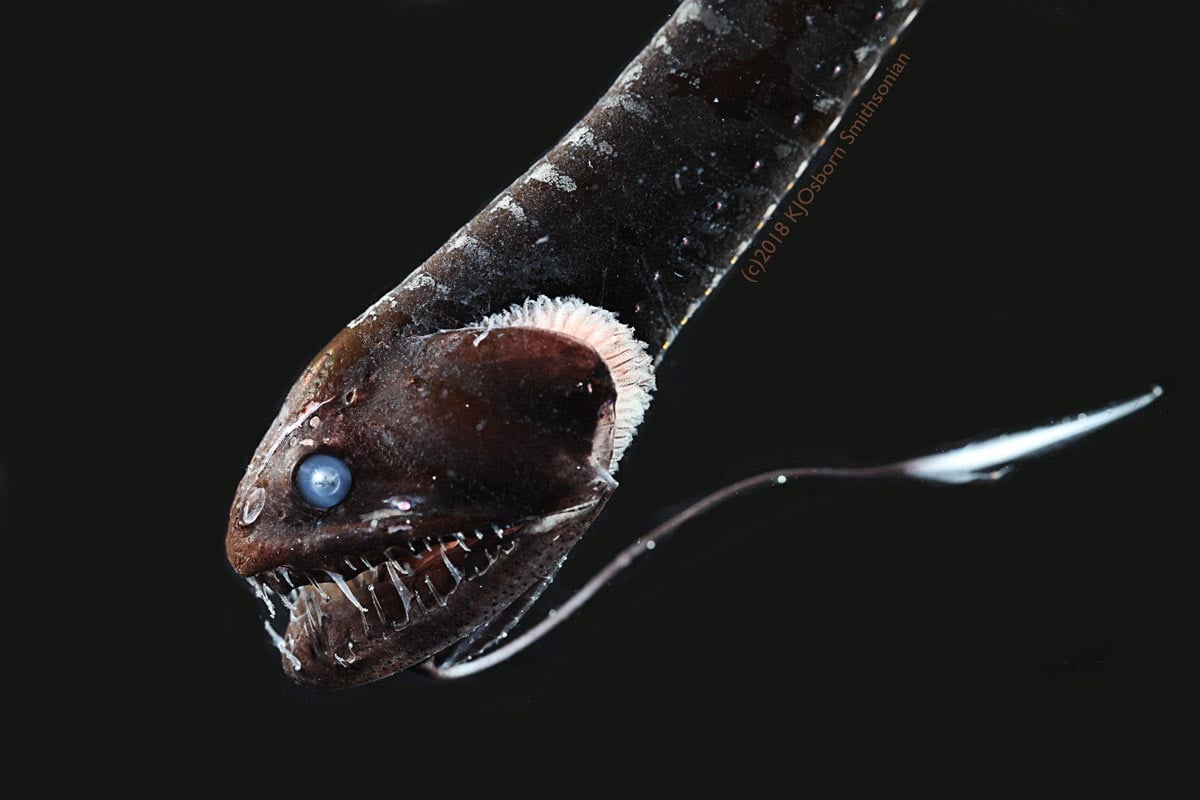
Packed pigment granules help them blend in without blowing their cover.
If there were a stagehand of the sea, wearing black to disappear into the darkness backstage, it might be the dragonfish. Or the common fangtooth.
These fish live in the ocean’s inky depths where there is nowhere to take cover. Even beyond the reach of sunlight, they can still be caught in the glow of bioluminescent organisms that illuminate the water to hunt. So they evade detection with a trick of their own: stealth wear.
Scientists report that at least 16 species of deep-sea fish have evolved ultra-black skin that absorbs more than 99.5% of the light that hits them, making them nearly impossible to pick out from the shadows.
These fish owe their disappearing act to tiny packets of pigment within their skin cells called melanosomes. The melanosomes of ultra-black fish are differently shaped and arranged, on a microscopic level, compared with regular black fish, says a study led by Duke University and the Smithsonian National Museum of Natural History.
The researchers say the work could lead to new light-trapping materials for use in applications ranging from solar panels to telescopes.
For the paper, published on July 16, 2020, in the journal Current Biology, the team used a trawl net and a remotely operated vehicle to scoop up 39 black fish swimming up to a mile deep in the waters of Monterey Bay and the Gulf of Mexico, and bring them up to a ship to study.
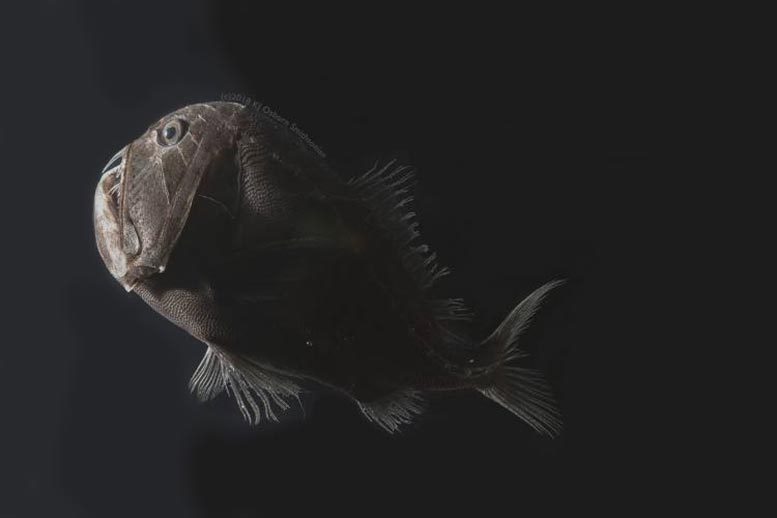
Using a spectrometer to measure the amount of light reflected off the fishes’ skin, the researchers identified 16 species that reflected less than 0.5% of light, making them some 20 times darker and less reflective than everyday black objects.
“Ultra-black arose more than once across the fish family tree,” said first author Alexander Davis, a biology Ph.D. student in Sonke Johnsen’s lab at Duke.
The darkest species they found, a tiny anglerfish not much longer than a golf tee, soaks up so much light that almost none — 0.04% — bounces back to the eye. Only one other group of black animals, the birds-of-paradise of Papua New Guinea with their ultra-dark plumage, are known to match them.
Getting decent photos of these fish onboard the ship was tough; their features kept getting lost. “It didn’t matter how you set up the camera or lighting — they just sucked up all the light,” said research zoologist Karen Osborn of the Smithsonian National Museum of Natural History.
The team found that, when magnified thousands of times under electron microscopes, normal black skin and ultra-black skin look very different. Both have tiny structures within their cells that contain melanin — the same pigment that lends human skin its color. What sets ultra-black fish apart, they say, is the shape and arrangement of these melanosomes.
Other cold-blooded animals with normal black skin have tiny pearl-shaped melanosomes, while ultra-black ones are larger, and more tic-tac-shaped. And ultra-black skin has melanosomes that are more tightly packed together, forming a continuous sheet around the body, whereas normal black skin contains unpigmented gaps.
The researchers ran some computer models, simulating fish skin containing different sizes and shapes of melanosomes, and found that ultra-black melanosomes have the optimal geometry for swallowing light.
Melanosomes are packed into the skin cells “like a tiny gumball machine, where all of the gumballs are of just the right size and shape to trap light within the machine,” Davis said.
Their ultra-black camouflage could be the difference between eating and getting eaten, Davis says. By being blacker than black, these fish manage to avoid detection even at six-fold shorter ranges.
Read How Deep-Sea, Ultra-Black Fish Disappear for more on this research.
Reference: “Ultra-black Camouflage in Deep-Sea Fishes” by Alexander L. Davis, Kate N. Thomas, Freya E. Goetz, Bruce H. Robison, Sönke Johnsen and Karen J. Osborn, 16 July 2020, Current Biology.
DOI: 10.1016/j.cub.2020.06.044
Funding for this work was provided by a NOAA Ocean Exploration and Research grant (NA17OAR0110208), a National Defense Science and Engineering Graduate Fellowship, the Smithsonian National Museum of Natural History, and the biology department at Duke.
Never miss a breakthrough: Join the SciTechDaily newsletter.
Follow us on Google and Google News.