

Scientists have set a new record for superconductivity at normal pressure, bringing the field closer to practical, real-world applications.
Researchers at the University of Houston have achieved a major milestone in the race toward practical superconductors, setting a new temperature record under everyday pressure conditions. The advance could eventually help reduce energy waste, lower costs, and improve technologies ranging from power grids to medical imaging.
The team, based at the Texas Center for Superconductivity (TcSUH), reported a transition temperature (Tc) of 151 Kelvin (about minus 122 degrees Celsius, or about minus 188 degrees Fahrenheit). That is now the highest temperature ever recorded for a superconductor operating at ambient pressure. Tc is the threshold below which a material can carry electricity with zero resistance, eliminating energy loss.
The study, led by University of Houston physicists Ching-Wu Chu and Liangzi Deng, was in the Proceedings of the National Academy of Sciences. Funding came from Intellectual Ventures, the state of Texas through TcSUH, and other organizations.
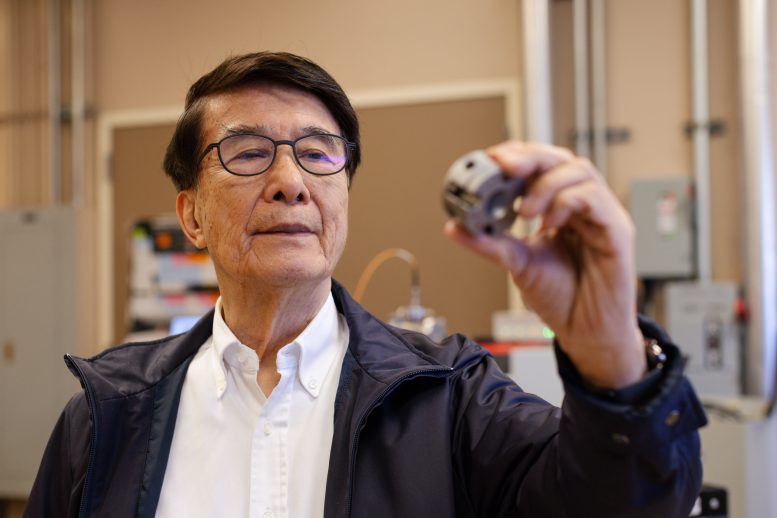
“Transmitting electricity in the grid loses about 8% of the electricity,” said Chu, professor of physics, TcSUH founding director and the paper’s senior author. “If we conserve that energy, that’s billions of dollars of savings, and it also saves us lots of effort and reduces environmental impacts.”
Research Background and Energy Impact
Superconductors already power technologies such as MRI machines and particle accelerators, and they are considered essential for future systems like fusion reactors and ultra-efficient electronics. The challenge has always been temperature. Most superconductors must be cooled to extremely low levels, often using expensive liquid helium, which limits large-scale adoption.
For decades, scientists have been trying to push Tc higher. The closer it gets to room temperature, the more realistic widespread use becomes. The new result does not reach that goal, but it significantly narrows the gap and introduces a promising new approach.
Challenges of Superconductors and Accessibility
“Once we bring the material to ambient pressure, it becomes much more accessible for scientists to use well-developed instrumentation to investigate it and further develop technologies for ambient condition operations,” said Deng, assistant professor of physics, principal investigator at the TcSUH, and lead author of the paper.
Progress toward higher-temperature superconductors has advanced steadily for more than 50 years. In 1987, Chu and colleagues discovered that YBCO becomes superconducting at minus 180 degrees Celsius (minus 292 degrees Fahrenheit, or 93 K), which sparked global efforts to develop high-temperature superconductors.
Later, in 1993, researchers identified a mercury-based copper oxide material called Hg1223 that operates at minus 140 degrees Celsius (minus 220 degrees Fahrenheit, or 133 K), holding the ambient pressure record until now.
New Record and Pressure Quenching Method
The new result raises that record by 18 degrees Celsius (32 degrees Fahrenheit), reaching 151 K.
The breakthrough relies on a method called pressure quenching, which is new to superconductors but widely used in processes such as diamond formation. Researchers first apply very high pressure to enhance the material’s properties and increase its transition temperature.
While still under pressure, the material is cooled to a target temperature and then rapidly returned to normal pressure, effectively “locking in” the improved superconducting behavior. This allows the material to maintain its higher Tc without continued pressure, keeping it stable under everyday conditions.
Stabilizing Superconductivity Without Pressure
“Other researchers have shown that reaching superconductivity at room temperature under pressure is achievable,” Chu said. “Our method shows that it is possible to retain that state without maintaining pressure.”
Although achieving room-temperature superconductivity at ambient pressure, around 300 K, remains the ultimate goal, the researchers say this milestone is an important advance.
“This finding has great potential,” Chu said. “We believe, with enough people working on it and given enough time, we should be able to realize the potential.”
Future Outlook and Scientific Collaboration
Chu and Deng also contributed to a companion perspective paper from Intellectual Ventures, the study’s main funder. Published in PNAS, the paper outlines six strategies for modifying materials to achieve higher superconducting temperatures, including pressure quenching, according to Rohit Prasankumar, director of superconductivity research at Intellectual Ventures.
“Room-temperature superconductivity has been seen as a ‘holy grail’ by scientists for over a century,” Prasankumar said. “The UH team’s result shows that this goal is closer than ever before. However, the distance between the new record set in this study and room temperature is still about 140 degrees C. Closing this gap will require concerted, intentional efforts by the broader scientific community, including materials scientists, chemists, and engineers, as well as physicists.”
References:
“Ambient-pressure 151-K superconductivity in HgBa2Ca2Cu3O8+δ via pressure quench” by Liangzi Deng, Thacien Habamahoro, Artin Safezoddeh, Bishnu Karki, Sudaice Kazibwe, Daniel J. Schulze, Zheng Wu, Matthew Julian, Rohit P. Prasankumar, Hua Zhou, Jesse S. Smith, Pavan R. Hosur and Ching-Wu Chu, 9 March 2026, Proceedings of the National Academy of Sciences.
DOI: 10.1073/pnas.2536178123
“The path to room-temperature superconductivity: A programmatic approach” by Rohit P. Prasankumar, Matthew Julian, Michael Hutcheon, Christoph Heil, Liangzi Deng, Dmitri Basov, Ching-Wu Chu, Riccardo Comin, Philip Kim, Bryce Meredig, Chris Pickard, Warren E. Pickett, Timothy Strobel, Stuart Wolf, Eva Zurek and Nathan Myhrvold, 9 March 2026, Proceedings of the National Academy of Sciences.
DOI: 10.1073/pnas.2520324123
Never miss a breakthrough: Join the SciTechDaily newsletter.
Follow us on Google and Google News.
1 Comment
Tc is only one of the real world challenges especially in eg MRI and high field magnets. Local magnetic field strength and mechanical stress also play huge parts in determining it’s true usefulness, and the processes to form the required geometries will need intense development to fully commercialise any ‘breakthrough’.
Not knocking the result but the statement that it brings it “closer to practical, real-world applications” may be academically true but realistically it’s WAY off..