
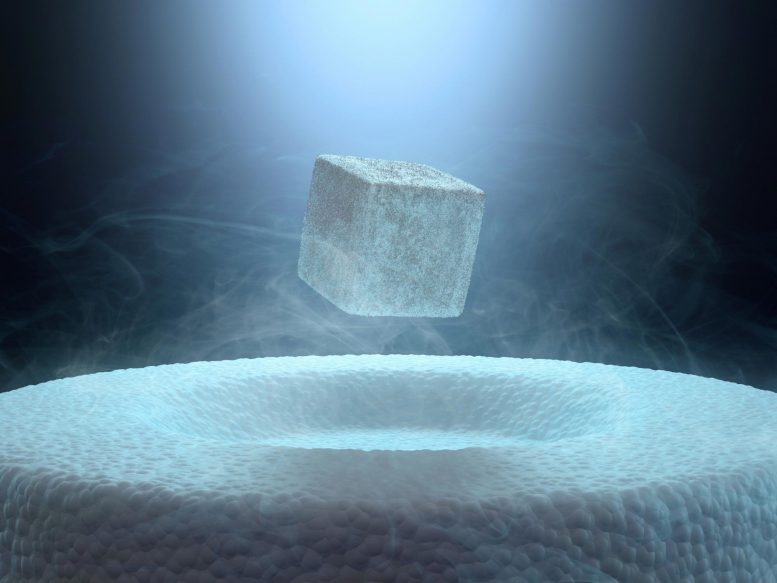
TU Wien has performed calculations that suggest the use of the precious metal palladium as a “Goldilocks” material for creating superconductors that remain superconductive even at relatively high temperatures.
In the realm of modern physics, an exhilarating pursuit is underway: identifying the optimal method for creating superconductors that maintain their superconductivity at high temperatures and ambient pressure. This quest has been invigorated in recent times by the emergence of nickelates, ushering in a new era of superconductivity.
The foundation of these superconductors lies in nickel, prompting numerous scientists to refer to this period of superconductivity research as the “nickel age.” In numerous aspects, nickelates are similar to cuprates, which were found in the 1980s and based on copper.
But now a new class of materials is coming into play: In a cooperation between TU Wien and universities in Japan, it was possible to simulate the behavior of various materials more precisely on the computer than before.
There is a “Goldilocks zone” in which superconductivity works particularly well. And this zone is reached neither with nickel nor with copper, but with palladium. This could usher in a new “age of palladates” in superconductivity research. The results have now been published in the scientific journal Physical Review Letters.
The Search for Higher Transition Temperatures
At high temperatures, superconductors behave very similarly to other conducting materials. But when they are cooled below a certain “critical temperature”, they change dramatically: their electrical resistance disappears completely and suddenly they can conduct electricity without any loss. This limit, at which a material changes between a superconducting and a normally conducting state, is called the “critical temperature”.
“We have now been able to calculate this “critical temperature” for a whole range of materials. With our modeling on high-performance computers, we were able to predict the phase diagram of nickelate superconductivity with a high degree of accuracy, as the experiments then showed later,” says Prof. Karsten Held from the Institute of Solid State Physics at TU Wien.
Many materials become superconducting only just above absolute zero (-273.15°C), while others retain their superconducting properties even at much higher temperatures. A superconductor that still remains superconducting at normal room temperature and normal atmospheric pressure would fundamentally revolutionize the way we generate, transport, and use electricity. However, such a material has not yet been discovered.
Nevertheless, high-temperature superconductors, including those from the cuprate class, play an important role in technology – for example, in the transmission of large currents or in the production of extremely strong magnetic fields.
Copper? Nickel? Or Palladium?
The search for the best possible superconducting materials is difficult: there are many different chemical elements that come into question. You can put them together in different structures, you can add tiny traces of other elements to optimize superconductivity. “To find suitable candidates, you have to understand on a quantum-physical level how the electrons interact with each other in the material,” says Prof. Karsten Held.
This showed that there is an optimum for the interaction strength of the electrons. The interaction must be strong, but also not too strong. There is a “golden zone” in between that makes it possible to achieve the highest transition temperatures.
Palladates As the Optimal Solution
This golden zone of medium interaction can be reached neither with cuprates nor with nickelates – but one can hit the bull’s eye with a new type of material: so-called palladates. “Palladium is directly one line below nickel in the periodic table. The properties are similar, but the electrons there are on average somewhat further away from the atomic nucleus and each other, so the electronic interaction is weaker,” says Karsten Held.
The model calculations show how to achieve optimal transition temperatures for palladium data. “The computational results are very promising,” says Karsten Held. “We hope that we can now use them to initiate experimental research. If we have a whole new, additional class of materials available with palladates to better understand superconductivity and to create even better superconductors, this could bring the entire research field forward.”
Reference: “Optimizing Superconductivity: From Cuprates via Nickelates to Palladates” by Motoharu Kitatani, Liang Si, Paul Worm, Jan M. Tomczak, Ryotaro Arita and Karsten Held, 20 April 2023, Physical Review Letters.
DOI: 10.1103/PhysRevLett.130.166002
Never miss a breakthrough: Join the SciTechDaily newsletter.
Follow us on Google and Google News.
5 Comments
Palladium is not abundant, and the sources for it typically are low grade, meaning moving a lot of rock and expending a lot of energy to obtain it. This is interesting, but I don’t think we can expect to make superconducting power-lines out of palladates.
Get that space asteroid mining operation going because rare metals on Earth aren’t going to cut it. The article doesn’t even address the rarity of Palladium, which is a platinum-like grouping of elements along with Platinum itself, Rhodium, Iridium, Osmium and Ruthenium, none of which are plentiful on Earth. Superconducting only for the ultra-rich?
Thank you for all your efforts on keeping all of us informed, ive chosen a career because of your collective writing
Best High-Temperature Superconductors for Maglev Trains
1. Carbon-Based Superconductors (Graphene and Carbon Nanotubes)
Graphene
Operating Temperature: Potentially higher than -100°C with advanced doping.
Why It’s Ideal for Maglev Trains:
Extremely lightweight, strong, and flexible.
Potential to reach superconducting states at near-room temperatures under specific conditions.
Excellent for future maglev designs requiring less cooling infrastructure.
Availability:
Currently limited by high production costs, but scalability is improving.
Cost Factors:
Expensive at present, but advancements in graphene production could make it viable in the future.
Carbon Nanotubes (CNTs)
Operating Temperature: Similar to graphene, with superconductivity achievable near -100°C under certain conditions.
Why It’s Ideal for Maglev Trains:
Exceptional conductivity and mechanical strength.
Potential to reduce cooling requirements in next-generation maglev systems.
Availability:
More scalable than graphene, though still costly for large-scale applications.
2. Room-Temperature Superconductors (Metal Hydrides)
Operating Temperature: Up to room temperature under high pressures (e.g., Lanthanum Hydride or Carbonaceous Sulfur Hydride).
Why It’s Ideal for Maglev Trains:
Could eliminate the need for cryogenic cooling entirely, revolutionizing maglev design.
High energy efficiency and strong magnetic properties at ambient temperatures.
Availability:
Currently impractical due to the requirement for extreme pressures, but advancements in stabilizing these materials could make them viable.
Cost Factors:
High production and infrastructure costs today, with the potential to drop as the technology evolves.
Recommendations for High-Temperature Superconductors in Maglev Applications
Emerging Technologies (Future Potential):
Graphene and CNTs: Offer higher-temperature operation and superior mechanical properties but require advancements in production and scalability.
Room-Temperature Superconductors (Metal Hydrides): The ultimate solution for room-temperature superconductivity, eliminating cooling infrastructure if their high-pressure requirements are resolved.
Conclusion
For maglev trains operating at higher temperatures:
Graphene and carbon nanotubes hold significant promise as scalable high-temperature superconductors, offering exceptional properties for next-generation maglev designs.
Metal hydrides represent the future of superconductivity, with the potential to revolutionize transportation by eliminating the need for cryogenic systems entirely. As technology evolves, these materials could make maglev trains more efficient, cost-effective, and accessible.
For a cost-effective, high-temperature superconductor suitable for power lines:
YBCO and MgB2 are the best immediate options.
In the future, graphene, carbon nanotubes, and room-temperature metal hydrides hold the most promise as their technologies mature. These materials could enable superconducting power lines that function efficiently at higher temperatures, reducing the need for extensive cryogenic infrastructure.