
“These are times of major changes in the environment, and how those changes impact the organisms is relevant to understanding our current environment and environmental changes.”
During periods of environmental disturbance, how do communities of organisms react? If entire species become extinct, do the remaining species move in to occupy the vacant areas, or do new species come in to fill the void?
Sarah Brisson, a Ph.D. student in the Department of Earth Sciences at UConn, aimed to investigate these questions. The results of her research have been published in the Proceedings of the Royal Society B.
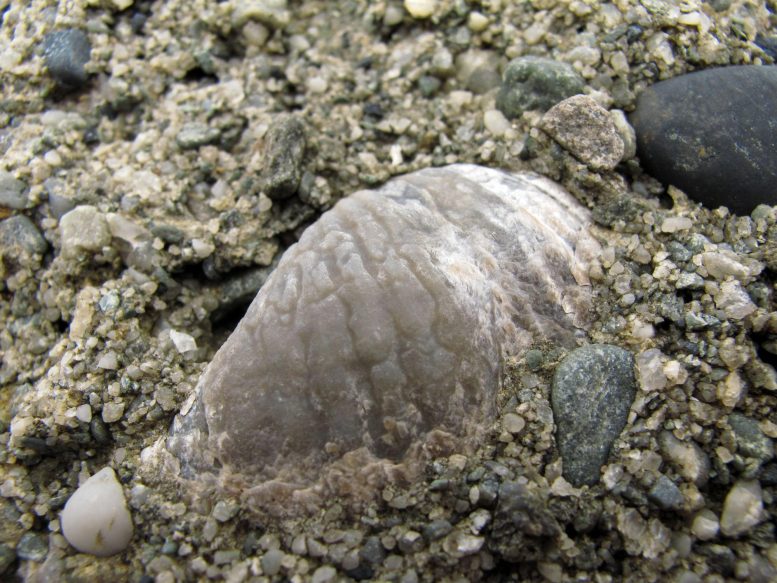
Brisson studies a mass extinction event that happened in the Late Devonian period, around 370 million years ago, with the goal of understanding how ecosystems and the communities of organisms within them respond. For this study, Brisson focused on small, shelled, ocean-dwelling creatures called brachiopods by studying fossils collected from the Appalachian Basin in New York and Pennsylvania.
“The name ‘mass extinction events’ captures people’s attention. These are times of major changes in the environment, and how those changes impact the organisms is relevant to understanding our current environment and environmental changes,” says Brisson.
In the Late Devonian, the Appalachian Basin was a shallow sea that formed in the wake of the growing mountains. Brisson says the seafloor was likely covered with brachiopods, which were abundant in the sample set. In the water, fish were also becoming more abundant, and on land, a great greening was happening, with new plants evolving for the first time in Earth’s history.
“The Devonian world was very different; there were no flowering plants for millions of years. We’re just setting the stage to move into the Mesozoic — the dinosaur era — where we have big ferns and large, woody trees,” Brisson says.
In studying these ecosystem dynamics, Brisson looks at Earth as a system, with niche changes as just one aspect of the entire structure.
“A niche space is an environment where an organism lives, in this case, the level of substrate disturbance and where along the depth profile the organisms most comfortable with,” says Brisson.
Two concepts to consider are niche conservatism and niche evolution. Brisson explains that with niche conservatism, organisms remain in place and retain their characteristics, whereas with niche evolution organisms change and evolve in some way into preferring the new environmental parameters through time.
“In biology, there’s a lot of talk about niche dynamics, and whether we see niche evolution or niche conservatism and there are not as many researchers studying this in deep time,” says Brisson.
Niche Conservatism Amid Extinction
After painstakingly identifying around 20,000 brachiopod fossils and analyzing their preferences across the depth gradient, Brisson assembled a dataset and used non-metric multi-dimensional scaling (nMDS) to see where different species were grouped across the stratigraphic range over time to interpret how the organisms responded before and after the mass extinction event. Brisson says the results were a bit of a surprise.
“I saw a lot of turnover where some species went extinct, but some species survived and remained in place, and their niches are conserved. Some scientists argue this isn’t the case in a large-scale extinction event and I didn’t expect that niche conservatism would be shown here.”
In extinction events like this one, where an estimated 35% of marine species went extinct, Brisson explains it is expected that the opening of so many niches would encourage nearby surviving species to move in to occupy the newly free space, and the results did show this happening to some extent.
“As a rule, however, we’re seeing niche conservatism in this region. In cases where you might see niche evolution in the rock record, there may have been different pressures on the organisms. I think leaving that question open is important because there are many different selective pressures and not all selective pressures can be applied to every situation.”
Possible Drivers of the Late Devonian Extinction
The factors that drove the extinction pulses in the Late Devonian are still debated, says Brisson. Some work, including co-author and UConn graduate Jaleigh Pier’s ’18 (CLAS) research, indicated a global cooling event took place. Other evidence shows widespread anoxia which could have resulted from an influx of nutrients, much like we see today with dead zones forming in offshore marine and aquatic environments.
“Part of the reason why I love the Devonian is that there are mass extinction events that have been studied so thoroughly, especially the Mesozoic mass extinction event, but there’s less certainty surrounding the Late Devonian. As you’re moving back through time, it’s harder to be certain because some of the proxies used in the Mesozoic don’t apply to the Devonian. It’s a neat and dynamic time to study.”
This work represents just one chapter of Brisson’s dissertation, and future analyses will look at the data further, including stable isotope analysis to understand how nitrogen may have impacted this region. Peering this far into the past may shed light on the accelerating species extinctions of today.
“I do foresee using this method for future studies because it’s a powerful tool for understanding what our ecosystems looked like in the past. It’s really fascinating to take these biological concepts and apply them back through time.”
Reference: “Niche conservatism and ecological change during the Late Devonian mass extinction” by Sarah K. Brisson, Jaleigh Q. Pier, J. Andrew Beard, Anjali M. Fernandes and Andrew M. Bush, 5 April 2023, Proceedings of the Royal Society B: Biological Sciences.
DOI: 10.1098/rspb.2022.2524
Never miss a breakthrough: Join the SciTechDaily newsletter.
Follow us on Google and Google News.
1 Comment
“… it is expected that the opening of so many niches would encourage nearby surviving species to move in to occupy the newly free space…”
The niche concept and theory seems a bit contradictory. Each species has its own niche by definition. So a species moving into a vacant niche would leave the existing space vacant with no net change. In other words a niche doesn’t exist until a species evolves to make and fill it. A niche of a species that is extinct is lost forever and cannot be reopened or filled. It’s a semantic problem, not a real one.