

Close Menu
    Facebook X (Twitter) Instagram
    SciTechDaily
    • Biology
    • Chemistry
    • Earth
    • Health
    • Physics
    • Science
    • Space
    • Technology
    Facebook X (Twitter) Pinterest YouTube RSS
    SciTechDaily
    Home»Biology»Scientists Solve Century-Old Supergene Mystery
    Biology

    Scientists Solve Century-Old Supergene Mystery

    By Stockholm UniversitySeptember 9, 2022No Comments3 Mins Read
    Facebook Twitter Pinterest Telegram LinkedIn WhatsApp Email Reddit
    Share
    Facebook Twitter LinkedIn Pinterest Telegram Email Reddit
    DNA Genetic Analysis Animation
    Scientists have solved the century-old mystery of a supergene that causes efficient cross-pollination in flowers. 

    The Long and Short of a Supergene for Efficient Pollination

    Researchers have solved the century-old mystery of a supergene that causes efficient cross-pollination in flowers. The results reveal that sequence length variation at the DNA level is important for the evolution of two forms of flowers that differ in the length of their sexual organs.

    Since the 1500s, botanists and gardeners have known that some plant species have two forms of flowers that differ reciprocally in the length of their male and female sexual organs. Charles Darwin first proposed that such distylous flowers promoted efficient cross-pollination by insect pollinators. Early geneticists showed that the two forms of flowers were controlled by a single chromosomal region that likely harbored a cluster of genes, a supergene. Until recently, however, this supergene had never been sequenced.
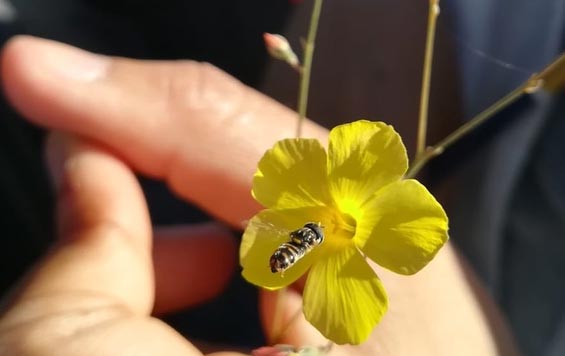
    Pollinator Visiting Linum tenue
    Pollinator visiting Linum tenue. Credit: Juanita Gutiérrez-Valencia

    Now, researchers have solved the mystery of the supergene. They studied a system where already Darwin described distyly, wild flaxseed species, Linum, and used modern DNA sequencing methods to identify the supergene. The study by scientists at Stockholm University, together with partners at Uppsala University, Durham University, University of Granada, and University of Seville, is published today (September 9, 2022) in the journal Current Biology.

    Surprisingly, the researchers discovered that the supergene responsible for differing lengths of male and female sexual organs itself varied in length. Specifically, the dominant form of the supergene contained about 260,000 base pairs of DNA that were missing from the recessive form. The 260,000 base pair stretch of DNA harbored several genes likely to cause length variation in sexual organs.

    Linum tenue Flower
    Linum tenue flowers photographed in the field in Spain. Credit: Benjamin Laenen and Aurélie Désamoré

    ”These results were really surprising to us, because a similar genetic makeup of the supergene that governs distyly has previously been identified in another system, primroses, where it evolved completely independently,” said Tanja Slotte, senior author of the study and Professor in Ecological Genomics at Stockholm University.

    ”Not only has evolution repeatedly led to similar variation in the flowers of primroses and flaxseed species, it has also relied on a similar genetic solution to achieve this feat,” said Juanita Gutiérrez-Valencia, PhD, first author of the study and student at Stockholm University.
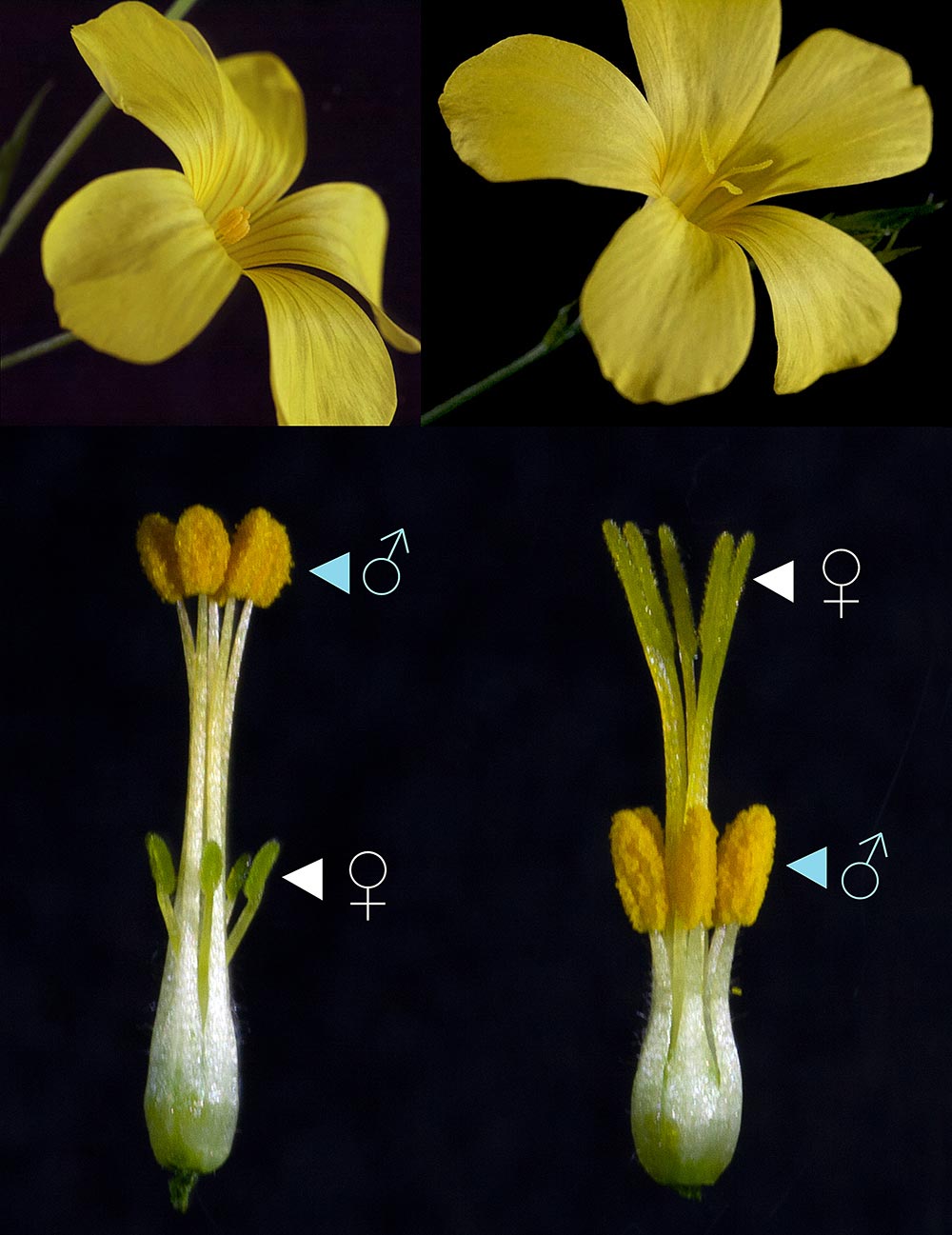
    Sexual Organs of Fine Flax
    The two forms of flowers of fine flax, Linum tenue, differ reciprocally in the length of their sexual organs. The top panel shows entire flowers whereas the bottom part shows the reproductive structures within the flowers, with arrows indicating male and female sexual organs. Credit: Juanita Gutiérrez-Valencia

    These discoveries provide new insights into the remarkable power of evolution to find convergent solutions to widespread adaptive challenges such as the need for flowering plants to be cross-pollinated.

    ”Distyly is ultimately a mechanism for efficient cross-pollination. Understanding pollination mechanisms is particularly important today given climate change and challenges faced by both plant and insect pollinator populations,” said Professor Tanja Slotte.

    Reference: “Genomic analyses of the Linum distyly supergene reveal convergent evolution at the molecular level” by Juanita Gutiérrez-Valencia, Marco Fracassetti, Emma L. Berdan, Ignas Bunikis, Lucile Soler, Jacques Dainat, Verena E. Kutschera, Aleksandra Losvik, Aurélie Désamoré, P. William Hughes, Alireza Foroozani, Benjamin Laenen, Edouard Pesquet, Mohamed Abdelaziz, Olga Vinnere Pettersson, Björn Nystedt, Adrian C. Brennan, Juan Arroyo and Tanja Slotte, 9 September 2022, Current Biology.
    DOI: 10.1016/j.cub.2022.08.042

    Never miss a breakthrough: Join the SciTechDaily newsletter.
    Follow us on Google and Google News.

    DNA Flowers Genetics Popular Stockholm University
    Share. Facebook Twitter Pinterest LinkedIn Email Reddit

    Related Articles

    World’s Oldest DNA – 1.2 Million Years Old – Reveals How Mammoths Evolved

    Scientists Discover Genes for a Longer, Healthier Life

    New Epigenetic Algorithm Accurately Predicts Male Sexual Orientation

    Prolific Changes in the Human Genome in the Past 5,000 Years

    Mitochondrial Transfer Technology Could Reduce Risk of Childhood Disease

    Improved Estimates of DNA’s Mutation Rate Paint Clearer Picture of Human Prehistory

    Butterfly Research Reveals Genetic Sharing from Hybridization

    3-D Image Shows How DNA Packs Itself into a “Fractal Globule”

    Researchers Complete Genome Sequence of a Denisovan Human Finger Bone

    Leave A Reply Cancel Reply

    • Facebook
    • Twitter
    • Pinterest
    • YouTube

    Don't Miss a Discovery

    Subscribe for the Latest in Science & Tech!

    Trending News

    Popular Sugar-Free Sweetener Linked to Liver Disease, Study Warns

    What Is Hantavirus? The Deadly Disease Raising Alarm Worldwide

    Scientists Just Discovered How the Universe Builds Monster Black Holes

    Scientists Unveil New Treatment Strategy That Could Outsmart Cancer

    A Simple Vitamin May Hold the Key to Treating Rare Genetic Diseases

    Scientists Think the Real Fountain of Youth May Be Hiding in Your Gut

    Ravens Don’t Follow Wolves, They Predict Them

    This Common Knee Surgery May Be Doing More Harm Than Good

    Follow SciTechDaily
    • Facebook
    • Twitter
    • YouTube
    • Pinterest
    • Newsletter
    • RSS
    SciTech News
    • Biology News
    • Chemistry News
    • Earth News
    • Health News
    • Physics News
    • Science News
    • Space News
    • Technology News
    Recent Posts
    • Scientists May Have Found a Way To Repair Nerve Damage in Multiple Sclerosis
    • GLP-1 Weight Loss Linked To Dramatically Lower Risk of Sleep Apnea, Kidney Disease and More
    • Scientists Uncover the Surprising Source of Strange Clouds Near the Milky Way’s Supermassive Black Hole
    • This Dazzling Green Snake Was Hiding in Plain Sight for Decades
    • Scientists Discover That a Single Dose of Psilocybin Changes the Human Brain
    Copyright © 1998 - 2026 SciTechDaily. All Rights Reserved.
    • Science News
    • About
    • Contact
    • Editorial Board
    • Privacy Policy
    • Terms of Use

    Type above and press Enter to search. Press Esc to cancel.