
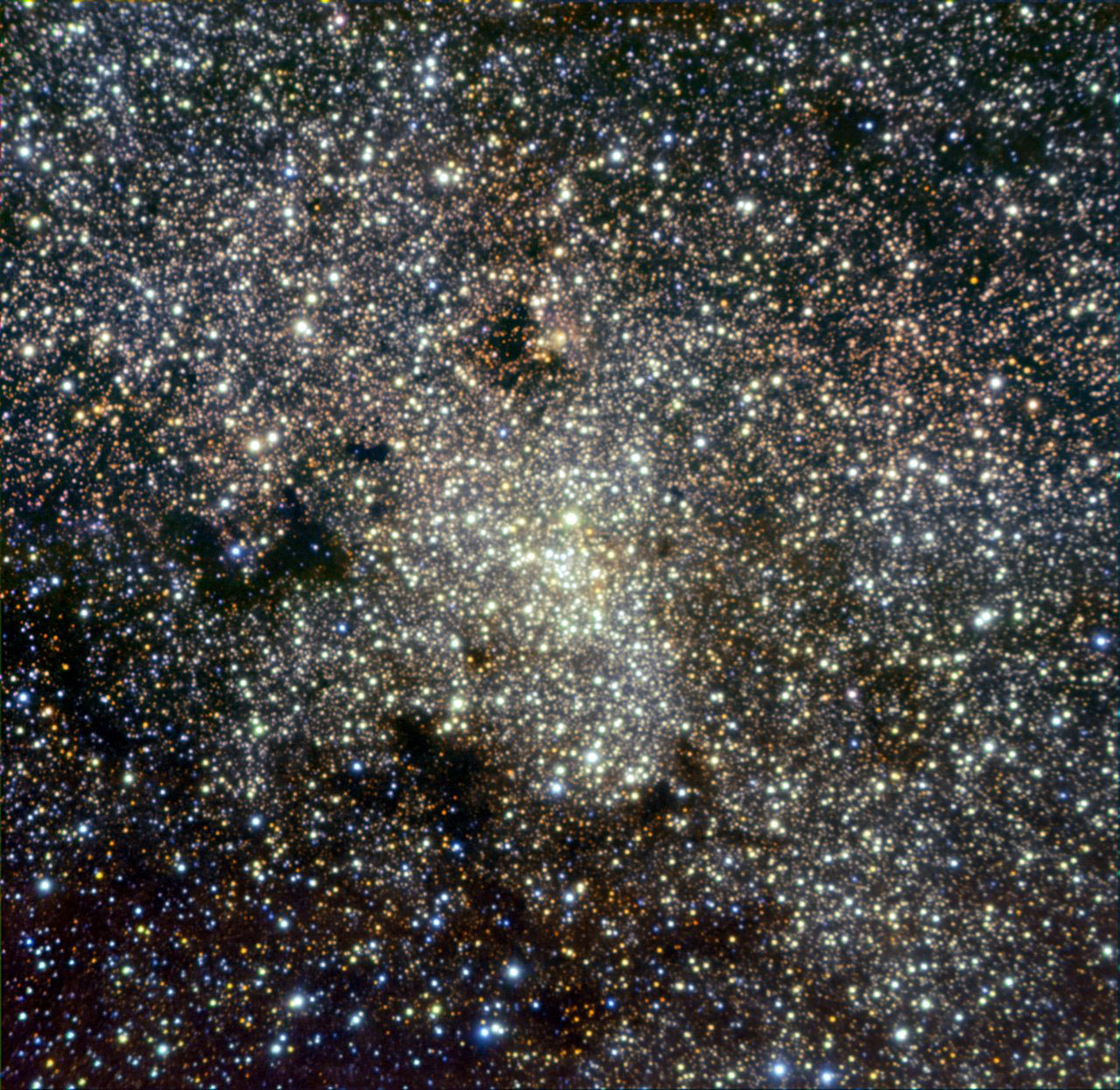
Astronomers from Lund University in Sweden have now found the explanation to a recent mystery at the center of the Milky Way galaxy: the high levels of scandium discovered last spring near the galaxy’s giant black hole were in fact an optical illusion.
Last spring, researchers published a study about the apparent presence of astonishing and dramatically high levels of three different elements in red giant stars, located less than three light years away from the big black hole at the center of our galaxy. Various possible explanations were presented, for example, that the high levels were a result of earlier stars being disrupted as they fall into the black hole, or a result of debris from the collisions of neutron stars.
Now another group of astronomers from Lund University among others, in collaboration with UCLA in California, have found an explanation for the high levels of scandium, vanadium, and yttrium. They argue that the so-called spectral lines presented last spring were actually an optical illusion. Spectral lines are used to find out which elements a star contains — by using its own light.
“These giant red stars have used up most of their hydrogen fuel and their temperatures are therefore only half of the sun’s”, says Brian Thorsbro, lead author of the study and doctoral student in astronomy at Lund University.
According to the new study, the lower temperatures of the giant stars helped to create the optical illusion that appeared in the measurements of spectral lines. Specifically, it means that the electrons in the elements behave differently at different temperatures, which in turn can be misleading when measuring the spectral lines of elements in different stars. The conclusion is the result of a close collaboration between astronomers and atomic physicists.
Brian Thorsbro and his colleagues have had the world’s largest telescope, at the W. M. Keck Observatory on Mauna Kea, Hawaii, at their disposal, thanks to their collaboration with R. Michael Rich at UCLA. Using this telescope and others, the research team is currently conducting a comprehensive mapping of the central areas of the Milky Way, exploring the spectral lines in the light from different stars to find out which elements they contain. The purpose is to gain an understanding of the events that have occurred in the history of the Milky Way, but also to understand how galaxies, in general, have formed.
“Our research collaboration is world-leading in terms of systematically mapping the elements contained in the huge central star cluster – the star cluster that surrounds the black hole,” says research leader and astronomer Nils Ryde at Lund University.
The spectral lines for different elements are recorded in a high-resolution spectrometer – an advanced camera that generates a rainbow of the starlight. The research team has studied the part of the spectrum consisting of near-infrared light, i.e. the heat radiation emitted by the stars. The reason for this is that infrared light can penetrate the dust that obstructs the line of sight between us and the center of the Milky Way, approximately 25,000 light years away. The technology for recording this light is very advanced, and has only recently become available to astronomers.
“We have only started to map the stellar compositions in these central areas of the Milky Way,” says Nils Ryde.
Reference: “Evidence against Anomalous Compositions for Giants in the Galactic Nuclear Star Cluster” by B. Thorsbro, N. Ryde, M. Schultheis, H. Hartman, R. M. Rich, M. Lomaeva, L. Origlia and H. Jönsson, 10 October 2018, The Astrophysical Journal.
DOI: 10.3847/1538-4357/aadb97
Never miss a breakthrough: Join the SciTechDaily newsletter.
Follow us on Google and Google News.