

A rare mineral found in a centuries-old meteorite — and even on Mars — has stunned scientists with its bizarre heat behavior.
Neither fully crystal nor fully glass, this hybrid material conducts heat in a way unlike anything else known: it stays constant across temperatures instead of rising or falling.
Why Heat-Conduction Matters in Modern Technology
Crystals and glasses handle heat in completely different ways, a property that plays an important role in many modern technologies. These include everything from making electronics smaller and more efficient, to recovering wasted heat for energy, to extending the life of thermal shields used in aerospace.
Improving the performance and durability of the materials behind these technologies depends on understanding how their chemistry and atomic arrangement (for example, crystalline, glassy, or nanostructured) affects the way they carry heat. Michele Simoncelli, an assistant professor of applied physics and applied mathematics at Columbia Engineering, studies this challenge from first principles. In Aristotle’s words, he works from “the first basis from which a thing is known,” starting with the core equations of quantum mechanics and applying machine-learning methods to solve them with precise accuracy.
Meteorites, Mars, and a Hybrid Discovery
In findings published on July 11 in the Proceedings of the National Academy of Sciences, Simoncelli teamed up with Nicola Marzari of the Swiss Federal Technology Institute of Lausanne and Francesco Mauri of Sapienza University of Rome to predict the existence of a material that blends the thermal behavior of crystals and glasses. A research group led by Etienne Balan, Daniele Fournier, and Massimiliano Marangolo at Sorbonne University in Paris later confirmed the prediction through experimental measurements.
This unique material was first identified in meteorites and has also been detected on Mars. The physics behind its unusual heat-handling abilities could lead to new ways of designing materials that withstand extreme temperature differences, while also offering clues about the thermal history of planets.
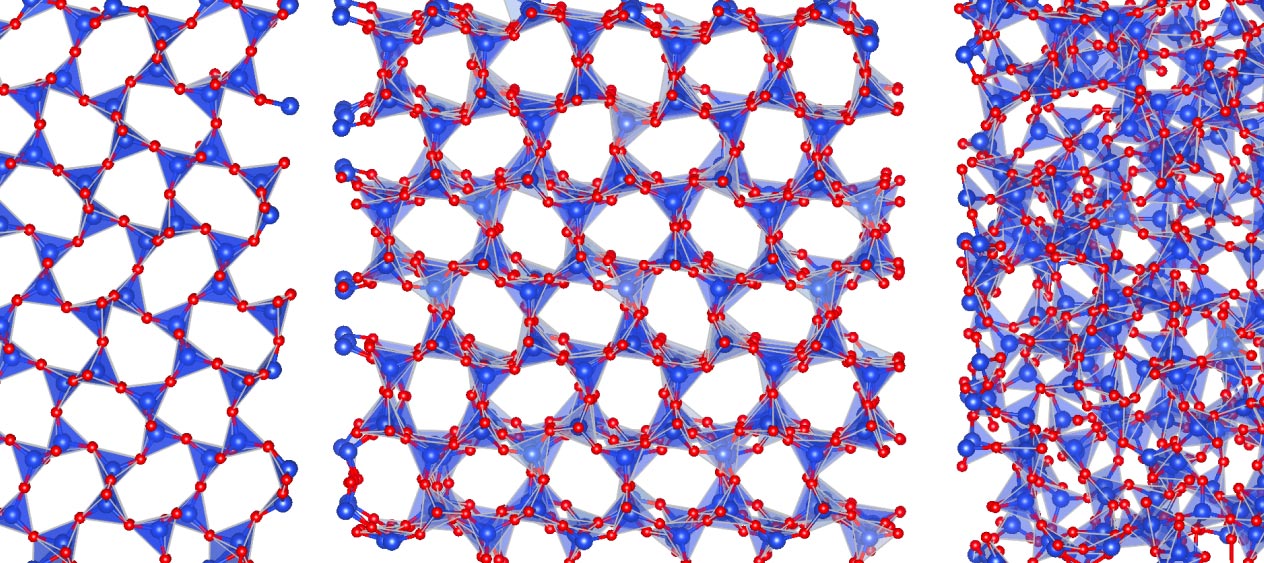
Crystals vs. Glasses: How Atomic Structure Impacts Heat
Thermal conduction depends on whether a material is crystalline, with an ordered lattice of atoms, or glassy, with a disordered, amorphous structure, which influences how heat flows at the quantum level–broadly speaking, thermal conduction in crystals typically decreases with increasing temperature, while in glasses it increases upon heating.
In 2019, Simoncelli, Nicola Marzari, and Francesco Mauri derived a single equation that captures the opposite thermal-conductivity trends observed in crystals and glasses—and, most importantly, also describes the intermediate behavior of defective or partially disordered materials, such as those used in thermoelectrics for waste-heat recovery, perovskite solar cells, and thermal barrier coatings for heat shields.
Meteorite Silica Reveals Rare Thermal Constancy
Using this equation, they investigated the relationship between atomic structure and thermal conductivity in materials made from silicon dioxide, one of the main components of sand. They predicted that a particular “tridymite” form of silicon dioxide, described in the 1960s as typical of meteorites, would exhibit the hallmarks of a hybrid crystal-glass material with a thermal conductivity that remains unchanged with temperature. This unusual thermal-transport behavior bears analogies with the invar effect in thermal expansion, for which the Nobel Prize in Physics was awarded in 1920.
That led the team to the experimental groups of Etienne Balan, Daniele Fournier, and Massimiliano Marangolo in France, who obtained special permission from the National Museum of Natural History in Paris to perform experiments on a sample of silica tridymite carved from a meteorite that landed in Steinbach, Germany, in 1724. Their experiments confirmed their predictions: meteoric tridymite has an atomic structure that falls between an orderly crystal and disordered glass, and its thermal conductivity remains essentially constant over the experimentally accessible temperature range of 80 K to 380 K.
Upon further investigation, the team also predicted that this material could form from decade-long thermal aging in refractory bricks used in furnaces for steel production. Steel is one of the most essential materials in modern society, but producing it is carbon-intensive: just 1 kg of steel emits approximately 1.3 kg of carbon dioxide, with the nearly 1 billion tons produced each year accounting for about7% of carbon emissions in the U.S. Materials derived from tridymite could be used to more efficiently control the intense heat involved in steel production, helping to reduce the steel industry’s carbon footprint.
AI, Quantum Physics, and the Future of Heat Control
In this new PNAS paper, Simoncelli employed machine-learning methods to overcome the computational bottlenecks of traditional first-principles methods and simulate atomic properties that influence heat transport with quantum-level accuracy. The quantum mechanisms that govern heat flow through hybrid crystal-glass materials may also help us understand the behavior of other excitations in solids, such as charge-carrying electrons and spin-carrying magnons. Research on these topics is shaping emerging technologies, including wearable devices powered by thermoelectrics, neuromorphic computing, and spintronic devices that exploit magnetic excitations for information processing.
Simoncelli’s group at Columbia is exploring these topics, structured around three core pillars: the formulation of first-principles theories to predict experimental observables, the development of AI simulation methods for quantitatively accurate predictions of materials properties, and the application of theory and methods to design and discover materials to overcome targeted industrial or engineering challenges.
Reference: “Temperature-invariant crystal–glass heat conduction: From meteorites to refractories” by Michele Simoncelli, Daniele Fournier, Massimiliano Marangolo, Etienne Balan, Keevin Béneut, Benoit Baptiste, Béatrice Doisneau, Nicola Marzari and Francesco Mauri, 11 July 2025,Proceedings of the National Academy of Sciences.
DOI: 10.1073/pnas.2422763122
Never miss a breakthrough: Join the SciTechDaily newsletter.
Follow us on Google and Google News.
12 Comments
Scientists Stunned by Alien Mineral That Breaks the Rules of Heat。
VERY GOOD!
Please ask the scientists to think deeply:
Is the rules of heat that you have always believed in scientific?
Topology provides stability blueprints, but specific physics (spatial features, gravitational collapse, fluid viscosity, quantum measurement) dictates vortex generation, evolution, and decay. If researchers are interested in this, please visit https://zhuanlan.zhihu.com/p/1933484562941457487 and https://zhuanlan.zhihu.com/p/1925124100134790589.
And here go again. Do you ever get sick of spouting random nonsense? Guess not. Try reading the article you just commented on, it already goes against your lame attempts at convincing everyone you know everything about everything.
PS: Yes, science is, in fact, based on science.
Thank you for your continuous browsing.
You are right.
Publications are always based on publications, just as your understanding is based on your intelligence.
sybaau
B note 2508130414_Source1.Reinterpretation【
Source 1.
https://scitechdaily.com/scientists-stunned-by-alien-mineral-that-breaks-the-rules-of-heat/
1.
Scientists Stunned by Extraterrestrial Minerals Breaking the Law of Heat
Ellen Neff, Department of Engineering and Applied Sciences, Columbia University, August 11, 2025
-It is shown that minerals produced from meteorites with both crystal and glass properties defy the existing heat conduction laws.
_The constant heat flow of this mineral, discovered through AI-based research, could revolutionize industries from the steel industry to space technology.
_In centuries-old meteorites, rare minerals found even on Mars have surprised scientists with their bizarre thermal behavior.
_This hybrid material, which is neither a complete crystal nor a complete glass, transfers heat in a way that is different from anything known to date. In other words, the temperature remains constant without going up or down.
<<<<<<>>>^!^
^Did Thales philosopher say that water is the source of all things? I woke up and immediately thought of water as all areas around 03:00 a.m., before writing this article. __*Fire is also the source of all things. It changes everything.
_*The saying, “Water is the source of all things,” was the argument of the ancient Greek philosopher Thales, who came from thinking that the fundamental principle of all things in the world was water. He saw that everything originated from water, and that water changed and became everything else.
__*Hercules, an ancient Greek philosopher, argued that “fire is the source of all things.” In his philosophy, fire does not simply mean sparks or combustion, but rather represents the essential principles of the universe that is constantly changing and created. Just as fire constantly changes and extinguishes when it is burned, everything in the world is constantly changing and created. He called this principle of change the logos. In other words, to Hercules, fire was the fundamental material that unifies all things, the principle of change, and at the same time a symbol that reveals the essence of the world.
^ In the 21st century, the water of Jungoolee’s philosophy in Korea is all ‘numerous new areas’. An individual can create that area, enter the area created by others, collectively be included, swept away, and separated.
^The universe, the Internet, the study, the power, the appearance of life, and the existence itself are the realms,
^ An individual or individual called you can enter the water in that area or meet a huge sea.
It can be naturally separated and decomposed by floating on water in areas that other individuals have come up with or naturally formed areas. This is a reinterpretation of Thales’ philosophical thinking in the 21st century. The qpeoms unit is water. Everything is msbase.moss.
^Heraclitus has a point in arguing that “fire is the source of all things.” Fire changes individuals. Hmm.
That means fire provides the qcell.qvix.qms path by the einstein equivalent formula, where energy is converted to particle mass. Uh-huh.
1-1. Why Heat Conductivity Is Important in Modern Technology
-Crystal and glass treat heat in completely different ways, which play an important role in many modern technologies.
_These technologies range from miniaturization and efficiency improvements in electronics to recovering wasted heat as energy to extending the life of heat shielding membranes used in aerospace fields.
<<<<>>>^!^
^qcell.qvix.qms Using water and fire, the composite properties of all cosmic materials appear. Hybrid was found in meteorite or Martian and lunar mineral samples.
1-2.
_In Aristotle’s words, he starts from “the first foundation of knowing things,” solving key equations in quantum mechanics and applying machine learning techniques to find an exact solution.
1-3. Meteorite, Mars, and Hybrid Discovery
-We predicted the existence of a material that combines these crystals with the thermal behavior of glass.
_A research team led by Etienne Balan, Daniele Fournier and Masimiliano Marangolo from Sorbonne University in Paris later confirmed the prediction through experimental measurements.
2.
-The unique material was first discovered in meteorites and also on Mars.
_The physics principles hidden in this material’s unusual heat-processing capacity not only suggest new material design methods that can withstand extreme temperature differences, but can also provide clues to the thermal history of the planet.
_Increasing disorder in the atomic structure of a material affects macroscopic thermal conduction, an important property for thermal management techniques.
><<<<<>>^!^
^Fire changes matter through heat conduction. Heat is created by the msbase activity of atoms or molecules. Hmm.
2-1.
Decision vs. Glass: Effects of atomic structure on heat
-The thermal conductivity depends on whether the material is crystalline (the regular lattice structure of atoms) or glassy (the disordered and amorphous structure),
_This affects how heat flows at the quantum level. In general, the thermal conductivity in crystalline crystals usually decreases with increasing temperature, whereas in glass it increases with heating.
3-1.
_Meteorite tridimites have an atomic structure between ordered crystals and disordered glass, and their thermal conductivity remains essentially constant in the experimentally measurable temperature range of 80 K to 380 K.
3-2.
Through further investigation, the research team predicted that the material could be produced by heat aging refractory bricks used in steel production furnaces for 10 years.
Steel is one of the most essential materials in modern society, but carbon-intensive problems arise in the production process.
One kilogram of steel emits about 1.3 kilograms of carbon dioxide, and about 1 billion tons produced each year accounts for about 7% of U.S. carbon emissions.
_Materials extracted from tridimite can help reduce the carbon footprint of the steel industry by more efficiently controlling the high temperatures generated during the steel production process.
Thank you for your continuous browsing.
You are right.
Publications are always based on publications, just as your understanding is based on your intelligence.
Poor scientists, living in a constant state of stunned.
I Believe in Science. First for anything outside, with the exception of in person, hand on. Documented Interaction. outside, with the exception of in person, hand on. Documented Interaction.
I Believe in Science. First for anything outside, with the exception of in person, hand on. Documented Interaction.
outside, with the exception of in person, hand on. Documented Interaction.
I forgot to self document myself in person and my hands were on the wrong person…need new Jason.
Crystal, opal, agate, and glass are different formations of Silica (SiO2). Really needed to mention this information. Surely the science community have named this extraterrestrial mineral?