
Close Menu
    Facebook X (Twitter) Instagram
    SciTechDaily
    • Biology
    • Chemistry
    • Earth
    • Health
    • Physics
    • Science
    • Space
    • Technology
    Facebook X (Twitter) Pinterest YouTube RSS
    SciTechDaily
    Home»Physics»Scientists Successfully Produce Slow Electrons in a Solution
    Physics

    Scientists Successfully Produce Slow Electrons in a Solution

    By ETH ZurichJuly 17, 20232 Comments3 Mins Read
    Facebook Twitter Pinterest Telegram LinkedIn WhatsApp Email Reddit
    Share
    Facebook Twitter LinkedIn Pinterest Telegram Email Reddit
    Two Electrons Are Briefly United as a Dielectron
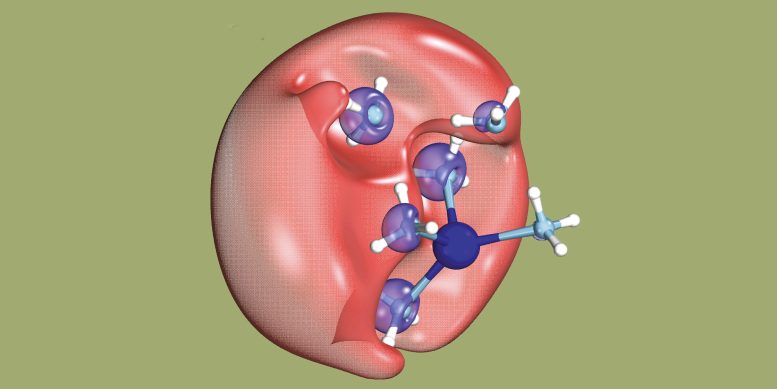
    Here, two electrons are briefly united as a dielectron (red) surrounded by solvent molecules. The dielectron can’t be localized more precisely. One of the electrons will subsequently leave this area. Credit: Hartweg S et al. Science 2023

    An international group of scientists managed to produce slow electrons in a solution. These electrons could potentially enhance the efficiency of certain chemical reactions in the future.

    The original aim of this multinational research team was to detect a mysterious chemical object: a dielectron in solution. A dielectron is made up of two electrons, but unlike an atom, it has no nucleus. Up to now, scientists have been unable to directly detect such an object.

    While the researchers led by ETH Zurich Professor Ruth Signorell were experimenting with dielectrons, they accidentally discovered a new process for producing slow electrons. These can be used to initiate certain chemical reactions.

    Dielectrons are unstable. They break apart again into two electrons in less than one-​trillionth of a second. As the researchers were able to show, one of these electrons remains in place, while the other – which has low energy and is therefore relatively slow – moves away. What’s special about the new method is that it allows the researchers to control the kinetic energy of this electron and thus its speed.

    Dielectrons Occupy Cavities

    But first things first: to produce the dielectrons, the researchers dissolved sodium in (liquid) ammonia and exposed this solution to UV light. This exposure causes an electron from an ammonia molecule to join an electron from a sodium atom and thus form a dielectron. The dielectron briefly occupies a tiny cavity in the solution. The researchers managed to show that when the dielectron breaks up, one of the electrons moves away at a speed determined by the wavelength of the UV light used. “Some of the UV light energy has been transferred to the electron,” Signorell says.

    The ETH Zurich researchers carried out this work in collaboration with researchers from the University of Freiburg in Germany, the SOLEIL synchrotron in France, and Auburn University in the United States.

    Examining Reactions and Radiation Damage

    Such electrons with low kinetic energy are interesting for a variety of reasons. One is that slow electrons cause radiation damage to human tissue. Mobile electrons can form in this tissue, for instance as a result of X-​rays or radioactivity. They can then attach to DNA molecules and trigger chemical reactions. Producing such slow electrons more easily in the lab will help researchers better examine the mechanisms that lead to radiation damage.

    But the human body isn’t the only place chemical reactions are induced by a compound accepting a free electron. The production of synthetic cortisone and other steroids is just one example.

    Making it possible to use UV light as a relatively simple means of producing slow electrons directly in a solution, and also controlling the energy of the electron, will make it easier to better examine these reactions in the future. It may even be possible for chemists to optimize reactions, for example by using UV light to increase the electrons’ kinetic energy.

    Reference: “Solvated dielectrons from optical excitation: An effective source of low-energy electrons” by Sebastian Hartweg, Jonathan Barnes, Bruce L. Yoder, Gustavo A. Garcia, Laurent Nahon, Evangelos Miliordos and Ruth Signorell, 25 May 2023, Science.
    DOI: 10.1126/science.adh0184

    Never miss a breakthrough: Join the SciTechDaily newsletter.
    Follow us on Google and Google News.

    Atomic Physics Electron ETH Zurich
    Share. Facebook Twitter Pinterest LinkedIn Email Reddit

    Related Articles

    World’s Fastest Microscope Freezes Time To Capture Moving Electrons

    Science Made Simple: What Are Electrons?

    A Crystal Made Exclusively of Electrons – “Holy Grail” Wigner Crystals Observed for First Time

    Milestone in Ultrashort-Pulse Laser Oscillators Paves Way to Even More Powerful Lasers

    Quantum Transmission Between Two Solid-State Qubits at the Push of a Button

    Quantum Cocktail Provides New Insights on Quantum Many-Body Systems

    High-Precision Measurement of the Electron is More Precise by a Factor of 13

    Splitting of an Electron into the Spinon and Orbiton

    Two-Dimensional Polymers Created for the First Time

    2 Comments

    1. Bao-hua ZHANG on July 17, 2023 10:52 pm

      Electrons and currents are nodes and regions formed by the interaction of topological vortices in a fluid or conductor.

      Reply
    2. Umar on July 21, 2023 9:00 pm

      Can these electrons used in fission reactions because there we also need slow elections

      Reply
    Leave A Reply Cancel Reply

    • Facebook
    • Twitter
    • Pinterest
    • YouTube

    Don't Miss a Discovery

    Subscribe for the Latest in Science & Tech!

    Trending News

    Scientists Discover Stem Cells That Could Regrow Teeth and Bone

    Early Cannabis Use May Stall Key Brain Skills in Teens

    Popular Vitamin D Supplement Has “Previously Unknown” Negative Effect, Study Finds

    Study Reveals Malaria’s Hidden Role in Human Evolution

    The Hidden Risk of Taking Breaks From Weight-Loss Drugs Like Ozempic

    Scientists Warn That This Common Pet Fish Can Wreck Entire Ecosystems

    Scientists Make Breakthrough in Turning Plastic Trash Into Clean Fuel Using Sunlight

    This Popular Supplement May Interfere With Cancer Treatment, Scientists Warn

    Follow SciTechDaily
    • Facebook
    • Twitter
    • YouTube
    • Pinterest
    • Newsletter
    • RSS
    SciTech News
    • Biology News
    • Chemistry News
    • Earth News
    • Health News
    • Physics News
    • Science News
    • Space News
    • Technology News
    Recent Posts
    • Researchers Unveil Groundbreaking Sustainable Solution to Vitamin B12 Deficiency
    • Scientists Identify Immune Protein That Could Mimic Anti-Aging Effects of Calorie Restriction
    • This Tiny Creature Survived a World of Dinosaurs and Changed What Came Next
    • Millions of People Have Osteopenia Without Realizing It – Here’s What You Need To Know
    • Researchers Discover Boosting a Single Protein Helps the Brain Fight Alzheimer’s
    Copyright © 1998 - 2026 SciTechDaily. All Rights Reserved.
    • Science News
    • About
    • Contact
    • Editorial Board
    • Privacy Policy
    • Terms of Use

    Type above and press Enter to search. Press Esc to cancel.