
Deciphering the Molecular Languages of Life
Canadian researchers at the University of Montreal have successfully recreated and mathematically confirmed two molecular languages at the origin of life.
Their groundbreaking findings, recently published in the Journal of American Chemical Society, pave the way for advancements in nanotechnologies, offering potential in areas like biosensing, drug delivery, and molecular imaging.
Living organisms are made up of billions of nanomachines and nanostructures that communicate to create higher-order entities able to do many essential things, such as moving, thinking, surviving, and reproducing.
“The key to life’s emergence relies on the development of molecular languages – also called signaling mechanisms – which ensure that all molecules in living organisms are working together to achieve specific tasks,” said the study’s principal investigator, UdeM bioengineering professor Alexis Vallée-Bélisle.
In yeasts, for example, upon detecting and binding a mating pheromone, billions of molecules will communicate and coordinate their activities to initiate union, said Vallée-Bélisle, holder of a Canada Research Chair in Bioengineering and Bionanotechnology.
“As we enter the era of nanotechnology, many scientists believe that the key to designing and programming more complex and useful artificial nanosystems relies on our ability to understand and better employ molecular languages developed by living organisms,” he said.
Two Types of Languages
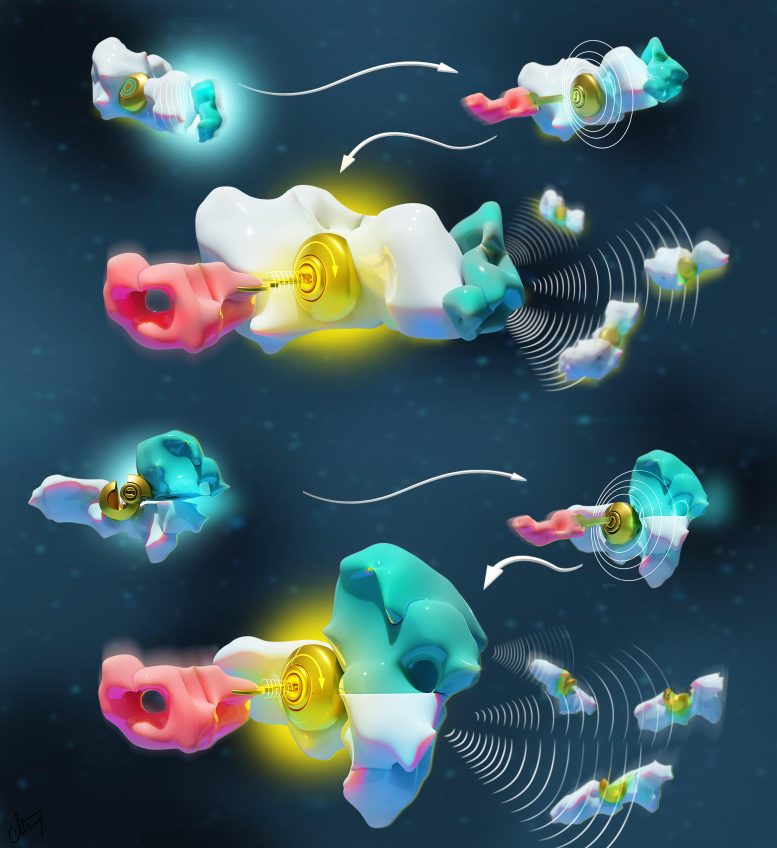
One well-known molecular language is allostery. The mechanism of this language is “lock-and-key”: a molecule binds and modifies the structure of another molecule, directing it to trigger or inhibit an activity.
Another, lesser-known molecular language is multivalency, also known as the chelate effect. It works like a puzzle: as one molecule binds to another, it facilitates (or not) the binding of a third molecule by simply increasing its binding interface.
Although these two languages are observed in all molecular systems of all living organisms, it is only recently that scientists have started to understand their rules and principles – and so use these languages to design and program novel artificial nanotechnologies.
“Given the complexity of natural nanosystems, before now nobody was able to compare the basic rules, advantages, or limitations of these two languages on the same system,” said Vallée-Bélisle.
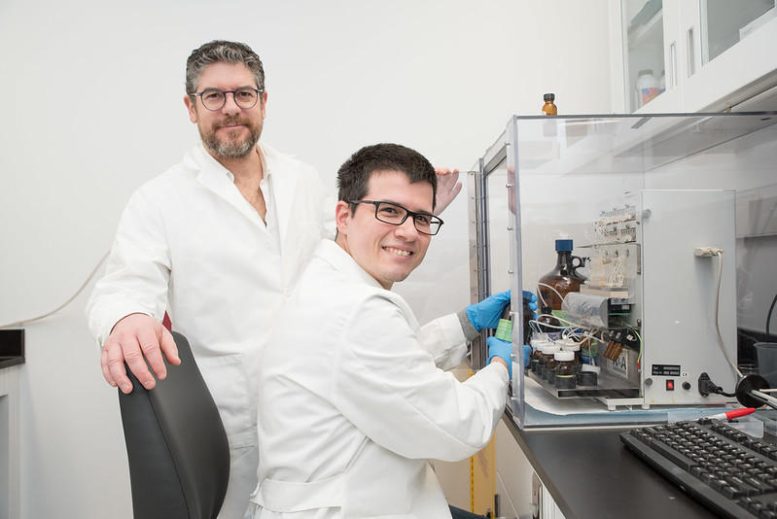
To do so, his doctoral student Dominic Lauzon, first author of the study, had the idea of creating a DNA-based molecular system that could function using both languages. “DNA is like Lego bricks for nanoengineers,” said Lauzon. “It’s a remarkable molecule that offers simple, programmable, and easy-to-use chemistry.”
Simple Mathematical Equations To Detect Antibodies
The researchers found that simple mathematical equations could well describe both languages, which unraveled the parameters and design rules to program the communication between molecules within a nanosystem.
For example, while the multivalent language enabled control of both the sensitivity and cooperativity of the activation or deactivation of the molecules, the corresponding allosteric translation only enabled control of the sensitivity of the response.
With this new understanding at hand, the researchers used the language of multivalency to design and engineer a programmable antibody sensor that allows the detection of antibodies over different ranges of concentration.
“As shown with the recent pandemic, our ability to precisely monitor the concentration of antibodies in the general population is a powerful tool to determine the people’s individual and collective immunity,” said Vallée-Bélisle.
In addition to expanding the synthetic toolbox to create the next generation of nanotechnology, the scientist’s discovery also shines a light on why some natural nanosystems may have selected one language over another to communicate chemical information.
Reference: “Programming Chemical Communication: Allostery vs Multivalent Mechanism” by Dominic Lauzon and Alexis Vallée-Bélisle, 15 August 2023, Journal of the American Chemical Society.
DOI: 10.1021/jacs.3c04045
Funding was provided by the National Sciences and Engineering Research Council of Canada, the Canada Research Chairs program, and Les Fonds de recherche du Québec – Nature et technologies.
Never miss a breakthrough: Join the SciTechDaily newsletter.
Follow us on Google and Google News.
5 Comments
Respectfully, that has nothing to do with the ORIGIN of life. It has to do with the evolution of life, once life was created.
It is inherent in chemistry, so it was there when life evolved – originated – in the first place.
Both kinds of languages are important for their indivisual
function in Bio-molecular Physics.
Allostery – the molecular language is quite natural and has a common function of general evolution.
Multivalency – this molecular language acts with one’s own heart.
I gotta ask are they trying to communicate with those DNA, or whatever name the scientists put on it? Because to me are our doing nothing more than forcing those Nanos to do their bidding instead than learning from them. Sad, sick and irresponsible that’s our scientific way of thinking is.
It is a useful description of useful chemistry. In that light, your comment is “sad, sick and irresponsible”.