
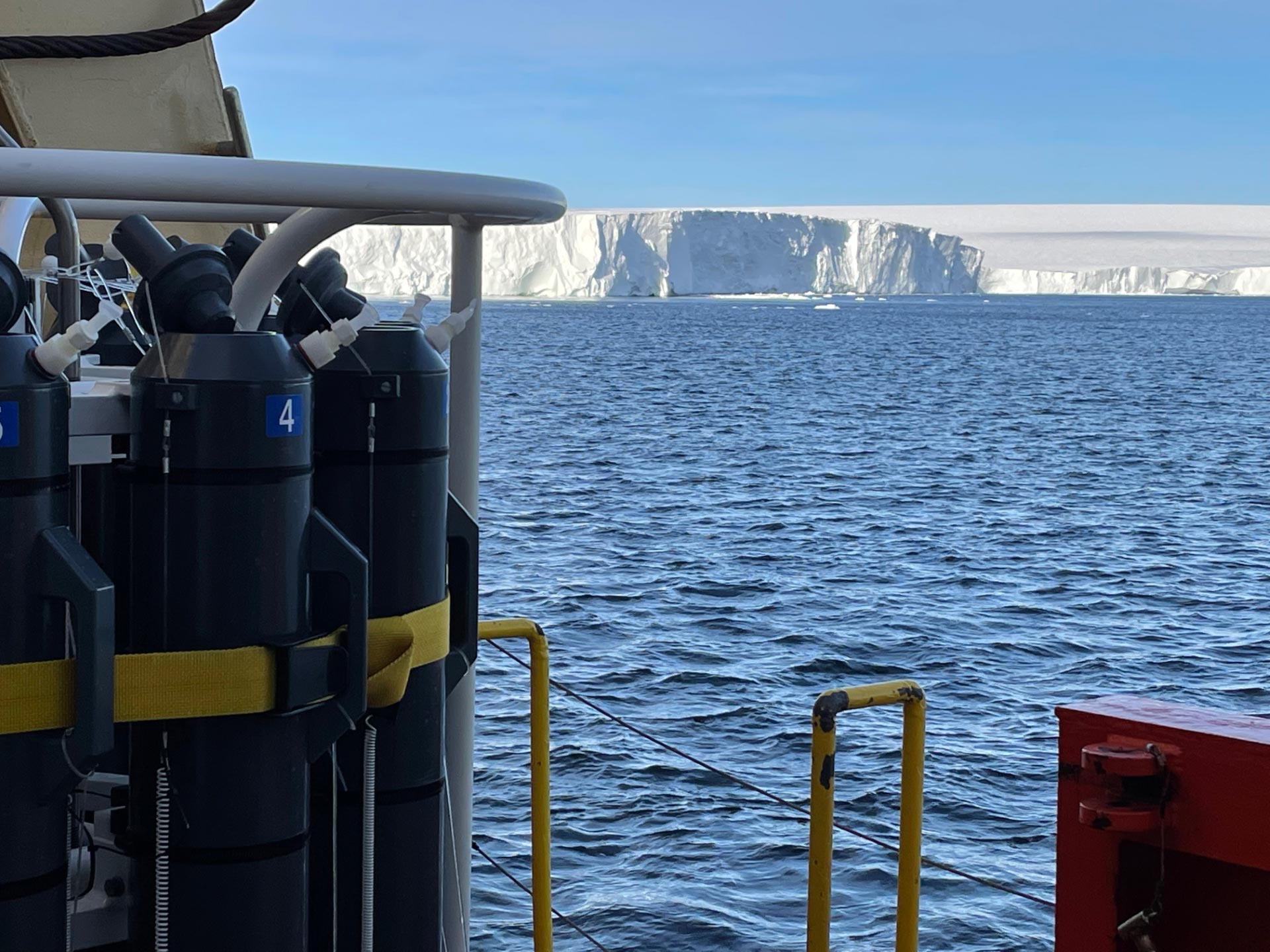
Scientists testing a popular climate theory in Antarctica found that melting glaciers deliver far less iron to the ocean than previously believed.
Most of the iron feeding carbon-hungry algae actually comes from deep water and sediments, not from the ice itself.
A Climate Hope in the Southern Ocean
For years, researchers studying the Southern Ocean have pointed to one possible bright spot in the climate crisis. The idea, known as iron fertilization, suggested that as Antarctica warms and glaciers melt, iron locked inside the ice would be released into nearby waters. That iron would fuel blooms of microscopic algae, which absorb heat-trapping carbon dioxide as they grow.
There is just one issue. The evidence now suggests this climate benefit may be far smaller than believed.
In what scientists describe as the most precise measurement yet of iron flowing from an Antarctic glacier, a team from Rutgers University-New Brunswick found that meltwater from an ice shelf contributes much less iron to surrounding ocean waters than previously estimated.
The study, published today (February 26) in Communications Earth and Environment, raises new questions about where iron in the Southern Ocean actually comes from. The findings could affect how scientists project and model future climate change.
“It has been widely assumed that glacial melting underneath ice shelves contributes considerable bioavailable iron to these shelf waters, in a process of natural glacier-driven iron fertilization,” said Rob Sherrell, a professor in the Department of Marine and Coastal Sciences at the Rutgers School of Environmental and Biological Sciences and the study’s principal investigator.
Sherrell explained that the new data revise those assumptions. The amount of iron carried by meltwater is several times lower than earlier estimates. In addition, most of that iron appears to originate from a different type of meltwater than the kind produced directly by melting ice shelves.
Why Iron Matters in Antarctica
Although Antarctic waters are plunged into darkness for months each year, the Southern Ocean remains one of the planet’s most biologically productive marine regions. Phytoplankton thrive there and serve as a critical food source for krill, which in turn support penguins, seals, and whales. As phytoplankton grow, they pull large amounts of carbon dioxide from the atmosphere through photosynthesis, making the region the world’s largest oceanic sink for the climate-warming gas.
Much of what scientists previously understood about iron in the Southern Ocean came from simulations and computer models. Sherrell and colleagues from Rutgers and partner institutions in the United States and the United Kingdom decided to gather direct measurements instead.
In 2022, the team boarded the now-decommissioned U.S. icebreaker, the Nathaniel B. Palmer, and traveled to the Dotson Ice Shelf in the Amundsen Sea of West Antarctica. The Amundsen Sea accounts for most of the sea level rise driven by Antarctic melting. Their goal was to collect glacial meltwater directly at its source.
Inside the Ice Shelf Cavity
In the Amundsen Sea, meltwater forms beneath floating ice shelves, which extend from land-based glaciers into the ocean. The melting occurs mainly because relatively warm deep ocean water flows into cavities beneath the ice.
At the Dotson Ice Shelf, the researchers pinpointed where seawater enters one of these cavities and where it exits after mixing with meltwater. They collected samples at both locations.
Back in New Jersey, Venkatesh Chinni, a postdoctoral scholar and the study’s lead author, measured iron levels in the samples, examining both dissolved iron and iron contained in suspended particles. Collaborators Jessica Fitzsimmons and Janelle Steffen at Texas A&M University analyzed isotopic ratios to “fingerprint” the iron and determine its origin. Steffen conducted the initial isotopic measurements in the laboratory of Tim Conway at the University of South Florida.
Using these data, Chinni and the team calculated how much iron was added as water passed through the cavity. Isotopic signatures also helped them identify the type of melting responsible.
Most Iron Comes From Deep Water and Sediments
The results surprised the researchers. Meltwater accounted for only about 10% of the dissolved iron leaving the cavity. In contrast, inflowing deep ocean water supplied 62%, while 28% came from sediments on the continental shelf.
“Roughly 90% of the dissolved iron coming out of the ice shelf cavity comes from deep waters and sediments outside the cavity, not from meltwater,” Chinni said.
The isotopic evidence also points to another source beneath the glacier itself. The data suggest the presence of a liquid meltwater layer that lacks dissolved oxygen. In such conditions, solid iron oxides in the bedrock can dissolve more easily, releasing iron into the water. According to Chinni, this process may contribute more iron than melting ice shelves do.
Rethinking Antarctic Iron and Climate Models
Taken together, the findings challenge long-standing assumptions about how iron enters the Southern Ocean in a warming climate. The researchers note that more work is needed to fully understand the role of subglacial processes.
“Our claim in this paper is that the meltwater itself carries very little iron, and that most of the iron that it does carry comes from the grinding up and dissolving of bedrock into the liquid layer between the bedrock and the ice sheet, not from the ice that is driving sea level rise,” Sherrell said.
He added that many colleagues may find this conclusion unexpected.
Reference: “Iron supply to the Amundsen Sea, Antarctica is dominated by circumpolar deepwater and continental subglacial sources” by Venkatesh Chinni, Janelle M. Steffen, Sharon E. Stammerjohn, Pierre St-Laurent, Lisa C. Herbert, Patricia L. Yager, Tim M. Conway, Jessica N. Fitzsimmons and Robert M. Sherrell, 26 February 2026,Communications Earth & Environment.
DOI: 10.1038/s43247-026-03264-x
Never miss a breakthrough: Join the SciTechDaily newsletter.
Follow us on Google and Google News.
3 Comments
“At the Dotson Ice Shelf, the researchers pinpointed where seawater enters one of these cavities and where it exits after mixing with meltwater. They collected samples at both locations.”
In other words, they had a sample of one. The amount and kind of ‘iron’ present in glacial till and entrained in the ice varies widely with the kind of bedrock over which a glacier moves. A sample of one (locality) tells us nothing about the variation in bio-available iron across the whole western continent. Would one sample an alkali lake in Nevada and then presume predict what surface waters are like, on average, for the entire western USA? All they have established with certainty is that for the particular locality observed, it does not behave as predicted by extant computer models. There could well be, and probably is, a wide range of responses depending on the proportion of fine sediment entrained in the ice and the specific types of minerals in the basement rocks in the interior zone of snow accumulation.
“Much of what scientists previously understood about iron in the Southern Ocean came from simulations and computer models.”
A fundamental problem with computer models is the very reason for which they exist. When something is poorly understood, for whatever reason(s), scientists will attempt to build on a scaffolding of principles that ARE well-understood. However, inevitably, the empirical data and descriptive equations of dynamic processes will not be adequate to completely characterize the poorly understood phenomenon of interest. One then has to resort to methods to attempt to fill in the gaps in knowledge to build a better model.
Approaches such as “parameterization” are used when computers are not fast enough to calculate the solutions to partial differential equations at the temporal or spatial resolution desired. Almost always, the empirical data will not have the resolution, precision, or coverage necessary to calculate the exact solutions desired, or there will be gaps in data for some ranges of the independent variable(s).
This is where things get even more problematic. The modelers will then make assumptions, sometimes explicit, but sometimes so subtle that they don’t even realize that there is an implicit assumption buried in the computer code. It is fundamental to the experimental procedure of “all other things being equal,” or nothing changing in an experiment other than one independent variable at a time. However, an assumption is only the best guess of a so-called expert of how everything works together. If a human were able to wrap their head around a complex dynamic system with interlinked feedback loops, there would be no need to build a computer model!
With a million lines of computer code, there is also likely to be programming errors that are very subtle and beyond the ken of human programmers unless the error results in a fatal error that halts the program. There is the old axiom that all non-trivial computer programs have programming errors or ‘bugs.’
There is also the problem that for many historical events, it is not possible to measure something directly. One has to depend on what are called proxies; things that are correlated with the variable of interest. The correlations are often multivariable correlations, and rarely perfect for the metric of interest. An implicit assumption is often that there has been no loss of the proxy, such as a light isotope that is more prone to diffusion than a heavier isotope.
The results, when used properly, may provide scientists with some insight on how a dynamic system reacts to a perturbation. Unfortunately, models are all too frequently treated as though they are reality — until it becomes painfully obvious that they are, at best, only reliable over a short, linear range. Sometimes it becomes obvious they are totally wrong for all inputs of a key independent variable. I think that is what the authors of this article are suggesting.
Plant lots and lots of Pine Trees on the North and South Poles…..These trees produce oxygen through winter and summer.