
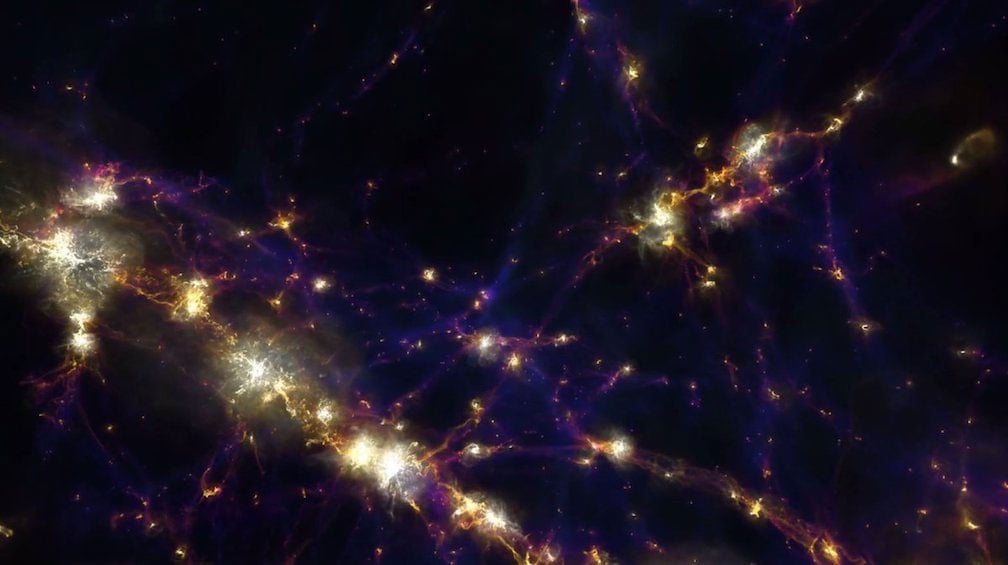
The formation and growth of galaxies in the early universe is a key research topic for future giant telescopes like the Giant Magellan Telescope and space missions like the James Webb Space Telescope. Meanwhile, computer simulations of cosmic galaxy development have made considerable progress in our understanding. They show that details of galaxy development are closely tied to the properties of the galaxies, like their sizes and star formation rates. These properties are in turn regulated by the galaxies’ gas content, the gas motions (primarily the angular momentum), and some still uncertain mechanisms that regulate star formation like feedback from the nuclear black hole. Finally, there is growing evidence for correlations between the properties of a supermassive black hole and its host galaxy.
Black holes with millions or even billions of solar masses are found in the centers of most galaxies. The most powerfully active nuclear black holes are in quasars and these have been spotted as far away as the epoch when the universe was less than a billion years old, suggesting that the galaxy-black hole symbiosis was already underway at this early time. Accreting black holes can emit powerful jets or winds that reverse the accretion and drive material outward, sometimes quenching the star formation. These and other lines of evidence help to clarify the co-evolution mechanisms between black holes and galaxies and reveal the joint evolution of the galaxy and the supermassive black hole populations.
CfA astronomers Lars Hernquist and Rainer Weinberger and their colleagues used the large-scale hydrodynamic simulation called IllustrisTNG to trace the development of galaxies and their black holes. The code is able to model the evolution of a wide range of black hole and galaxy properties as the universe ages. They successfully reproduce the observed correlation between star formation rate and galaxy mass. They find, among numerous other trends, that quiescent galaxies (those no longer actively making stars) first go through a phase of shrinking in size before they undergo a quenching event; they also find that in the cosmic epoch of peak star formation (about ten billion years ago) as many as twenty percent of galaxies hosted an active supermassive black hole.
Reference: “Linking Galaxy Structural Properties and Star Formation Activity to Black Hole Activity with IllustrisTNG” by Melanie Habouzit, Shy Genel, Rachel S. Somerville, Dale Kocevski, Michaela Hirschmann, Avishai Dekel, Ena Choi, Dylan Nelson, Annalisa Pillepich, Paul Torrey, Lars Hernquist, Mark Vogelsberger, Rainer Weinberger, and Volker Springel, 16 January, MNRAS.
DOI: 10.1093/mnras/stz102
Never miss a breakthrough: Join the SciTechDaily newsletter.
Follow us on Google and Google News.
1 Comment
Indeed mass, in and of itself, can then be viewed as a forced distortion in Space-Time via its own internal energy state. With some manipulation, gravity would be better represented in terms of the positive density or negative density of its overall volume, however inconsistent, which uniquely defines its influence within Space and Time. This being true, the entire expanse of a predetermined volume would then define, or cause to define, a center of gravitational force in an expression of its introspective interference within the Space-Time continuum as density. Such a perspective would then invoke a kind of ‘chicken and egg’ analogy, i.e., which came first. Ponder for a moment, did galactic center form first from its black hole(s), to attract and cause mass to amalgamate around it, or rather was galactic center formed from within the entire expanse of its predetermined volume (i.e., its volume of influence) causing a focus of gravitational force toward an aspect of density in which its black hole(s) engendered?
Explore these and other mysteries of the cosmos in the book, ‘The Evolutioning of Creation: Volume 2’.