

The study uses an advanced QuEChERS–GC–MS detection method to uncover hidden carcinogens in cooking oils and meats.
Many people today are placing greater emphasis on their overall health, turning daily workouts and calorie-tracking tools into regular habits. As part of this shift, more individuals are choosing diets that feature nutrient-rich foods such as fruits and vegetables.
Although these foods are widely viewed as healthy, they can still contain polycyclic aromatic hydrocarbons (PAHs) (hydrophobic organic compounds comprising multiple fused aromatic rings) when exposed to contamination or when cooked through heating, smoking, grilling, roasting, or frying. PAHs can enter plant-based foods (such as fruits and vegetables) through atmospheric deposition from vehicle exhaust and industrial emissions, irrigation with contaminated water, or uptake from polluted soil, where they may accumulate on the surface or within edible tissues.
In animal-based foods, such as meat and fish, PAHs are often generated during processing and cooking, particularly when food is exposed directly to open flames, smoke, or very high temperatures.
Foods commonly found to contain higher levels of PAHs include:
- Smoked or grilled meats and fish (e.g., smoked salmon, bacon, barbecued chicken, charred beef).
- Roasted or charred plant foods (roasted coffee beans, dark-roasted nuts, charred vegetables, burnt toast).
- High-heat processed oils and fats (reused frying oils, highly refined vegetable oils).
- Heat-processed grain products (roasted cereals, malted grains, toasted snacks).
- Produce exposed to environmental pollution (leafy greens, root vegetables, and fruits grown near roadways or industrial areas).
- Smoke-dried teas and herbs (black tea, green tea, certain herbal teas).
Cooking Processes That Generate PAHs
During grilling, barbecuing, and pan frying, PAHs can form from the incomplete combustion of fats and other organic components and tend to concentrate in charred or heavily browned areas. Smoked and roasted products, including smoked meats, smoked fish, certain cheeses, and roasted coffee, frequently show measurable PAH levels. Processed foods that undergo intensive thermal treatment, such as some baked goods and cereal products, can also contain PAHs, especially when surfaces are darkly browned.
Because certain PAHs are known carcinogens, their presence in such a wide variety of foods raises important public health concerns and highlights the need for monitoring and mitigation across the food supply chain.
To protect consumers, it has become essential to efficiently extract, identify, and measure PAHs in food. Common extraction methods, including solid-phase, liquid-liquid, and accelerated solvent extraction, are generally affordable but often slow, labor intensive, and not environmentally friendly.
In recent years, researchers have highlighted the QuEChERS (Quick, Easy, Cheap, Effective, Rugged, and Safe) method as a promising alternative for isolating organic compounds. This approach shortens analysis time, increases accuracy and recovery, and simplifies the overall preparation process, offering a safer and more dependable option for PAH testing.
Study Overview and Objectives
A recent study conducted by researchers in the Department of Food Science and Biotechnology at Seoul National University of Science and Technology, led by Professor Joon-Goo Lee, applied the QuEChERS method to measure eight PAHs (Benzo[a]anthracene, Chrysene, Benzo[b]fluoranthene, Benzo[k]fluoranthene, Benzo[a]pyrene, Indeno[1,2,3-cd]pyrene, Dibenz[a,h]anthracene, and Benzo[g,h,i]perylene) in food. The results of their work were published in the journal Food Science and Biotechnology.
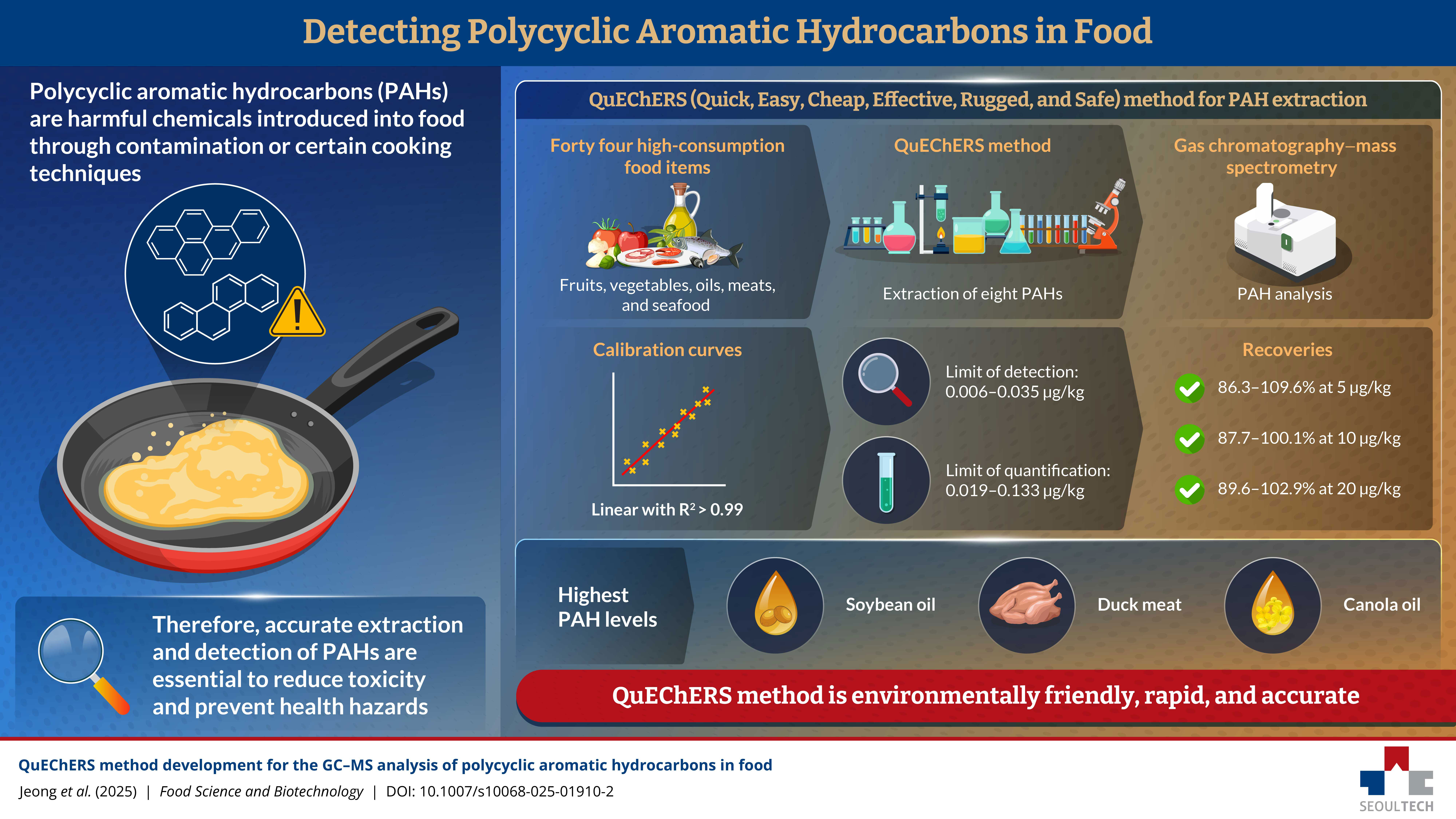
The researchers extracted PAHs using acetonitrile. This was followed by purification via different methods involving various combinations of sorbents. The researchers validated the QuEChERS extraction method through a number of food matrices, finding that the calibration curves for the eight PAHs demonstrated remarkable linearity, with the R2 value exceeding 0.99.
Further, the gas chromatography‒mass spectrometry analysis revealed that the limits of detection ranged from 0.006 to 0.035 µg/kg, while the limits of quantification ranged from 0.019 to 0.133 µg/kg. Notably, recoveries ranged from 86.3 to 109.6% at 5 µg/kg, 87.7 to 100.1% at 10 µg/kg, and 89.6 to 102.9% at 20 µg/kg, with precision values between 0.4 and 6.9% in all food matrices.
Significance and Industrial Impact
Prof. Lee reveals, “This method not only simplifies the analytical process but also demonstrates high efficiency in detection compared to conventional methods. It can be applied to a wide range of food matrices.”
In the industrial sector, this method could be used for inspecting food products for safety management. Furthermore, it is expected to lead to cost reduction and improved safety for workers.
“Our research can improve public health by providing safe food. It also reduces the use and emission of hazardous chemicals in laboratory testing,” concludes Prof. Lee.
Overall, this study showcases that the developed PAH analysis method based on the QuEChERS approach is environmentally friendly, rapid, and accurate.
Reference: “QuEChERS method development for the GC–MS analysis of polycyclic aromatic hydrocarbons in food” by Jihun Jeong, Minju Koo and Joon-Goo Lee, 5 June 2025, Food Science and Biotechnology.
DOI: 10.1007/s10068-025-01910-2
Never miss a breakthrough: Join the SciTechDaily newsletter.
Follow us on Google and Google News.
38 Comments
Information updates regularly keep abreast of it to survive!
One thing for certain is that if you get cancer then you have eaten something.
Eat everything in moderation. You can’t go wrong with that
Yard poisons and chemical big agricultural toxins need to be banned!
Very Informative
Just remember, very corrupt people are making big money on pushing certain narratives to manipulate you into spending money in certain ways. It has happened over and over and over again and it’s not about to stop. It’s not about gas emissions in your food that’s killing you, it’s herbicides and pesticides that are the actual culprit. They don’t fix that though because there’s no money to be gained in blaming that industry, only money to be lost. So, let’s blame something new, like carbon (eye roll) and create a new industry to get rich on…
Absolutely agree 👍
So the only thing I got from this article is eat all your food raw? It doesn’t matter how much research we do into our food the agency’s that control the poisons, dont care. It took 40 years to get rid of SOME chemical dyes in our food and its still prevalent.
The title of the article should be: Scientists DEVELOP COST-EFFECTIVE METHOD TO Uncover Cancer-Causing Chemicals in Common Foods.
There is hardly any mention of the actual common foods that this new process has uncovered. It’s all about the new approach and why it’s better.
Thank you. Exactly.
Really? So what are the “common foods”?
The entire groceries, everything
Can’t agree more! PAH have been known to be carcinogenic for decades, nothing new, but yet this work posed itself in a way that sounds like they are the first discover. Largely the reporter is to blame for lacking fact checking.
How about not adding carcinogen in our foods. If you eat anything you are exposed to cancer and if you cook it you’re even more exposed to cancer??
If you say Common Foods
Why not tell us Mear Mortels
What we need to know.
This is a dangerous situation?
Cancer ♋️
I agree. Those of us looking for ways to improve our health are still left wondering how to apply, and where to apply this information.
There are carcinogens everywhere, very true. However, healthy human bodies can destroy cancer before it gets a foothold. The trouble is our food supply is so bad that it is difficult for most people to remain healthy! For example, as a matter of public policy our food supply was stripped of healthy fats and to make what remained palatable, fat was replaced with sugar. Too bad cancer thrives on sugar (not fat). Oops! Fact is, the science was known but ignored for commercial / political reasons. Take heart, with effort it is possible to eliminate added sugar from your diet (not natural sugars) and you’ll be glad you did.
I think I can sometimes taste the poison in food
There are carcinogens everywhere, very true. However, healthy human bodies can destroy cancer before it gets a foothold. The trouble is our food supply is so bad that it is difficult for most people to remain healthy! For example, as a matter of public policy our food supply was stripped of healthy fats and to make what remained palatable, fat was replaced with sugar. Too bad cancer thrives on sugar (not fat). Oops! Fact is, the science was known but ignored for commercial / political reasons. Take heart, with effort it is possible to eliminate added sugar from your diet (not natural sugars) and you’ll be glad you did.
Yes, I was looking for specific foods and cooking.oils to stay away from. The headline was misleading.
Don’t burn your food and eat it? The charred or burnt part is not good for you. Not really something new. Read the actual EPA and health institute website. Aromatic?? Yes you can smell the food when it burns. Everyone knows that right? You can see if it is burnt maybe?
Agreed
I have made great efforts in maintaining a vegetarian, & periodic salmon-sardine diet for years, so to think that it is all for naught is heart wrenching and will take time for me to acclimate to the fact that nothing will change (may even get worse) in my lifetime. Thank goodness I’m closing in on my 80s and can give up on trying to make it much further than that.
It is what it is. We are all going to die of something. Harsh but true.
Unfortunately FDA , scientists have known for years. Just hush hush.
It was never kept hush-hush. It’s never been a secret and has been documented in the past in many scientific documents and has been posted by FDA.
Fret not. Stay on your path. Always trust your intuition and how you feel. There will always be contradicting views on all topics. But never compromise on your healthy habits and let No One tell you otherwise to steer you off course. Stay vigilant and alert.
This is nothing new, it’s been stated for decades that our foods have chemicals that are causing cancer or other health issues. The main problem is people dont care until it’s their problem.
Fruits and vegetables aren’t nearly as nutrient dense as proteins. Look it up. Also many of the nutrients in fruits and vegetables aren’t readily absorbed in the body. There are literal studies proving this vs the commonly taught methods.
I don’t get this study. We’ve known cooking causes by products that cause cancer. Just like we know breathing causes oxidative stress. It’s just part of life though, it’s unavoidable, there’s nothing to reduce
Yes it’s giving the wrong context I think and likely will be used to tell a narrative that isn’t articulated properly. So many compounds protest against these as well. We don’t have to avoid every small effect till we become bubble people with no capacity to handle anything because we’re eating sterile food with less and less diversity from all the fear and misdirection .
One thing that jumps out at me from this is to be cautious of cooking at high temperatures. I cook foods at a much lower temperature than cookbooks call for.
Eat raw ?
…just sneak up and bite a cow in the arse.
Sounds like we’re all supposed to just eat bugs instead and be happy about it.
Oh,
However your not concerned about the non labelling of lab produced cloned meat which is not natural?
I think this is the point of the article, they are trying to scare us away from while foods and steer us towards the lab tested food produced by the company’s that can test. It’s a push back against the “processed food is bad” movement.
I think this type of research is going to tell the wrong story and perspective unfortunately. Much like the WHO coming down on processed meats. It’s not about the meat it’s about the processing and we need better ways to communicate how to improve the industry. This minutia is not really the big fish for cancer rates going up. A bit of charred meat here and there is let important then the quality of the meat and the animals diet and exercise to the whole picture of why our food system is in this rut. Not to mention other compounds annulling these effects like vitamin C and other antioxidants often used in traditional cultures like in Argentina in salmueras and chimichurri. Scientist don’t know much about food culture and we need to get back to a system that isn’t regulated by the most isolated part of our food system.