
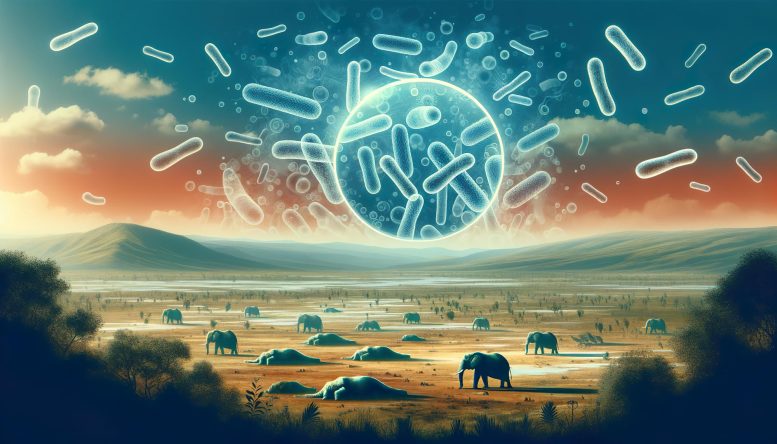
A bacterium linked to severe septicemia may be responsible for the deaths of six African elephants in Zimbabwe, and potentially others in nearby nations. This discovery adds infectious diseases to the growing list of challenges facing African elephants, a species whose numbers remain at risk.
Details of the Study
During this unique study, scientists from the Victoria Falls Wildlife Trust, the Animal and Plant Health Agency UK, the University of Surrey, and laboratories in South Africa investigated the mysterious deaths of 35 elephants mostly between August and September 2020, in a 40 x 25 km radius of North-Western Zimbabwe. This incident followed the death of approximately 350 elephants in neighboring northern Botswana from May to June 2020, which triggered much international concern.
African savanna elephants are an endangered species with only 350,000 remaining in the wild and ongoing losses estimated at eight percent annually. This finding is very worrying since elephants are on the International Union for Conservation of Nature’s red list already. Investigating the deaths of these elephants is crucial to sustain the future of this majestic species.
Challenges Faced
Lead Investigator, Dr Chris Foggin a Wildlife Veterinarian at the Victoria Falls Wildlife Trust, said;
“Investigating this mortality in the wildlife areas in north-west Zimbabwe proved challenging. Identifying and then reaching the carcasses in time to obtain useful samples is one problem we often face in this type of work.
“However, we also didn’t know what disease we may be dealing with, although we initially suspected that it could be anthrax, which is known to occur in the area; or possibly some other disease that might pose a risk to human health. We therefore had to be cautious when undertaking the post-mortem examinations on elephant which, in itself, is a difficult task with such a big animal, especially working in field conditions.”
Findings and Implications
A number of such postmortem examinations were carried out. Poaching was quickly ruled out, mainly because all the dead elephants had their tusks intact. Toxicology analyses, including immediate testing for cyanide, which is sometimes used to kill elephants in Zimbabwe, as well as more sophisticated analyses done in the UK, found no traces of poisons in the carcasses or at a waterhole close to many of the carcasses.
Further examination by veterinarians and scientists identified a septicaemic infection caused by a little-known bacteria provisionally named Bisgaard taxon 45, an unclassified member of the Pasteurellaceae bacterial family, in six elephants. This was confirmed by bacterial isolation and genetic analysis. Only a limited amount of samples were suitable to carry out such examinations. Pasteurella bacteria have previously been implicated in the sudden deaths of wild animals such as antelope, but a role in elephant deaths was not suspected prior to this study.
APHA Head of Virology Professor Falko Steinbach said:
“The identification of this bacterium is a significant step forward in learning more about why these elephants died, and I was pleased to be part of the team at APHA that could corroborate these important findings.
“Transmission of the bacteria is possible, especially given the highly sociable nature of elephants and the link between this infection and the stress associated with extreme weather events such as drought, which may make outbreaks more likely.
“Further research is needed to learn more about the bacteria and its long-term implications for the African elephant population and other wildlife.”
Dr Arnoud van Vliet, Senior Lecturer in Veterinary Microbiology from the School of Veterinary Medicine at the University of Surrey, said:
“The international composition of our research team highlights the opportunities arising for conservation investigations into the disease and death of free-ranging animals. Bisgaard taxon 45 has never before been associated with bacterial septicaemia and it adds to the growing list of disease-related threats to elephant conservation.”
Reference: “Pasteurella sp. associated with fatal septicaemia in six African elephants” by Chris M. Foggin, Laura E. Rosen, Marijke M. Henton, Angela Buys, Toby Floyd, Andrew D. Turner, Jonathan Tarbin, Antony S. Lloyd, Columbas Chaitezvi, Richard J. Ellis, Helen C. Roberts, Akbar Dastjerdi, Alejandro Nunez, Arnoud H. M. van Vliet and Falko Steinbach, 25 October 2023, Nature Communications.
DOI: 10.1038/s41467-023-41987-z
Never miss a breakthrough: Join the SciTechDaily newsletter.
Follow us on Google and Google News.
1 Comment
Extremely important work by all the scientists inolved in the battle for the conservation of elephants and other magnificent wildlife in Africa and other parts of the world. Their preservation is also our preservation, for without them the human especies will not last long.