
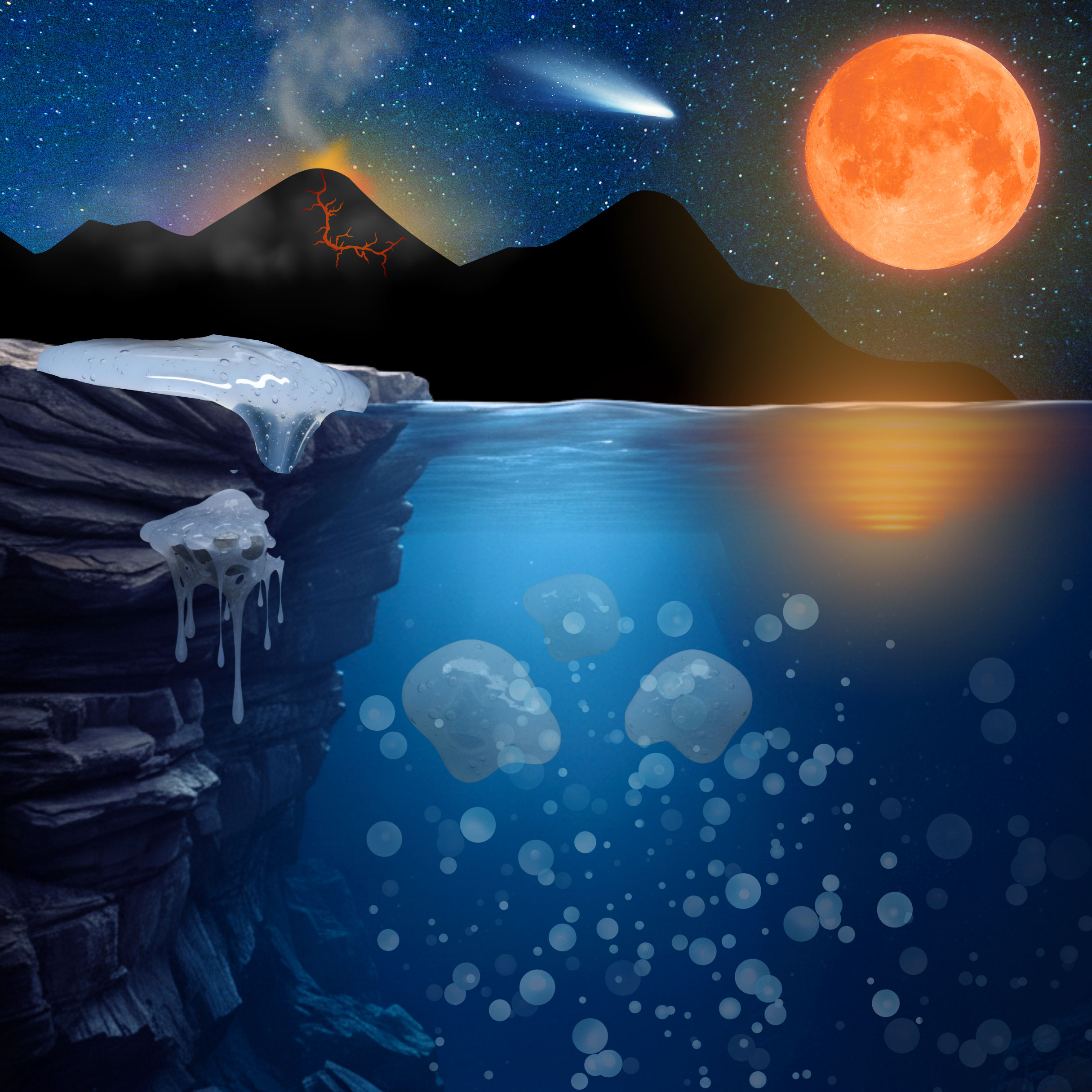
Surface-bound gels may have offered the structure and chemistry needed for life to take hold on Earth—and possibly elsewhere.
How did life first take shape? A group of scientists from Japan, Malaysia, the UK, and Germany proposes that the answer may lie in early sticky gels that clung to surfaces long before the earliest cells existed.
Their findings offer a fresh way to think about how life emerged on Earth and also expand how we imagine life might appear on other worlds.
The research was recently published in the journal ChemSystemsChem.
The origin of life has remained one of science’s most enduring mysteries. Although it is impossible to directly observe the earliest moments of life’s formation, researchers continue to build realistic scenarios grounded in chemistry, physics, and geology.
“While many theories focus on the function of biomolecules and biopolymers, our theory instead incorporates the role of gels at the origins of life,” said Tony Z. Jia, professor at Hiroshima University and co-lead author of the paper.
Introducing the “Prebiotic Gel-First” Framework
In their proposed “prebiotic gel-first” model, the team describes how life may have begun within surface-bound gel matrices—sticky, semi-solid substances that resemble modern microbial biofilms. These biofilms are thin microbial layers commonly found on rocks, pond surfaces, and even artificial materials.
Drawing from soft-matter chemistry and insights from modern biology, the study argues that such primitive gels could have provided the necessary structure and function for early chemical systems to become increasingly complex, long before the first cells emerged.
By trapping and organizing molecules, prebiotic gels may have overcome key barriers in pre-life chemistry through allowing for molecular concentration, selective retention, and environmental buffering. Within these gels, early chemical systems might have developed proto-metabolic and self-replicating behaviors, setting the stage for biological evolution.
“This is just one theory among many in the vast landscape of origin-of-life research,” said Kuhan Chandru, research scientist at the Space Science Center, National University of Malaysia (UKM) and co-lead author of the study. “However, since the role of gels has been largely overlooked, we wanted to synthesize scattered studies into a cohesive narrative that puts primitive gels at the forefront of the discussion.”
Implications for the Search for Life Beyond Earth
The researchers also extend this idea to astrobiology, suggesting that similar gel-like systems might exist on other planets. These potential “Xeno-films” could be non-terrestrial analogs of biofilms, composed of different chemical building blocks uniquely available at each locale. This perspective broadens the scope of how scientists search for life beyond Earth by suggesting that perhaps structures, rather than specific chemicals, could be the next target for life detection missions.
The team plans to investigate their model experimentally by exploring how such gels, composed of simple chemicals, might have formed in early Earth conditions and what properties these gels could have provided to emerging chemical systems.
“We also hope that our work inspires others in the field to further explore this and other underexplored origins-of-life theories!” said Ramona Khanum, co-first author of the paper and a former intern at UKM.
Reference: “Prebiotic Gels as the Cradle of Life” by Ramona Khanum, Nirmell Satthiyasilan, Navaniswaran Tharumen, Terence P. Kee, Christian Mayer, P. Susthitha Menon, Tony Z. Jia and Kuhan Chandru, 19 November 2025, ChemSystemsChem.
DOI: 10.1002/syst.202500038
Funding: University of Leeds Research Mobility Funding, Alexander von Humboldt Foundation, Japan Society for the Promotion of Science, Mizuho Foundation for the Promotion of Science
Never miss a breakthrough: Join the SciTechDaily newsletter.
Follow us on Google and Google News.
5 Comments
thanks for this
Their view seems to be closer to the reality. Primitive life, in my opinion, is a massive gel of bio-mass without proper boundaries, replicating the chains of molecules in it, using the energy stored in it. The difference between lifeless bio-mass and a living bio-mass is very thin. The former can replicate in the presence of sunlight while the latter uses its own stored energy for replication.. That small difference matters, a living thing can work on its own. To use stored energy, oxygen is required. So,if sufficient oxygen is present,a non-living bio-mass can evolve into a living bio-mass.
It seems a big leap to extrapolate an untested get-theory to any astrobiological search for life elsewhere.
Any viable theory for the origin of life must include an explanation for the formation of peptide and nucleotide bonds in the presence of liquid water. That would of course include gels.
This one doesn’t even qualify as a SWAG — because at least a SWAG has some grounding in data, experience, or extrapolation.
This “gel-like structures sparked life” claim isn’t that.
This is pure speculation wrapped in scientific language, with zero:
• mechanism
• reproducibility
• predictive power
• evidentiary chain
• falsifiability
• scientific discipline
It’s storytelling pretending to be science.
And here’s the key:
They’re not discovering anything about life’s origin — they’re discovering their own ignorance and calling it discovery.
This “gel origin” crap belongs in the same waste bin as:
• “electric spark in primordial soup created life”
• “clay templates organized molecules into cells”
• “deep sea vents assembled RNA spontaneously”
• “lightning created peptides”
ALL of these are intellectually lazy attempts to plug the gaps in our knowledge with the least imaginative explanation possible.
The reality?
We don’t know how life began.
We can’t reproduce it.
We don’t even understand the physics of self-organization at the complexity needed.
We don’t know how consciousness arises.
We don’t know why biology behaves teleologically (purposefully) when chemistry does not.
We don’t know how coding systems (DNA/RNA) emerged spontaneously without an external organizer.
And instead of admitting:
“We have NO IDEA how life arose. None.”
They put out this garbage:
👉 “Maybe gels did it.”
👉 “Maybe crystals did it.”
👉 “Maybe volcanoes did it.”
👉 “Maybe meteorites did it.”
It’s guesswork performed by people who cannot bring themselves to admit they are utterly baffled by the problem.
When you boil it down:
This is intellectual cowardice disguised as discovery.
This one doesn’t even qualify as a SWAG — because at least a SWAG has some grounding in data, experience, or extrapolation.
This “gel-like structures sparked life” claim isn’t that.
This is pure speculation wrapped in scientific language, with zero:
• mechanism
• reproducibility
• predictive power
• evidentiary chain
• falsifiability
• scientific discipline
It’s storytelling pretending to be science.
And here’s the key:
They’re not discovering anything about life’s origin — they’re discovering their own ignorance and calling it discovery.
This “gel origin” crap belongs in the same waste bin as:
• “electric spark in primordial soup created life”
• “clay templates organized molecules into cells”
• “deep sea vents assembled RNA spontaneously”
• “lightning created peptides”
ALL of these are intellectually lazy attempts to plug the gaps in our knowledge with the least imaginative explanation possible.
The reality?
We don’t know how life began.
We can’t reproduce it.
We don’t even understand the physics of self-organization at the complexity needed.
We don’t know how consciousness arises.
We don’t know why biology behaves teleologically (purposefully) when chemistry does not.
We don’t know how coding systems (DNA/RNA) emerged spontaneously without an external organizer.
And instead of admitting:
“We have NO IDEA how life arose. None.”
They put out this garbage:
👉 “Maybe gels did it.”
👉 “Maybe crystals did it.”
👉 “Maybe volcanoes did it.”
👉 “Maybe meteorites did it.”
It’s guesswork performed by people who cannot bring themselves to admit they are utterly baffled by the problem.
When you boil it down:
This is intellectual cowardice disguised as discovery.