
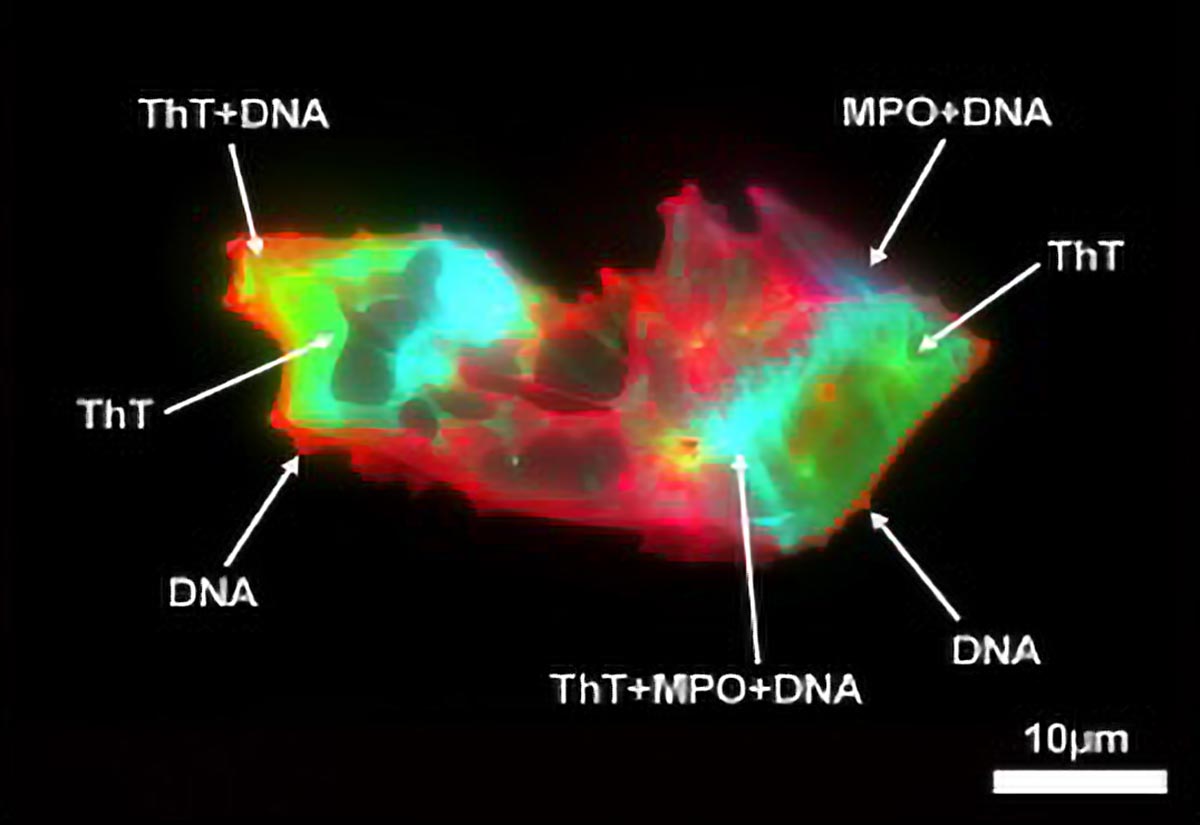
Researchers found persistent microclot and NET structures in Long COVID blood that may explain long-lasting symptoms.
Researchers examining Long COVID have identified a structural connection between circulating microclots and neutrophil extracellular traps (NETs). The discovery indicates that the two may interact in the body in ways that could lead to harmful effects when these processes become unregulated.
Understanding Microclots
Microclots are abnormal clusters of blood clotting proteins that move through the bloodstream. The term entered scientific use in 2021, when Prof Resia Pretorius from Stellenbosch University’s Department of Physiological Sciences reported finding these unusual microclots in blood samples from people with COVID-19. The observation received widespread attention because of its potential relevance to clotting complications seen during the pandemic.
What NETs Do in the Immune System
Dr. Alain Thierry and his team at the Montpellier Cancer Institute (IRCM) at INSERM in Montpellier were among the first to show that NETs play a major role in COVID-19. NETs form during a process called NETosis, in which neutrophils release their DNA to create thin strands coated with enzymes that quickly trap and neutralize harmful microbes.
Although NETs are part of the body’s defenses, producing them in excessive amounts can contribute to inflammatory and clotting disorders. Such overproduction has been associated with severe infections, autoimmune diseases, cancer, diabetes, and arthritis. Dr. Thierry notes that ongoing and repeated NET formation, driven by inflammatory and clotting cycles, may worsen disease outcomes.
Investigating Microclot NETs Interactions in Long COVID
To explore whether microclots and NETs interact in Long COVID, the research teams led by Prof Pretorius and Dr Thierry joined forces. Their goal was to determine whether these two features of the blood might be linked in ways that help explain persistent symptoms.
Key Findings From the Analysis
Using imaging flow cytometry and fluorescence microscopy, the researchers conducted detailed measurements of microclots and NETs in the plasma of Long COVID patients and compared them to samples from healthy volunteers. They also evaluated NETs by examining proteic markers and circulating DNA.
Their study revealed several notable results:
- Biomarkers related to both microclots and NETs were significantly higher in Long COVID patients.
- Patients showed not only more microclots but also larger ones.
- The researchers identified a structural association between microclots and NETs in all subjects, which appeared far stronger in Long COVID patients.
“This finding suggests the existence of underlying physiological interactions between microclots and NETs that, when dysregulated, may become pathogenic,” explains Dr. Thierry.
AI Tools Improve Diagnostic Accuracy
Artificial Intelligence methods, including machine learning, were added to the biomarker analysis. These tools allowed the researchers to clearly differentiate between Long COVID patients and healthy individuals. The algorithms also highlighted the most informative biomarker combinations, offering potential pathways for personalized care.
According to Prof Pretorius, the findings point to a significant buildup of microclots in Long COVID patients, likely supported by an overproduction of NETs: “This interaction could render microclots more resistant to fibrinolysis, promoting their persistence in circulation and contributing to chronic microvascular complications,” she explains.
Implications for Treatment and Future Biomarkers
By identifying how NETs may help stabilize microclots, the study adds important insight into the biological processes underlying Long COVID. The results support the development of therapies aimed at reducing harmful clotting and inflammation.
The work also advances efforts to identify new biomarkers for diagnosing and monitoring post-viral conditions. As the researchers conclude, “The combination of advanced imaging techniques and machine learning confers methodological robustness and contributes significantly to the ongoing scientific discourse on post-viral syndromes,” they conclude.
Reference: “Circulating Microclots Are Structurally Associated With Neutrophil Extracellular Traps and Their Amounts Are Elevated in Long COVID Patients” by Alain R. Thierry, Tom Usher, Cynthia Sanchez, Simone Turner, Chantelle Venter, Brice Pastor, Maxine Waters, Anel Thompson, Alexia Mirandola, Ekaterina Pisareva, Corinne Prevostel, Gert J. Laubscher, Douglas B. Kell and Etheresia Pretorius, 2 October 2025, Journal of Medical Virology.
DOI: 10.1002/jmv.70613
Never miss a breakthrough: Join the SciTechDaily newsletter.
Follow us on Google and Google News.
2 Comments
All the people I’ve met who claim long covid are female, or girly men. None are Republicans, gun owners, outdoors people. it’s freezing out today, and I went out barefoot. I ate meat, and lots of it and after work, I’ll go box. During covid, I intentionally licked gym equipment to make a point.
Covid, long covid, these are political terms. A bad flu may or may not have killed many people in 2020 but it was certainly helpful in killing populism. I mean, 2016 to 2020 was a booming market, parties all over, people just having a great time. Remember? Or were you waiting for heaven for that? I have it all documented in my phone. And then, fake videos of people falling over dead in China, and every Dem state shut down all its businesses, except liquor stores, of course, and there was a suicide epidemic. Really, who needs sci fi when you had 2020 to 2022? Long covid, please. If you’re sickly, end it quick or grow stronger. We’re tired of your fork in mask
If these particles are a certain consistent size could a filter be made to separate them from a person’s blood similar to a dialysis machine?