
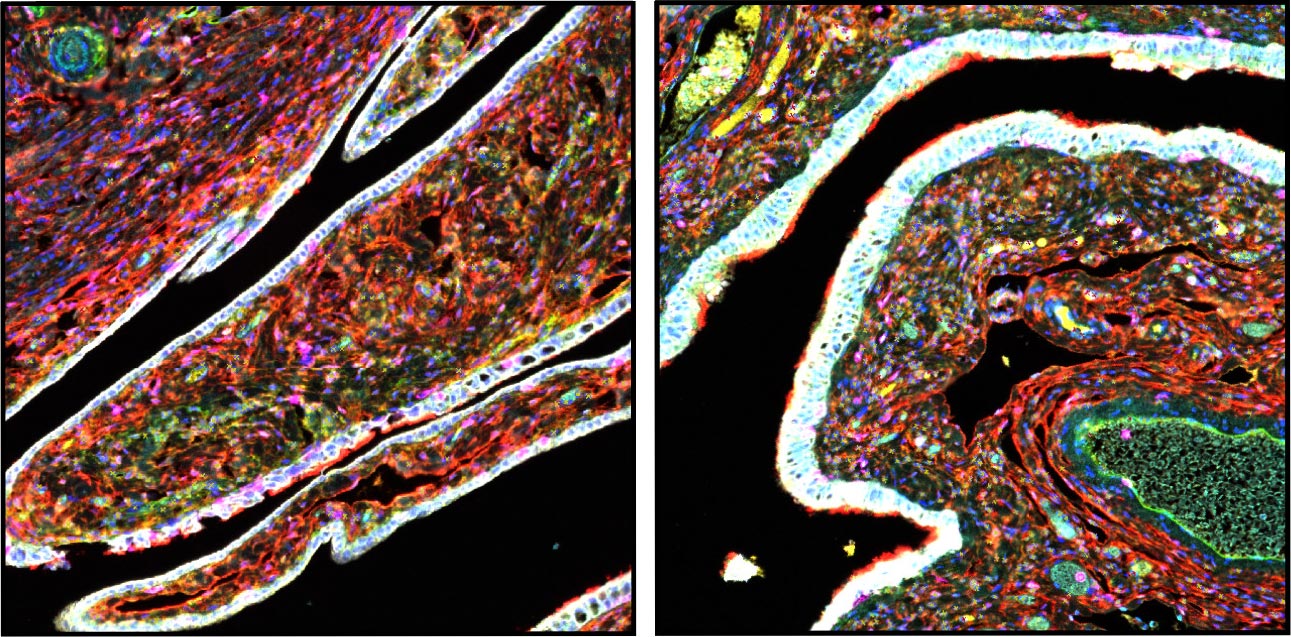
Scientists have uncovered a hidden driver of ovarian cancer—high-risk mesenchymal stem cells lurking in the fallopian tubes.
These cells, present even in healthy women at risk, set the stage for cancer by promoting DNA damage and helping mutated cells survive. Their discovery opens new doors for prevention, early detection, and targeted therapies.
Uncovering a Hidden Trigger of Ovarian Cancer
Researchers at the University of Pittsburgh have discovered a previously unknown trigger for a deadly form of ovarian cancer. Their study identifies a specific group of progenitor cells located in the supportive tissue (stroma) of the fallopian tubes as a key player in cancer development.
Published today (March 14) in Cancer Discovery, a journal of the American Association for Cancer Research, the findings could lead to new ways to detect and prevent high-grade serous ovarian cancer (HGSOC) — the most common and lethal form of ovarian cancer, responsible for more than 12,000 deaths annually in the U.S.
The Urgent Need for Better Solutions
“Ovarian cancer is the leading cause of death from gynecologic cancer in the Western world, but we currently have no way to detect it early and no prevention strategies apart from surgical castration, which is only indicated in high-risk women,” said co-senior author Lan Coffman, M.D., Ph.D., associate professor of malignant hematology and medical oncology in the Pitt School of Medicine and member of Magee-Womens Research Institute and UPMC Hillman Cancer Center. “Understanding the underlying biology of how ovarian cancer forms is critical to improving outcomes for our patients.”

How Ovarian Cancer Begins in the Fallopian Tubes
HGSOC begins in the fallopian tubes when healthy epithelial cells transform into precursor lesions known as serous tubal intraepithelial carcinoma (STIC). Similar to how precancerous colon polyps can become colorectal cancer, STIC lesions often develop into HGSOC tumors.
But why do healthy cells become STIC? To find out, Coffman and her team turned to the stroma, the non-cancerous connective tissue that helps cancer grow.
“Most researchers have been focused on the epithelial cells that turn into these STIC lesions and eventually into cancer,” said Coffman. “Until now, no one has really looked at the surrounding stromal microenvironment of these lesions.”
A Key Role for Mesenchymal Stem Cells
In the stroma of ovarian cancer, a type of progenitor cell normally involved in the growth and repair of healthy tissue — mesenchymal stem cells (MSCs) — become reprogrammed by tumor cells to support cancer growth. Coffman started by asking when these cancer-associated MSCs form and how early they play a role in cancer formation.
When she and her team profiled MSCs in the fallopian tubes of patients who did not have cancer, they were surprised to find cells that looked like cancer-associated MSCs in these healthy women. These cells, which the researchers named high-risk MSCs, were more common in women with higher risk of ovarian cancer — those of older age or with mutations in the BRCA gene — suggesting that they play a role in cancer initiation.
High-Risk MSCs Drive Cancer Formation
When the researchers introduced these high-risk MSCs into organoids, or mini-organs, derived from patient fallopian tube tissue, healthy epithelial cells transformed into cancerous cells.
“High-risk MSCs promote DNA damage in epithelial cells and then help those mutated cells survive,” explained Coffman. “It’s the perfect storm for cancer initiation.”
High-risk MSCs also promoted tumor cell growth and increased resistance to a chemotherapy drug.
In search of a mechanism for why high-risk MSCs drive ovarian cancer, the researchers found that these cells have a loss of an antioxidant called AMP kinase. Lower levels of AMP kinase led to higher levels of a protein called WT1, which in turn drove the formation of compounds that cause DNA damage.
New Avenues for Treatment and Early Detection
“This is the first report that stromal changes in the fallopian tube actually have a causative role in ovarian cancer initiation,” said Coffman. “It also points to a path where we might be able to intervene.”
For example, already existing drugs that upregulate AMP kinase could potentially prevent or reverse early changes in the stroma that lead to ovarian cancer.
The findings could also inform approaches for early detection, which are sorely lacking for ovarian cancer. According to Coffman, compounds secreted by high-risk MSCs that are detectable in the bloodstream could act as biomarkers for early-stage ovarian cancer.
Reference: “Aged and BRCA mutated stromal cells drive epithelial cell transformation” by Geyon L. Garcia, Taylor Orellana, Grace Gorecki, Leonard Frisbie, Roja Baruwal, Swathi Suresh, Ester Goldfeld, Ian Beddows, Ian P. MacFawn, Ananya K. Britt, Macy M. Hale, Amal Taher. Elhaw, Brian R. Isett, Nadine Hempel, Riyue Bao, Hui Shen, Ronald J. Buckanovich, Toren Finkel, Ronny Drapkin, T Rinda Soong, Tullia C. Bruno, Huda I. Atiya and Lan G. Coffman, 14 March 2025, Cancer Discovery.
DOI: 10.1158/2159-8290.CD-24-0805
Other authors on the study were Geyon Garcia, Taylor Orellana, M.D., Grace Gorecki, M.D., Leonard Frisbie, Roja Baruwal, Swathi Suresh, Ester Goldfeld, M.D., Ian MacFawn, Ph.D., Ananya Britt, Macy Hale, Brian Isett, Ph.D., Nadine Hempel, Ph.D., Riyue Bao, Ph.D., Ronald Buckanovich, M.D., Ph.D., Toren Finkel, M.D., Ph.D., T. Rinda Soong, M.D., Ph.D., M.P.H., Tullia Bruno, Ph.D., and Huda Atiya, Ph.D., all of Pitt and UPMC; Ian Beddows, Ph.D., and Hui Shen, Ph.D., both of Van Andel Research Institute; Amal Taher Elhaw, of Pitt and Penn State University; and Ronny Drapkin, M.D., Ph.D., of the University of Pennsylvania.
This research was supported by Tina’s Wish (The Honorable Tina Brozman Foundation), the Department of Defense (W81XWH-22-1-0852 and OC210139) and the National Institutes of Health (P50CA272218-01A1, U01 AG077923, P50 CA228991, R01CA242021, S10OD028483 and P30CA047904).
Never miss a breakthrough: Join the SciTechDaily newsletter.
Follow us on Google and Google News.