
Revealing the Atomic Mechanism Behind Thermoelectric Heat Transport
The Science
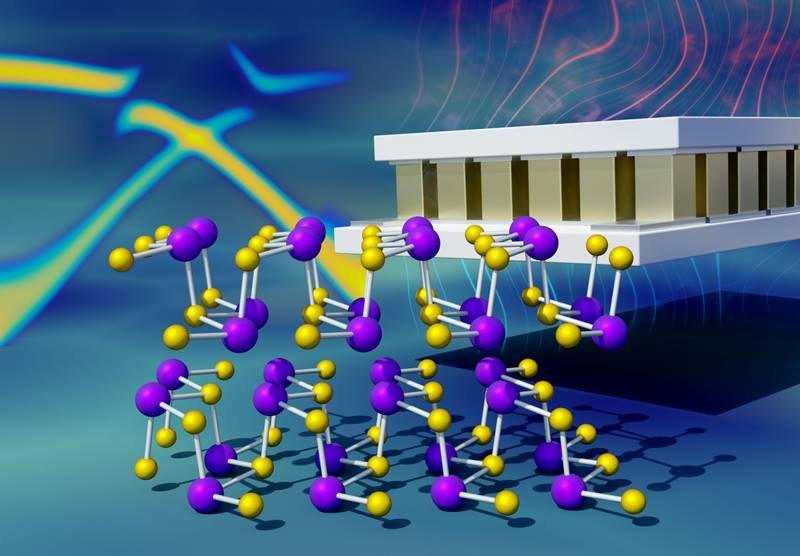
Thermoelectric devices turn thermal energy into electricity by creating a voltage from the temperature differential between the hot and cold sections of a device. Researchers utilized neutrons to investigate single crystals of tin sulfide and tin selenide to better understand how the conversion process happens at the atomic scale. They measured changes that were temperature dependent. The tests found a strong connection between structural changes at different temperatures and the frequency of atomic vibrations (phonons).
This connection influences how heat is conducted by the materials. The study also identified the ideal temperatures for energy conversion. It also provided fundamental scientific insights that may be used to assist researchers to create new materials with improved thermoelectric performance.
The Impact
Thermoelectric materials are critical for clean energy technology. Researchers used neutron scattering to uncover details about the phonon renormalization mechanism. This is the quantum mechanics process that explains the extraordinarily low thermal conductivity of two common thermoelectric materials. The findings might help researchers create materials for more efficient thermoelectric devices. It will also help improve renewable energy conversion technology.
Summary
Thermoelectrics convert thermal energy into electricity. They are among the mix of clean energy technologies that can mitigate the impact of climate change. One major challenge with thermoelectrics is their relatively low efficiencies and the limited number of available materials. To design higher efficiency materials, scientists need a fundamental understanding of the mechanism enabling ultralow thermal conductivity.
To address this longstanding scientific puzzle, researchers from Duke University employed neutron scattering experiments, complemented by other techniques, to probe the archetypical thermoelectric materials, tin (Sn) crystallized with sulfur (S) and selenium (Se) into binaries – SnS and SnSe.
By using the advanced neutron scattering instruments at the Spallation Neutron Source and High Flux Isotope Reactor, Department of Energy (DOE) user facilities at Oak Ridge National Laboratory, structural changes, and phonon spectra were measured in a wide temperature range from 150 K to 1050 K, revealing a transition at 800 K where the atomic spacings expand in one direction but contract in others.
Measurement of the dynamics also provided key information on the dramatic reduction in the frequencies of atomic vibrations at the transition, which is responsible for the reduced heat conduction. The work also suggests that the observed phonon behavior could be present in many other materials with similar phase transitions, such as halide perovskites, oxide ferroelectrics, or thermoelectrics near instabilities, significantly broadening the pool of possibilities for energy conversion materials.
Reference: “Extended anharmonic collapse of phonon dispersions in SnS and SnSe” by T. Lanigan-Atkins, S. Yang, J. L. Niedziela, D. Bansal, A. F. May, A. A. Puretzky, J. Y. Y. Lin, D. M. Pajerowski, T. Hong, S. Chi, G. Ehlers and O. Delaire, 4 September 2020, Nature Communications.
DOI: 10.1038/s41467-020-18121-4
The study was funded by the US Department of Energy’s Office of Science, Basic Energy Sciences, Materials Sciences, and Engineering Division. The research also used the US Department of Energy’s Office of Science user facilities.
Never miss a breakthrough: Join the SciTechDaily newsletter.
Follow us on Google and Google News.
2 Comments
Dark matter and dark energy is everywhere. Different substances have different forms and modes of motion, mainly because of the way they formed via dark matter or dark energy and the way they interact with dark matter or dark energy in the motion are different.
Hope that innovation takes place in Oak Ridge National Laboratory.