
Close Menu
    Facebook X (Twitter) Instagram
    SciTechDaily
    • Biology
    • Chemistry
    • Earth
    • Health
    • Physics
    • Science
    • Space
    • Technology
    Facebook X (Twitter) Pinterest YouTube RSS
    SciTechDaily
    Home»Biology»Scientists Use AI To Unlock the Secrets of Bacterial Languages
    Biology

    Scientists Use AI To Unlock the Secrets of Bacterial Languages

    By Aalto UniversityJanuary 6, 2024No Comments3 Mins Read
    Facebook Twitter Pinterest Telegram LinkedIn WhatsApp Email Reddit
    Share
    Facebook Twitter LinkedIn Pinterest Telegram Email Reddit
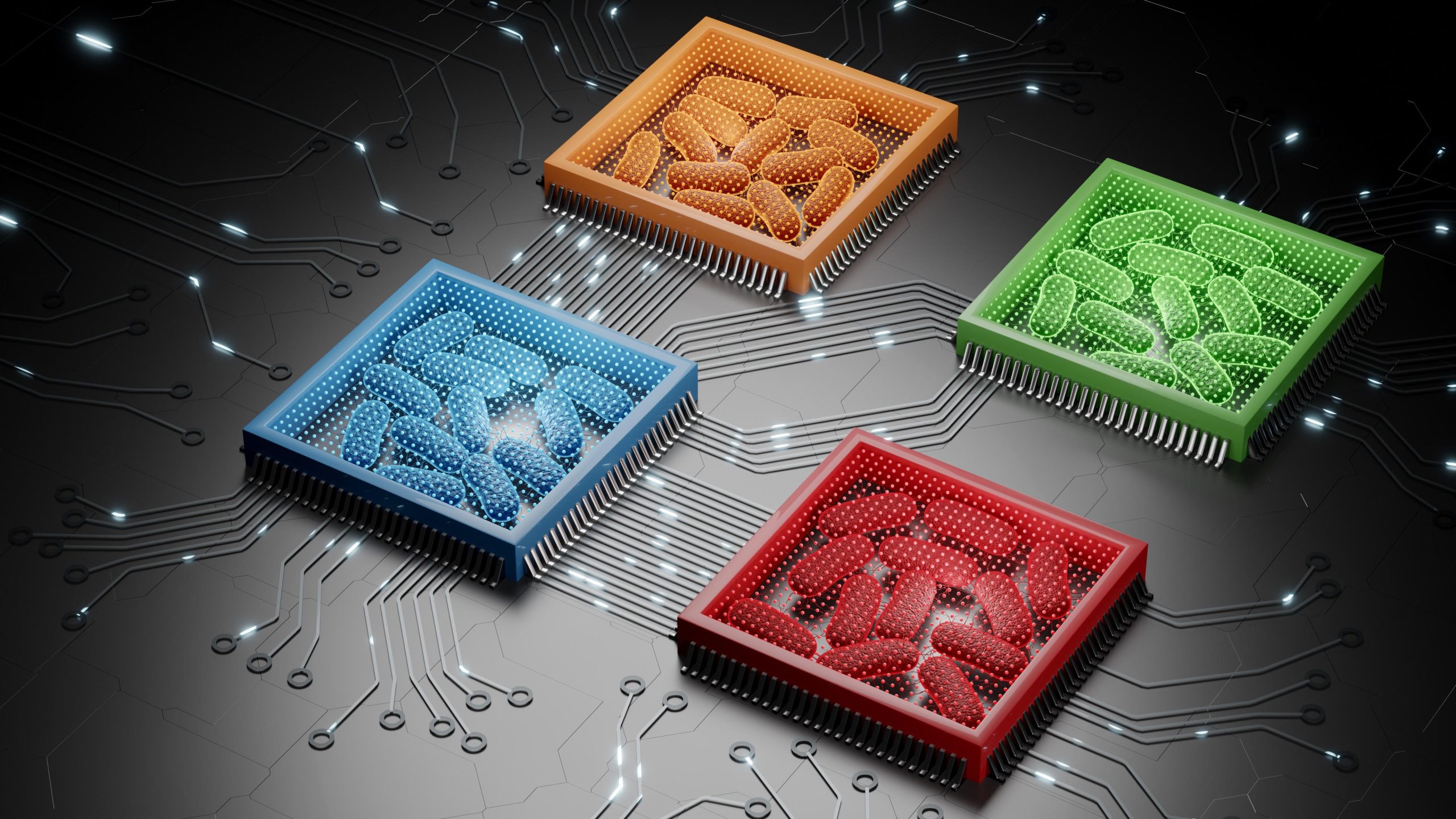
    Bacterial Processor
    An improved understanding of bacterial languages brings us closer to controlling and coordinating the behavior of bacteria. Credit: Ekaterina Osmekhina/Aalto University

    Scientists tease apart the relationships between bacterial languages.

    Machine learning and laboratory experiments have provided scientists with insights into the different languages bacteria use to communicate. By understanding the ways in which bacteria interact and the circumstances under which their communication is disrupted, researchers can tackle issues related to drug-resistant bacteria and advance the development of biocomputing technologies.

    The study builds on an earlier project in which the researchers showed that disrupting bacterial communication is an effective way to fight multidrug-resistant bacteria. Bacteria use small molecules to communicate with each other and coordinate infection, and the team showed that interfering with bacterial communication by blocking these molecules reduced inflammation and made the bacteria more vulnerable to antibiotics.

    Deciphering Bacterial Languages: A New Frontier

    Now, the researchers have taken a closer look at the languages that bacteria communicate with. They used a combination of machine learning and wet-lab experiments to examine all the roughly 170 known bacterial languages. This analysis provides an understanding of the similarities and differences between the languages, which can be used both to disrupt harmful bacteria and to build useful ‘bacterial logic circuits’.

    The first step was a machine learning analysis that grouped the languages into clusters based on the structure of their molecules. The resulting groups consisted of languages more similar to each other and different from languages in other groups. This is comparable to human languages: English, French, and Dutch are in one group of languages, while Arabic and Hebrew are in another, for example.

    Bacterial Understanding and Misunderstanding: A Key Discovery

    Next, the team experimentally showed that bacteria can somewhat understand related languages. “We did a ‘bacterial language check’ and found that bacteria using very similar languages can understand each other, just like a Dutch person might understand some German. We also tested communication between bacteria using very different languages and found that they couldn’t understand each other at all – just like a conversation between people speaking Finnish, Dutch, and Arabic wouldn’t get far,” says Christopher Jonkergouw, the doctoral student who led the study.

    With these tools, the researchers have shown that we can accurately estimate the connections between bacterial languages and predict whether they can be understood. These findings will be valuable in further refining the team’s new treatment approach, and they also have implications for biotechnology – bacterial languages can be used to coordinate tasks between groups in bacterial communities, or even in bacterial microprocessors.

    Reference: “Exploration of Chemical Diversity in Intercellular Quorum Sensing Signalling Systems in Prokaryotes” by Christopher Jonkergouw, Pihla Savola, Ekaterina Osmekhina, Joeri van Strien, Piotr Batys and Markus B. Linder, 25 October 2023, Angewandte Chemie International Edition.
    DOI: 10.1002/anie.202314469

    Never miss a breakthrough: Join the SciTechDaily newsletter.
    Follow us on Google and Google News.

    Aalto University Antibiotics Bacteria Machine Learning
    Share. Facebook Twitter Pinterest LinkedIn Email Reddit

    Related Articles

    AI Revolutionizes Antibiotic Discovery: A New Hope Against Evasive Hospital Superbugs

    AI Battles Superbugs: Helps Find New Antibiotic Drug To Combat Drug-Resistant Infections

    Shark Skin Microbiome Protects Wounds From Infection

    Evolution of Antibiotic Resistance Altered by Bacterial Lifestyle

    New Antibiotic in Discovered in Tropical Forest – May Leaded to a “Plant Probiotic”

    MetaCherchant Software Reveals New Causes of Antibiotic Resistance

    Stimulating Resolution Programs Limit Consequences of Infection

    Understanding Antibiotics and Their Role in Killing Bacteria

    Antibiotic-Free Meat Might Still Be Contaminated with Drug Resistant Bacteria

    Leave A Reply Cancel Reply

    • Facebook
    • Twitter
    • Pinterest
    • YouTube

    Don't Miss a Discovery

    Subscribe for the Latest in Science & Tech!

    Trending News

    New Study Reveals Why Ozempic Works Better for Some People Than Others

    Climate Change Is Altering a Key Greenhouse Gas in a Way Scientists Didn’t Expect

    New Study Suggests Gravitational Waves May Have Created Dark Matter

    Scientists Discover Why the Brain Gets Stuck in Schizophrenia

    Scientists Engineer “Tumor-Eating” Bacteria That Devour Cancer From Within

    Even “Failed” Diets May Deliver Long-Term Health Gains, Study Finds

    NIH Scientists Discover Powerful New Opioid That Relieves Pain Without Dangerous Side Effects

    Collapsing Plasma May Hold the Key to Cosmic Magnetism

    Follow SciTechDaily
    • Facebook
    • Twitter
    • YouTube
    • Pinterest
    • Newsletter
    • RSS
    SciTech News
    • Biology News
    • Chemistry News
    • Earth News
    • Health News
    • Physics News
    • Science News
    • Space News
    • Technology News
    Recent Posts
    • The Surprising Reason You Might Want To Sleep Without a Pillow
    • Household Cats Could Hold the Secret to Fighting Breast Cancer
    • Scientists Say This Natural Hormone Reverses Obesity by Targeting the Brain
    • This 15,000-Year-Old Discovery Changes What We Know About Early Human Creativity
    • 35-Million-Year-Old Mystery: Strange Arachnid Discovered Preserved in Amber
    Copyright © 1998 - 2026 SciTechDaily. All Rights Reserved.
    • Science News
    • About
    • Contact
    • Editorial Board
    • Privacy Policy
    • Terms of Use

    Type above and press Enter to search. Press Esc to cancel.