
Close Menu
    Facebook X (Twitter) Instagram
    SciTechDaily
    • Biology
    • Chemistry
    • Earth
    • Health
    • Physics
    • Science
    • Space
    • Technology
    Facebook X (Twitter) Pinterest YouTube RSS
    SciTechDaily
    Home»Space»SDO Collects Its 100-Millionth Image of the Sun
    Space

    SDO Collects Its 100-Millionth Image of the Sun

    By NASAJanuary 21, 2015No Comments2 Mins Read
    Facebook Twitter Pinterest Telegram LinkedIn WhatsApp Email Reddit
    Share
    Facebook Twitter LinkedIn Pinterest Telegram Email Reddit
    SDO Collects Its 100-Millionth Image
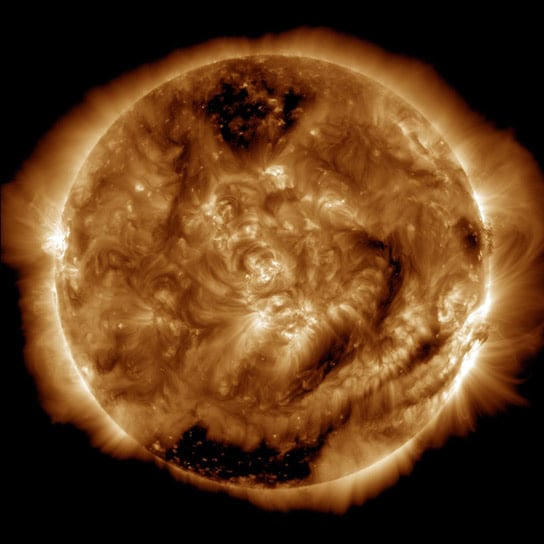
    The Atmospheric Imaging Assembly on NASA’s Solar Dynamics Observatory captured its 100 millionth image of the sun on January 19, 2015. The dark areas at the bottom and the top of the image are coronal holes — areas of less dense gas, where solar material has flowed away from the sun. Credit: NASA/SDO/AIA/LMSAL; NASA/SDO/Mosaic created with AndreaMosaic

    On January 19, 2015, at 12:49 p.m. EST, the Atmospheric Imaging Assembly on NASA’s Solar Dynamics Observatory captured its 100 millionth image of the sun.

    The Atmospheric Imaging Assembly, or AIA, uses four telescopes working parallel to gather eight images of the sun – cycling through 10 different wavelengths — every 12 seconds.

    Between the AIA and two other instruments on board, the Helioseismic Magnetic Imager, and the Extreme Ultraviolet Variability Experiment, SDO sends down a whopping 1.5 terabytes of data a day. AIA is responsible for about half of that. Every day it provides 57,600 detailed images of the sun that show the dance of how solar material sways and sometimes erupts in the solar atmosphere, the corona.

    In the almost five years since its launch on February 11, 2010, SDO has provided images of the sun to help scientists better understand how the roiling corona gets to temperatures some 1000 times hotter than the sun’s surface, what causes giant eruptions such as solar flares, and why the sun’s magnetic fields are constantly on the move.

    In honor of the 100 millionth image, Dean Pesnell, SDO’s project scientist at NASA’s Goddard Space Flight Center in Greenbelt, Maryland, and Karel Schrijver, the AIA principal investigator at Lockheed Martin in Palo Alto, California, chose some of their favorite images produced by SDO so far.

    SDO 100-Millionth Mosaic Image
    This mosaic of the 100 millionth image from the Advanced Imaging Assembly on NASA’s Solar Dynamics Observatory is created from previous AIA images – each tile in the mosaic is 50 pixels across. All the sun pictures used in the mosaic show extreme ultraviolet light with a wavelength of 193 angstroms. Credit: NASA/SDO/AIA/LMSAL; NASA/SDO/Mosaic created with AndreaMosaic


    Never miss a breakthrough: Join the SciTechDaily newsletter.
    Follow us on Google and Google News.

    Astronomy Solar Dynamics Observatory Sun
    Share. Facebook Twitter Pinterest LinkedIn Email Reddit

    Related Articles

    Powerful X-Class Solar Flare Erupts From Sun – Captured by NASA’s Solar Dynamics Observatory

    Moderate Solar Flare Erupts From Sun – Captured by NASA’s Solar Dynamics Observatory

    In 1999 Mysterious Finger-Like Features Were Spotted on the Sun – Now Scientists Have an Explanation

    NASA’s Solar Dynamics Observatory Captures Mid-Level Flare Erupting From the Sun

    Resonant Modes: Long-Period Oscillations of the Sun Discovered

    Solar Dynamics Observatory: Artificial Intelligence Helps Improve NASA’s Eyes on the Sun

    U.S. Postal Service Issues Stunning New Sun Science Forever Stamps

    Gorgeous New Sun Science Stamps Highlight a Decade of Sun-Watching From Space

    Unusual “Rosetta Stone” Solar Eruption Could Help Explain Mysterious Powerful Explosions on the Sun

    Leave A Reply Cancel Reply

    • Facebook
    • Twitter
    • Pinterest
    • YouTube

    Don't Miss a Discovery

    Subscribe for the Latest in Science & Tech!

    Trending News

    Breakthrough Parkinson’s Drug Targets Disease at Its Genetic Roots

    Just 4 Weeks of Simple Diet Changes Reversed Signs of Aging in Older Adults

    Scientists May Have Finally Solved Why Humans Are Right-Handed

    NASA’s Hubble Accidentally Witnesses a Comet Shattering in Space

    Researchers Discover the Body’s Hidden “Off Switch” for Inflammation

    Scientists Discover Metformin Doesn’t Work the Way We Thought

    Tea or Coffee? Your Daily Choice Could Affect Osteoporosis Risk

    Vitamin C May Fight Cancer in a Surprising Way

    Follow SciTechDaily
    • Facebook
    • Twitter
    • YouTube
    • Pinterest
    • Newsletter
    • RSS
    SciTech News
    • Biology News
    • Chemistry News
    • Earth News
    • Health News
    • Physics News
    • Science News
    • Space News
    • Technology News
    Recent Posts
    • Scientists Stunned by Hybrid California Bees That Beat Deadly Mites
    • Scientists Discover Terrifying Giant Crocodile That Hunted Human Ancestors
    • Scientists Finally Think They Know Why T. rex Had Tiny Arms
    • Scientists Are Turning Ocean Trash Into Roads – and It’s Actually Working
    • This Alien Planet Has Rock Clouds That Vaporize Before Sunset
    Copyright © 1998 - 2026 SciTechDaily. All Rights Reserved.
    • Science News
    • About
    • Contact
    • Editorial Board
    • Privacy Policy
    • Terms of Use

    Type above and press Enter to search. Press Esc to cancel.