
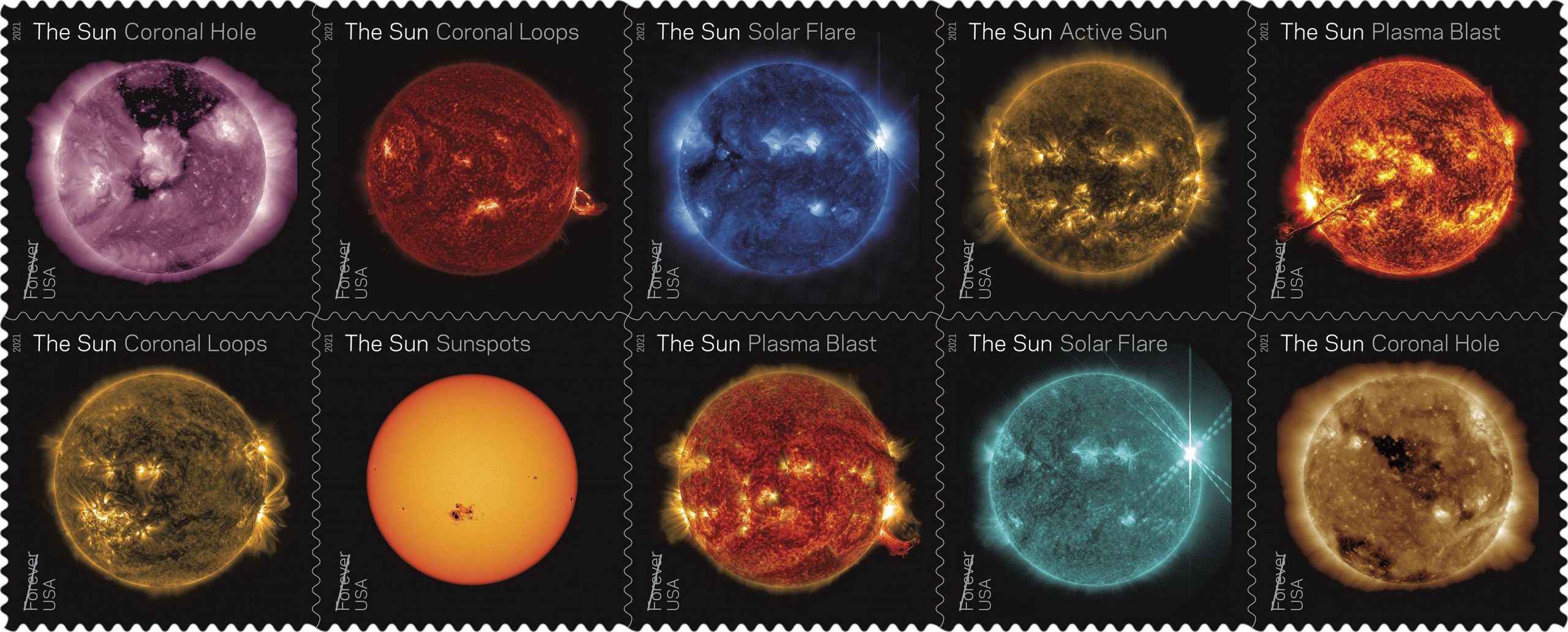
The U.S. Postal Service issued the Sun Science stamps last month. The Forever stamps were dedicated during a ceremony at the Greenbelt Main Post Office and are now for sale at Post Offices nationwide.
“We hope these amazing stamps will help generate the same sense of wonder and curiosity about our star that inspired our ancestors and the scientists at NASA to want to better understand the sun, space, and the myriad of possibilities that exist in our solar system, in our universe and beyond,” said Thomas J. Marshall, the Postal Service’s general counsel and executive vice president, and the stamp ceremony’s dedicating official.
Background
The Postal Service highlights stunning images of the sun that celebrate the science behind the ongoing exploration of our nearest star.
Printed with a foil treatment that adds a glimmer to the stamps, the images on these stamps come from NASA’s Solar Dynamics Observatory, a spacecraft launched in February 2010 to keep a constant watch on the sun from geosynchronous orbit above Earth. The striking colors in these images do not represent the actual colors of the sun as perceived by human eyesight. Instead, each image is colorized by NASA according to different wavelengths that reveal or highlight specific features of the sun’s activity.
One of the stamps highlights sunspots, two feature images of coronal holes, two show coronal loops, two depict plasma blasts, one is a view of an active sun that emphasizes its magnetic fields, and two show different views of a solar flare.
The U.S. Postal Service illuminates the light and warmth of our nearest star by highlighting these stunning images of the Sun on stamps. These images come from NASA’s Solar Dynamics Observatory, a spacecraft launched in February 2010 to keep a constant watch on the Sun. The Sun is the only star that humans are able to observe in great detail, making it a vital source of information about the universe. The Solar Dynamics Observatory lets us see the Sun in wavelengths of ultraviolet light that would otherwise be invisible to our eyes. Each black-and-white image is colorized to the bright hues seen here. The stamps highlight different features on the Sun that help scientists learn about how our star works and how its constantly churning magnetic fields create the solar activity we see. Sunspots, coronal holes and coronal loops, for example, can reveal how those magnetic fields dance through the Sun and its atmosphere. Observing plasma blasts and solar flares can help us better understand and mitigate the impact of such eruptions on technology in space. Credit: NASA’s Goddard Space Flight Center
Heliophysics, the study of the sun and its influence on the planets and space surrounding them, has important implications for our day-to-day lives. Although the space between the sun and Earth appears empty to human eyes, it is actually full of particles and energy from the constant flow of solar wind emitted by the sun. That space is affected by a complex, ever-changing magnetic field that influences our entire solar system. Increased understanding of the sun helps us better explain and predict its impact not only on Earth’s climate but also on the near-Earth space environment and how it affects sensitive human technology, such as communications systems and satellite electronics. As humanity continues to explore space, a deeper knowledge of solar activity will also make it possible to identify and solve problems involved in communications, data collection, spacecraft and satellite design, and the effects of space radiation on the human body.
Art director Antonio Alcalá designed the stamps from photos that have been colorized by NASA to correspond with the wavelengths that reveal specific features of the sun’s activity.
The Sun Science stamps are being issued as a Forever stamp in panes of 20. These Forever stamps will always be equal in value to the current First-Class Mail 1‑ounce price.
Never miss a breakthrough: Join the SciTechDaily newsletter.
Follow us on Google and Google News.