
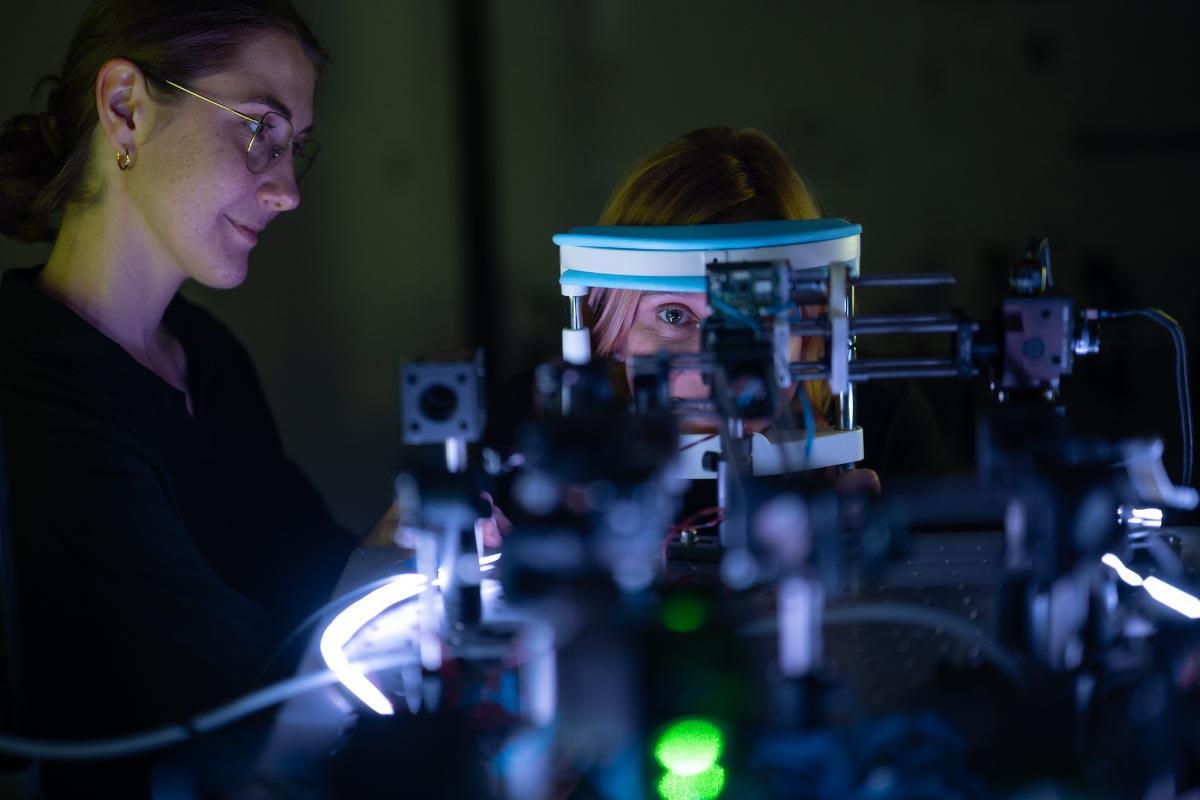
ICTER scientists have pioneered a method to quantify two-photon vision brightness, unlocking new possibilities for medical diagnostics and AR/VR applications.
Two-photon vision is an emerging technique with significant potential for the future of ophthalmic diagnostics. While it offers many advantages, certain aspects still require refinement. Scientists at ICTER have advanced this technology, enhancing its capabilities and expanding its potential applications in ocular medicine.
Imagine looking through a kaleidoscope that reveals a spectrum of colors beyond human vision, where invisible light is brought into focus. In conventional sight, photons—the fleeting messengers of light—typically appear alone. However, in the phenomenon of two-photon vision, they work in pairs, allowing the human eye to perceive infrared laser pulses instead of visible light, unlocking access to an otherwise invisible world.
A crucial aspect of understanding two-photon vision is measuring the brightness of these stimuli. Until now, this was only possible for visible light. Scientists at the International Centre for Eye Research (ICTER) have achieved a groundbreaking milestone by determining the luminance value of infrared light using photometric units (cd/m²). This discovery has enabled them to connect the brightness of two-photon stimuli to a newly defined physical quantity: two-photon retinal illumination, a key factor in understanding perceived brightness.
The research, led by ICTER scientists in collaboration with PhD student Oliwia Kaczkoś, PhD Eng. Katarzyna Komar, and Prof. Maciej Wojtkowski, has shown that the luminance of a two-photon stimulus can reach nearly 670 cd/m² while remaining within safe laser power limits for the human eye. Their findings, published in Biomedical Optics Express, mark a significant advancement in vision science and the study of human perception beyond the visible spectrum.
Seeing the Invisible World
The human eye can receive stimuli from the surrounding world in the form of electromagnetic waves in the range of about 380 nm to 780 nm (from violet to red). Waves outside this range, such as infrared (above 780 nm) and ultraviolet (below 380 nm), are invisible to us without special devices, although they can affect the senses in other ways.
Every vision process follows the same path when a photon of visible light is absorbed by the visual pigment of the photoreceptor in the retina (the light-sensitive part of the eye). This event initiates a series of chemical reactions, as a result of which a quantum of light is converted into an electrical signal, processed in the brain.
Two-photon vision is a phenomenon in which the human eye can perceive ultrashort pulses of infrared lasers with a wavelength in the range of 800-1300 nm by absorbing two photons. This process causes isomerization of visual pigments, which leads to the perception of light with a wavelength corresponding to half the infrared wavelength. Although these lasers are outside the visible range of the spectrum, their effect on visual pigments allows infrared light to be recorded as different colors.
Two-photon vision differs from single-photon vision primarily in the way light is absorbed. In single-photon vision, each photon with a specific energy is absorbed by molecules in the eye, which allows light to be perceived in the visible range. In two-photon vision, on the other hand, two photons with half the energy are simultaneously absorbed by visual pigments, which leads to the perception of light with half the wavelength, which theoretically should not be visible.
Furthermore, the brightness of the two-photon stimulus varies with the square of the power of optical radiation, so light scattered in the eye will not be perceived. Brightness also depends on the focus of the beam on the observer’s retina – the received stimuli are sharper and have better contrast than in the case of “normal,” single-photon vision.
ICTER scientists have long been studying the phenomenon of two-photon vision, were the first in the world to describe it, and now they have made another groundbreaking discovery.
A novel method for determining the brightness of two-photon stimuli
Two-photon vision shows potential in two key areas: medical diagnostics and virtual/augmented reality (VR/AR). It can be used for advanced diagnostic tests, especially in neurology and ophthalmology, where infrared pulses allow for safe monitoring of visual functions without the need to use visible light. On the other hand, this phenomenon allows the creation of new, realistic visual experiences by manipulating light stimuli from the infrared range, opening up new possibilities in interaction with virtual images (VR/AR).
All future applications of this phenomenon require knowledge of the luminance of two-photon stimuli, but the luminous efficiency function V(λ) outside the visible range is unknown. A non-standard approach to quantifying the luminance of two-photon stimuli is necessary, e.g., using infrared – which is what ICTER scientists did.
The method presented in the paper allowed the expression of the brightness of two-photon stimuli in photometric units. Thanks to the measurements performed, the scientists were able to demonstrate the relationship between the power of the infrared beam and the power of the visible beam, which was subjectively adjusted so that both were perceived as having the same luminance. Using the relationship between the power density of the VIS laser and the luminance of the projected stimuli, it was possible to determine the subjective luminance of the infrared stimuli using photometric units (cd/m2). These results emphasize the nonlinear nature of two-photon vision, which is in agreement with previous studies.
“The study aimed to develop a repeatable method for determining the brightness of stimuli for two-photon vision. Standard methods do not allow this to be done outside the visible spectrum of light, but our research opens the door to achieving this goal, which is necessary for further research and development of applications of this phenomenon in medical diagnostics and augmented reality (AR) and virtual reality (VR) technologies. The new approach will also enable comparison of the brightness of two-photon stimuli with traditional displays based on standard, single-photon vision,” says Oliwia Kaczkoś, ICTER PhD student and optometrist, lead author of the study.
A platform for further discoveries
The result of the research is the proposal of a completely new physical quantity, called two-photon retinal illumination, which is sufficient to describe systems emitting two-photon stimuli. This relationship allowed the prediction of the luminance values of two-photon stimuli, which could reach 670 cd/m2 in the safe laser power range of the human eye without adaptive optics (AO) correction.
Moreover, ICTER scientists documented twice the repeatability for measurements made on a background with a luminance of 10 cd/m2. This is crucial for the development of future technologies, such as two-photon retinal displays, which could be used in augmented reality (AR) glasses or in advanced diagnostic tools such as two-photon microperimetry.
Reference: “Method for the determination of the luminance of two-photon vision stimuli” by Maciej Wojtkowski, Agnieszka Zielińska, Katarzyna Komar, Oliwia Kaczkoś and Jacek Pniewski, 9 September 2024, Biomedical Optics Express.
DOI: 10.1364/BOE.525180
Never miss a breakthrough: Join the SciTechDaily newsletter.
Follow us on Google and Google News.
1 Comment
An amazing read…..😊👍❤️