

Scientists have created a spiral-shaped lens capable of maintaining sharp focus across various distances under different lighting conditions. This innovative lens functions similarly to progressive lenses designed for vision correction, yet it eliminates the common distortions associated with such lenses. This breakthrough could significantly enhance contact lens technologies, intraocular implants for cataract treatment, and compact imaging systems.
“Unlike existing multifocal lenses, our lens performs well under a wide range of light conditions and maintains multifocality regardless of the size of the pupil,” said Bertrand Simon from Photonics, Numerical and Nanosciences Laboratory (LP2N), a joint research unit between the Institut d’Optique Graduate School, the University of Bordeaux and the CNRS in France. “For potential implant users or people with age-related farsightedness, it could provide consistently clear vision, potentially revolutionizing ophthalmology.”
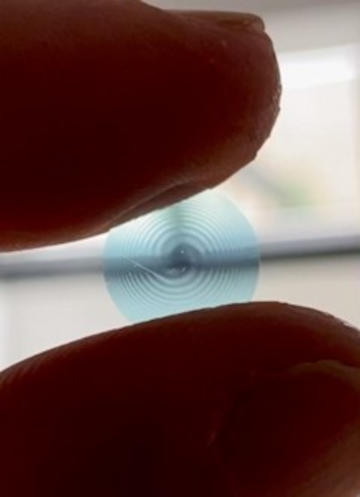
In Optica, Optica Publishing Group’s journal for high-impact research, the researchers describe the new lens, which they call the spiral diopter. Its spiraling features are arranged in a way that creates many separate points of focus — much like having multiple lenses in one. This makes it possible to see clearly at various distances.
“In addition to ophthalmology applications, the simple design of this lens could greatly benefit compact imaging systems,” said Simon. “It would streamline the design and function of these systems while also offering a way to accomplish imaging at various depths without additional optical elements. These capabilities, coupled with the lens’s multifocal properties, offer a powerful tool for depth perception in advanced imaging applications.”
Creating a vortex of light
The inspiration for the spiral lens design came when the paper’s first author, Laurent Galinier from SPIRAL SAS in France, was analyzing the optical properties of severe corneal deformations in patients. This led him to conceptualize a lens with a unique spiral design that causes light to spin, like water going down a drain. This phenomenon, known as an optical vortex, creates multiple clear focus points, which allow the lens to provide clear focus at different distances.
“Creating an optical vortex usually requires multiple optical components,” said Galinier. “Our lens, however, incorporates the elements necessary to make an optical vortex directly into its surface. Creating optical vortices is a thriving field of research, but our method simplifies the process, marking a significant advancement in the field of optics.”
The spiral lens (bottom) extends the of the sharpness zone beyond what is possible with a classic lens (top). Credit: Laurent Galinier
The researchers created the lens by using advanced digital machining to mold the unique spiral design with high precision. They then validated the lens by using it to image a digital ‘E,’ much like those used on an optometrist’s light-up board. The authors observed that the image quality remained satisfactory regardless of the aperture size used. They also discovered that the optical vortices could be modified by adjusting the topological charge, which is essentially the number of windings around the optical axis. Volunteers using the lenses also reported noticeable improvements in visual acuity at a variety of distances and lighting conditions.
Crossing disciplines
Bringing the new lens to fruition required combining the intuitively crafted design with advanced fabrication techniques through a cross-disciplinary collaboration. “The spiral diopter lens, first conceived by an intuitive inventor, was scientifically substantiated through an intensive research collaboration with optical scientists,” said Simon. “The result was an innovative approach to creating advanced lenses.”
The researchers are now working to better understand the unique optical vortices produced by their lens. They also plan to perform systematic trials of the lens’ ability to correct vision in people to comprehensively establish its performance and advantages in real-world conditions. In addition, they are exploring the possibility of applying the concept to prescription eyeglasses, which could potentially offer users clear vision across multiple distances.
“This new lens could significantly improve people’s depth of vision under changing lighting conditions,” said Simon. “Future developments with this technology might also lead to advancements in compact imaging technologies, wearable devices and remote sensing systems for drones or self-driving cars, which could make them more reliable and efficient.”
Reference: “Spiral diopter: freeform lenses with enhanced multifocal behavior” by Philippe Renaud-Goud, Bertrand Simon, Jean Augereau, Jean Brusau, Laurent Galinier and Lucien Kergadallan, 19 February 2024, Optica.
DOI: 10.1364/OPTICA.507066
Never miss a breakthrough: Join the SciTechDaily newsletter.
Follow us on Google and Google News.