
Close Menu
    Facebook X (Twitter) Instagram
    SciTechDaily
    • Biology
    • Chemistry
    • Earth
    • Health
    • Physics
    • Science
    • Space
    • Technology
    Facebook X (Twitter) Pinterest YouTube RSS
    SciTechDaily
    Home»Technology»Self-Powered X-Ray Detector to Revolutionize Medicine, Security and Research Imaging
    Technology

    Self-Powered X-Ray Detector to Revolutionize Medicine, Security and Research Imaging

    By Los Alamos National Laboratory,April 10, 20201 Comment3 Mins Read
    Facebook Twitter Pinterest Telegram LinkedIn WhatsApp Email Reddit
    Share
    Facebook Twitter LinkedIn Pinterest Telegram Email Reddit
    Self-Powered Perovskite X-ray Detector
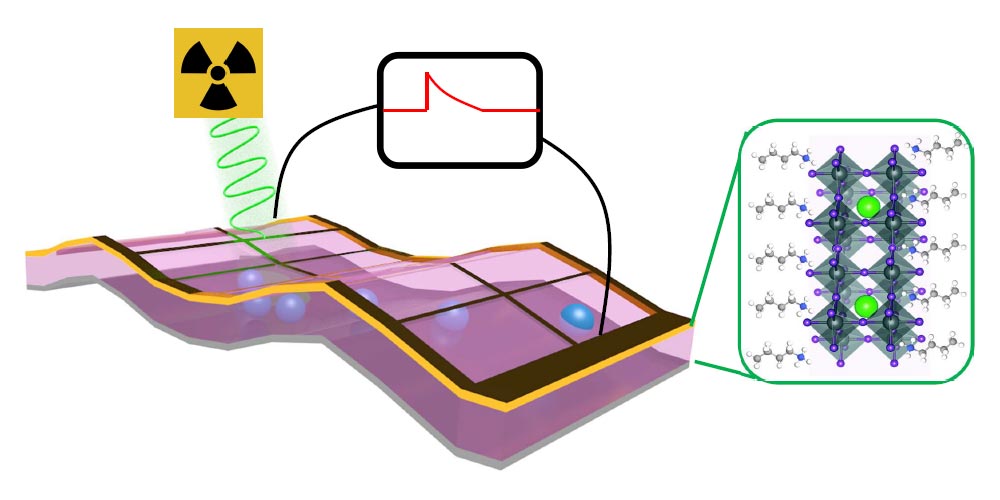
    X-ray detectors made with 2-dimensional perovskite thin films convert X-ray photons to electrical signals without requiring an outside power source, and are a hundred times more sensitive than conventional detectors. Credit: Los Alamos National Laboratory

    2D perovskite thin films boost sensitivity 100-fold compared to conventional detectors, require no outside power source, and enable low-dose dental and medical images.

    A new X-ray detector prototype is on the brink of revolutionizing medical imaging, with dramatic reduction in radiation exposure and the associated health risks, while also boosting resolution in security scanners and research applications, thanks to a collaboration between Los Alamos National Laboratory and Argonne National Laboratory researchers.

    “The perovskite material at the heart of our detector prototype can be produced with low-cost fabrication techniques,” said Hsinhan (Dave) Tsai, an Oppenheimer Postdoctoral fellow at Los Alamos National Laboratory. “The result is a cost-effective, highly sensitive, and self-powered detector that could radically improve existing X-ray detectors, and potentially lead to a host of unforeseen applications.”

    The detector replaces silicon-based technology with a structure built around a thin film of the mineral perovskite, resulting in a hundred times more sensitive than conventional silicon-based detectors. In addition, the new perovskite detector does not require an outside power source to produce electrical signals in response to X-rays.

    High-sensitivity perovskite detectors could enable dental and medical images that require a tiny fraction of the exposure that accompanies conventional X-ray imaging. Reduced exposure decreases risks for patients and medical staff alike. The fact that perovskite detectors can be made very thin allows them to offer increased resolution for highly detailed images, which will lead to improved medical evaluations and diagnoses. Lower-energy and increased-resolution detectors could also revolutionize security scanners and imaging in X-ray research applications.

    Because perovskite is rich in heavy elements, such as lead and iodine, X-rays that easily pass through silicon undetected are more readily absorbed, and detected, in perovskite. As a result, perovskite significantly outperforms silicon, particularly at detecting high-energy X-rays. This is a crucial advantage when it comes to monitoring X-rays at high-energy research facilities, such as synchrotron light sources.

    Perovskite films can be deposited on surfaces by spraying solutions that cure and leave thin layers of the material behind As a result, the thin-layer detectors will be much easier and cheaper to produce than silicon-based detectors, which require high-temperature metal deposition under vacuum conditions.

    “Potentially, we could use ink-jet types of systems to print large-scale detectors,” said Tsai. “This would allow us to replace half-million-dollar silicon detector arrays with inexpensive, higher-resolution perovskite alternatives.”

    In addition to the promise of thin-layer perovskites in X-ray detectors, thicker layers work well provided they include a small voltage source. This suggests that their useful energy range could be extended beyond X-rays to low-energy gamma-rays.

    The new prototype was fabricated and tested successfully thanks to a collaborative effort among Los Alamos National Laboratory material scientists led by Wanyi Nie and Hsinhan Tsai, and the Los Alamos Theory team led by Sergei Tretiak, in conjunction with Joseph Strzalka at Argonne National Laboratory’s X-ray Science Division.

    Never miss a breakthrough: Join the SciTechDaily newsletter.
    Follow us on Google and Google News.

    DOE Imaging Los Alamos National Laboratory
    Share. Facebook Twitter Pinterest LinkedIn Email Reddit

    Related Articles

    New Perovskite Fabrication Method for Solar Cells Paves Way to Low-Cost, Large-Scale Production

    New “Fast Forward” Algorithm Could Unleash the Power of Quantum Computers

    Lack of Sleep Could Be a Problem for Artificial Intelligence

    Groundbreaking Experiment Tracks the Real-Time Transport of Individual Molecules

    Breakthrough Quantum-Dot Transistors Open the Door to a Host of Innovative Electronics

    New Atomtronic Device to Probe Weird Boundary Between Quantum and Everyday Worlds

    Forging High-Tech Armor From Shock-Dissipating Fractal Cubes

    Artificial Brains Need Sleep Too – Desperate AI Researchers Discover Way to Stabilize Neuromorphic Processors

    Reinventing the Mirror to Transform Antennas, Wireless and Cell Phone Communications

    1 Comment

    1. Sven on April 10, 2020 1:24 pm

      Any estimates for time to clinical use?

      Reply
    Leave A Reply Cancel Reply

    • Facebook
    • Twitter
    • Pinterest
    • YouTube

    Don't Miss a Discovery

    Subscribe for the Latest in Science & Tech!

    Trending News

    Monster Storms on Jupiter Unleash Lightning Beyond Anything on Earth

    Scientists Create “Liquid Gears” That Spin Without Touching

    The Simple Habit That Could Help Prevent Cancer

    Millions Take These IBS Drugs, But a New Study Finds Serious Risks

    Scientists Unlock Hidden Secrets of 2,300-Year-Old Mummies Using Cutting-Edge CT Scanner

    Bread Might Be Making You Gain Weight Even Without Eating More Calories

    Scientists Discover Massive Magma Reservoir Beneath Tuscany

    Europe’s Most Active Volcano Just Got Stranger – Here’s Why Scientists Are Rethinking It

    Follow SciTechDaily
    • Facebook
    • Twitter
    • YouTube
    • Pinterest
    • Newsletter
    • RSS
    SciTech News
    • Biology News
    • Chemistry News
    • Earth News
    • Health News
    • Physics News
    • Science News
    • Space News
    • Technology News
    Recent Posts
    • Scientists Were Wrong About This Strange “Rule-Breaking” Particle
    • Webb Space Telescope Uncovers Unexpected Ice Clouds on a Jupiter-Like World
    • 289-Million-Year-Old Reptile Mummy Reveals Origin of Human Breathing System
    • New Brain Discovery Challenges Long-Held Theory of Teenage Brain Development
    • Sharks Are Overheating as Warming Oceans Push Them to the Edge
    Copyright © 1998 - 2026 SciTechDaily. All Rights Reserved.
    • Science News
    • About
    • Contact
    • Editorial Board
    • Privacy Policy
    • Terms of Use

    Type above and press Enter to search. Press Esc to cancel.