
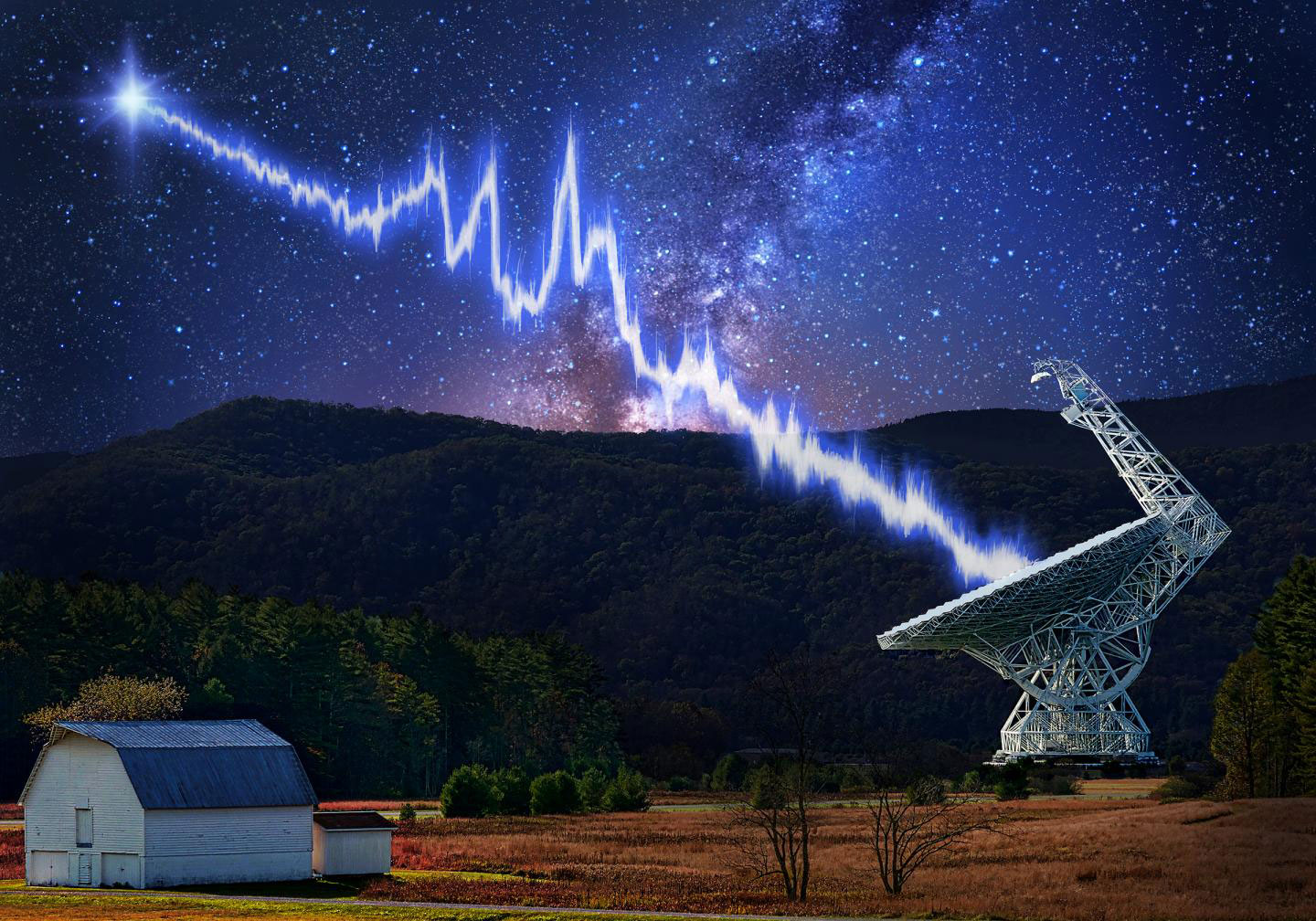
Recent observations of a mysterious and distant object that emits intermittent bursts of radio waves so bright that they’re visible across the universe provide new data about the source but fail to clear up the mystery of what causes them.
The observations by the Breakthrough Listen team at the University of California, Berkeley using the Robert C. Byrd Green Bank Telescope in West Virginia show that the fast radio bursts from this object, called FRB 121102, are nearly 100 percent linearly polarized, an indication that the source of the bursts is embedded in strong magnetic fields like those around a massive black hole.
The measurements confirm observations by another team of astronomers from the Netherlands, which detected the polarized bursts using the William E. Gordon Telescope at the Arecibo Observatory in Puerto Rico.
Both teams will report their findings during a media briefing on January 10th at a meeting of the American Astronomical Society in Washington, D.C. The results are detailed in a combined paper to be published online the same day by the journal Nature.
Fast radio bursts are brief, bright pulses of radio emission from distant but so far unknown sources, and FRB 121102 is the only one known to repeat: more than 200 high-energy bursts have been observed coming from this source, which is located in a dwarf galaxy about 3 billion light-years from Earth.

The nearly 100 percent polarization of the radio bursts is unusual, and has only been seen in radio emissions from the extreme magnetic environments around massive black holes, such as those at the centers of galaxies. The Dutch and Breakthrough Listen teams suggest that the fast radio bursts may come from a highly magnetized rotating neutron star — a magnetar — in the vicinity of a massive black hole that is still growing as gas and dust fall into it.
The short bursts, which range from 30 microseconds to 9 milliseconds in duration, indicate that the source could be as small as 10 kilometers across — the typical size of a neutron star.
Other possible sources are a magnetar interacting with the nebula of material shed when the original star exploded to produce the magnetar; or interactions with the highly magnetized wind from a rotating neutron star, or pulsar.
“At this point, we don’t really know the mechanism. There are many questions, such as, how can a rotating neutron star produce the high amount of energy typical of an FRB?” said UC Berkeley postdoctoral fellow Vishal Gajjar of Breakthrough Listen and the Berkeley SETI Research Center.
Gajjar will participate in the media briefing with three members of the Dutch ASTRON team: Daniele Michilli and Jason Hessels of the University of Amsterdam and Betsey Adams of the Kapteyn Astronomical Institute.
“This result is an excellent demonstration of the capabilities of the Breakthrough Listen instrumentation and the synergies between SETI and other types of astronomy,” said Andrew Siemion, director of the Berkeley SETI Research Center and of the Breakthrough Listen program. “We look forward to working with the international scientific community to learn more about these enigmatic and dynamic sources.”
Are FRBs signals from advanced civilizations?
Another possibility, though remote, is that the FRB is a high-powered signal from an advanced civilization. Hence the interest of Breakthrough Listen, which looks for signs of intelligent life in the universe, funded by $100 million over 10 years from internet investor Yuri Milner.
“We can not rule out completely the ET hypothesis for the FRBs in general,” Gajjar said.
Breakthrough Listen has to date recorded data from a dozen FRBs, including FRB 121102, and plans eventually to sample all 30-some known sources of fast radio bursts.
“We want a complete sample so that we can conduct our standard SETI analysis in search of modulation patterns or narrow-band signals — any kind of information-bearing signal emitted from their direction that we don’t expect from nature,” he said.
Breakthrough Listen allotted tens of hours of observational time on the Green Bank Telescope to record radio emissions from FRB 121102, and last August 26 detected 15 bursts over a relatively short period of five hours. They analyzed the two brightest of these and found that the radio waves were nearly 100 percent linearly polarized.
The team plans a few more observations of FRB 121102 before moving on to other FRB sources. Gajjar said that they want to observe at higher frequencies — up to 12 gigahertz, versus the present Green Bank observations in the 4-8 GHz range — to see if the energy drops off at higher frequencies. This could help narrow the range of possible sources, he said.
Reference: “An extreme magneto-ionic environment associated with the fast radio burst source FRB 121102” by D. Michilli, A. Seymour, J. W. T. Hessels, L. G. Spitler, V. Gajjar, A. M. Archibald, G. C. Bower, S. Chatterjee, J. M. Cordes, K. Gourdji, G. H. Heald, V. M. Kaspi, C. J. Law, C. Sobey, E. A. K. Adams, C. G. Bassa, S. Bogdanov, C. Brinkman, P. Demorest, F. Fernandez, G. Hellbourg, T. J. W. Lazio, R. S. Lynch, N. Maddox, B. Marcote, M. A. McLaughlin, Z. Paragi, S. M. Ransom, P. Scholz, A. P. V. Siemion, S. P. Tendulkar, P. Van Rooy, R. S. Wharton and D. Whitlow, 11 January 2018, Nature.
DOI: 10.1038/nature25149
Never miss a breakthrough: Join the SciTechDaily newsletter.
Follow us on Google and Google News.