

Close Menu
    Facebook X (Twitter) Instagram
    SciTechDaily
    • Biology
    • Chemistry
    • Earth
    • Health
    • Physics
    • Science
    • Space
    • Technology
    Facebook X (Twitter) Pinterest YouTube RSS
    SciTechDaily
    Home»Chemistry»Shape-Shifting Antibiotics – A New Weapon Against Drug-Resistant Superbugs
    Chemistry

    Shape-Shifting Antibiotics – A New Weapon Against Drug-Resistant Superbugs

    By Cold Spring Harbor LaboratoryApril 5, 2023No Comments4 Mins Read
    Facebook Twitter Pinterest Telegram LinkedIn WhatsApp Email Reddit
    Share
    Facebook Twitter LinkedIn Pinterest Telegram Email Reddit
    Bacterial Superbug Concept
    Professor John E. Moses has developed a shape-shifting antibiotic using click chemistry, combining vancomycin with bullvalene—a molecule with over a million configurations—to create a more effective drug that bacteria did not develop resistance to, potentially revolutionizing the fight against drug-resistant infections.

    A shape-shifting antibiotic, combining bullvalene and vancomycin via click chemistry, has shown superior efficacy against drug-resistant bacteria in tests.

    Antibiotic resistance is a major public health threat, ranked as one of the top 10 by the World Health Organization. Every year, in the United States alone, nearly 3 million people are infected by drug-resistant bacteria and fungi, resulting in the death of around 35,000. While antibiotics are crucial in treating infections, overuse has led to the development of antibiotic-resistant strains of bacteria. These infections pose a significant challenge to treatment.

    Now, Professor John E. Moses of Cold Spring Harbor Laboratory (CSHL) has developed a new weapon to combat drug-resistant superbugs – an innovative antibiotic that has the ability to shape-shift by rearranging its atoms.

    Moses came up with the idea of shape-shifting antibiotics while observing tanks in military training exercises. With rotating turrets and nimble movements, the tanks could respond quickly to possible threats.

    A few years later, Moses learned of a molecule called bullvalene. Bullvalene is a fluxional molecule, meaning its atoms can swap positions. This gives it a changing shape with over a million possible configurations—exactly the fluidity Moses was looking for.
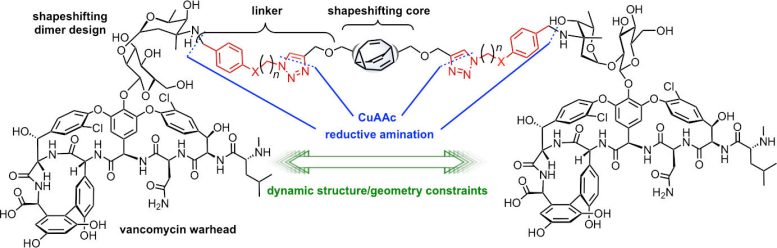
    Chemical Structure for Shape Shifting Antibiotic
    The chemical structure of the new antibiotic was designed by Moses and synthetically assembled by his lab. Dr. Thomas Fallon, Moses’ collaborator at the University of Newcastle, Australia, provided the shape-shifting bullvalene core. Moses says one commenter called the study “probably the ‘coolest’ and most complex natural product derivative paper I’ve come across.” Credit: Moses Lab/Cold Spring Harbor Laboratory

    Combining Vancomycin with Bullvalene

    Several bacteria, including MRSA, VRSA, and VRE, have developed resistance to a potent antibiotic called vancomycin, used to treat everything from skin infections to meningitis. Moses thought he could improve the drug’s bacteria-fighting performance by combining it with bullvalene.

    He turned to click chemistry, a Nobel Prize-winning class of fast, high-yielding chemical reactions that “click” molecules together reliably. This makes the reactions more efficient for wide-scale use.

    “Click chemistry is great,” says Moses, who studied this revolutionary development under two-time Nobel laureate K. Barry Sharpless. “It gives you certainty and the best chance you’ve got of making complex things.”

    Using this technique, Moses and his colleagues created a new antibiotic with two vancomycin “warheads” and a fluctuating bullvalene center.

    Moses tested the new drug in collaboration with Dr. Tatiana Soares da-Costa (University of Adelaide). The researchers gave the drug to VRE-infected wax moth larvae, which are commonly used to test antibiotics. They found the shape-shifting antibiotic significantly more effective than vancomycin at clearing the deadly infection. Additionally, the bacteria didn’t develop resistance to the new antibiotic.

    Researchers can use click chemistry with shape-shifting antibiotics to create a multitude of new drugs, Moses explains. Such weapons against infection may even be key to our species’ survival and evolution.

    “If we can invent molecules that mean the difference between life and death,” he says, “that’d be the greatest achievement ever.”

    Reference: “Shapeshifting bullvalene-linked vancomycin dimers as effective antibiotics against multidrug-resistant gram-positive bacteria” by Alessandra Ottonello, Jessica A. Wyllie, Oussama Yahiaoui, Shoujun Sun, Rebecca A. Koelln, Joshua A. Homer, Robert M. Johnson, Ewan Murray, Paul Williams, Jani R. Bolla, Carol V. Robinson, Thomas Fallon, Tatiana P. Soares da Costa and John E. Moses, 3 April 2023, Proceedings of the National Academy of Sciences.
    DOI: 10.1073/pnas.2208737120

    The study was funded by the National Cancer Institute, the Australian Research Council, the National Health and Medical Research Council, the Marsden Fund, the Royal Society University Research Fellowship, Wolfson College, and the Medical Research Council.

    Never miss a breakthrough: Join the SciTechDaily newsletter.
    Follow us on Google and Google News.

    Antibiotics Bacteria Cold Spring Harbor Laboratory Drugs Infection Popular Superbug
    Share. Facebook Twitter Pinterest LinkedIn Email Reddit

    Related Articles

    Warning: New Research Indicates That Your Pet Dog or Cat Could Be Spreading Deadly Superbugs

    Microbial “Dark Matter” Yields Gold – New Antibiotic Could Be a Powerful Weapon Against Superbugs

    CDC Warning: The Eye Drop Danger Lurking in Your Medicine Cabinet

    “Opportunistic Pathogens” – Potentially Deadly Infection Has Dangerous Ally Lurking in Our Guts

    New Compound Fights Off Over 300 Drug-Resistant Bacteria

    Highly Antibiotic-Resistant Superbug Strain Discovered To Be Able To Infect Humans

    Infectious Diseases Experts: Superbugs on Track to Kill More People Than COVID-19

    Failure Against “Nightmare Bacteria” a Chilling Commentary on Future of Antibiotics – “Much of Modern Medicine May Become Infeasible”

    Unlocking Chemical Pathways to Synthesize Chemicals Found in Nature

    Leave A Reply Cancel Reply

    • Facebook
    • Twitter
    • Pinterest
    • YouTube

    Don't Miss a Discovery

    Subscribe for the Latest in Science & Tech!

    Trending News

    Scientists Discover How Coffee Impacts Memory, Mood, and Gut Health

    Why Did the Neanderthals Disappear? Scientists Reveal Humans Had a Hidden Advantage

    Physicists Propose Strange Experiment Where Time Goes Quantum

    Magnesium Magic: New Drug Melts Fat Even on a High-Fat, High-Sugar Diet

    Weight-Loss Drugs Like Ozempic May Come With an Unexpected Cost

    Mezcal “Worm” in a Bottle Mystery: DNA Testing Reveals a Surprise

    New Research Reveals That Your Morning Coffee Activates an Ancient Longevity Switch

    This Is What Makes You Irresistible to Mosquitoes

    Follow SciTechDaily
    • Facebook
    • Twitter
    • YouTube
    • Pinterest
    • Newsletter
    • RSS
    SciTech News
    • Biology News
    • Chemistry News
    • Earth News
    • Health News
    • Physics News
    • Science News
    • Space News
    • Technology News
    Recent Posts
    • Harvard Scientists Reveal Secret Structure Behind How You Smell
    • Scientists Just Discovered the Hidden Trick That Keeps Your Cells Alive
    • This Simple Movement Could Be Secretly Cleaning Your Brain
    • Male Birth Control Breakthrough: Scientists Find Way To Turn Sperm Production Off and Back On
    • A Common Vitamin Could Hold the Key to Treating Fatty Liver Disease
    Copyright © 1998 - 2026 SciTechDaily. All Rights Reserved.
    • Science News
    • About
    • Contact
    • Editorial Board
    • Privacy Policy
    • Terms of Use

    Type above and press Enter to search. Press Esc to cancel.