
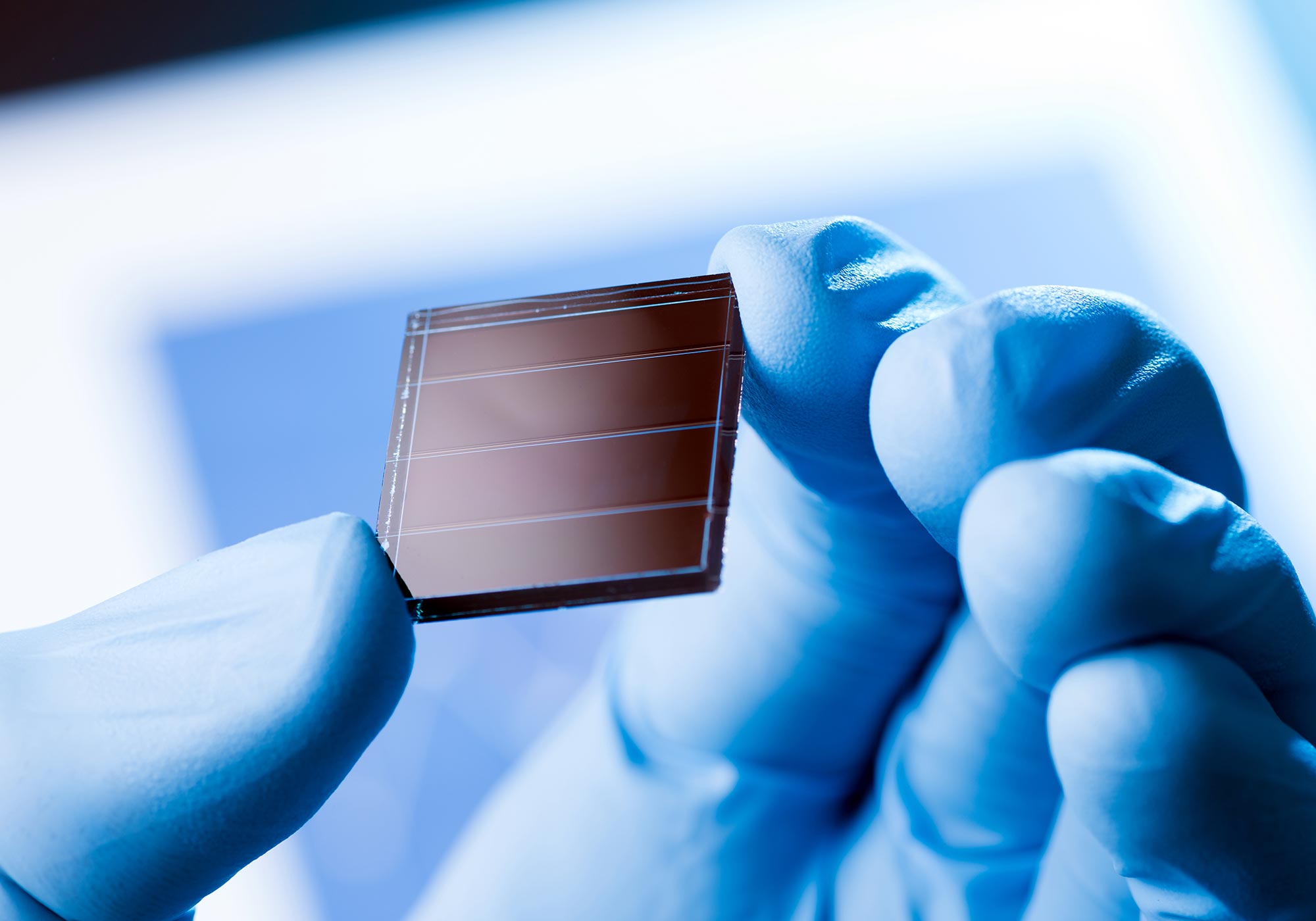
Researchers investigate the bulk photovoltaic effect in a promising material for future solar energy harvesting technologies.
The bulk photovoltaic (BPV) effect is a rare phenomenon that could allow certain materials to surpass the performance of traditional p–n junctions in solar cells. In a recent breakthrough, researchers in Japan have experimentally confirmed the BPV effect in alpha-phase indium selenide (α-In2Se3) along the out-of-plane direction for the first time, aligning with prior theoretical predictions. The impressive conversion efficiency achieved in their α-In2Se3 device represents a significant step forward for next-generation solar cell technologies and photosensors.
A firm understanding of the photovoltaic effect, by which light can be converted into useful electrical energy, lies at the core of solar cell design and development. Today, most solar cells employ p–n junctions, leveraging the photovoltaic effect that occurs at the interface of different materials. However, such designs are constrained by the Shockley–Queisser limit, which puts a hard cap on their theoretical maximum solar conversion efficiency and imposes a tradeoff between the voltage and current that can be produced via the photovoltaic effect.
Exploring the BPV Effect in Crystalline Materials
However, certain crystalline materials exhibit an intriguing phenomenon known as the bulk photovoltaic (BPV) effect. In materials lacking internal symmetry, electrons excited by light can move coherently in a specific direction instead of returning to their original positions. This results in what is known as “shift currents,” leading to the generation of the BPV effect. Although experts have predicted alpha-phase indium selenide (α-In2Se3) to be a possible candidate to demonstrate this phenomenon, it hasn’t yet been experimentally investigated.
To fill this knowledge gap, a research team from Japan led by Associate Professor Noriyuki Urakami from Shinshu University set out to explore the BPV effect in α-In2Se3. Their findings were recently published in the journal Applied Physics Letters.
“This material has recently become a hot topic in the field of condensed matter physics, as it might be able to generate a shift current. Our study is the first to experimentally demonstrate this prediction,” shares Prof. Urakami.
The α-In2Se3 Layered Device
First, the researchers produced a layered device composed of a thin α-In2Se3 layer sandwiched between two transparent graphite layers. These graphite layers served as electrodes and were connected to a voltage source and an ammeter to measure any generated currents upon light irradiation. Notably, the team employed this specific arrangement of layers because they focused on the shift currents occurring in the out-of-plane direction in the α-In2Se3 layer.
After testing with different external voltages and incident light of various frequencies, the researchers verified the existence of shift currents in the out-of-plane direction, confirming the abovementioned predictions. The BPV effect occurred throughout a wide range of light frequencies.
Most importantly, the researchers gauged the potential of the BPV effect in α-In2Se3 and compared it to that in other materials. “Our α-In2Se3 device demonstrated a quantum efficiency several orders of magnitude higher than other ferroelectric materials, and a comparable one to that of low-dimensional materials with enhanced electric polarization,” remarks Prof. Urakami. He further adds, “This discovery will guide material selection for the development of functional photovoltaic devices in the near future.”
The research team is hopeful that their efforts will eventually have a positive environmental impact by contributing to the field of renewable energy generation. “Our findings have the potential to further accelerate the spread of solar cells, one of the key technologies for environmental energy harvesting and a promising avenue towards a carbon neutral society,” concludes a hopeful Prof. Urakami.
We hope that this study paves the way for further studies to harness the BVP effect and vastly improve the performance of solar cells, as well as enhance the design of sensitive photodetectors.
Reference: “Bulk photovoltaic effect of an alpha-phase indium selenide (α-In2Se3) crystal along the out-of-plane direction” by Noriyuki Urakami, Sho Ozaki and Yoshio Hashimoto, 14 August 2024, Applied Physics Letters.
DOI: 10.1063/5.0222926
Never miss a breakthrough: Join the SciTechDaily newsletter.
Follow us on Google and Google News.
4 Comments
24:10:24. Good job and good day for Energy Efficiencies. Thanks to those Scientists and researchers that trying to make this Planet / World a better places to Stay and enjoying. Am not saying that you don’t have energy efficiency but you don’t know how to maximizes to Energise. All the Energy you are using every day were good. Only you just have to know how to maximizes those energy. Including the Nuclear power plants or power Station. They’re all good for your energy efficiency. Thanks. To be continued. M. Luke.
What’s the theoretical maximum performance?
As a journalist, you need to bring the story home. Assuming this goes into production, what efficiency can we expect. Currently solar panels capture about 25% of incoming light.
What percentage will this new tech help capture? 40%? 50%?
Give me a number, or don’t publish such generic stuff.
I completely agree. An estimate should be given